Publications

- Category: Real estate
National Monetary Council (CMN) Resolution No. 4,661/2018 established new rules and restrictions on investment in real estate by pension funds. Published on May 29, the regulation revoked Resolution No. 3.972/2009, prohibited the direct acquisition of real estate by closed-end private pension entities (EFPC), and forced them to sell properties owned directly by them within a period of up to 12 years (or May 28, 2030).
According to Resolution No. 4,661, the new limit for the participation of EFPCs in the real estate segment is 20%, and this participation may only be done through: (i) units of real estate investment funds (FII), (ii) units of investment funds in units of FIIs (FICFII), (iii) real estate receivables certificates (CRIs), or (iv) real estate credit certificates (CCIs). In addition to increasing the percentage limit from 8% to 20%, this new resolution changed the assets of the real estate segment in which EFPCs may invest. Previously, the real estate segment encompassed investments in (i) real estate projects, (ii) rental and income properties, and (iii) other real estate. Although permitted, investment in units of FIIs was classified in the segment of structured investments and analyzed in a segregated manner, in order to comply with the percentage limits.
In addition to prohibiting direct investment in real estate in order to make pension funds more liquid so that they can pay the pensions of their pensioners, the new resolution authorized investment in FICFIIs, CRIs, and CCIs issued by publicly traded companies or CCIs issued by limited companies or privately held corporations, provided that there is co-obligation of a financial institution authorized to operate by the Central Bank (Bacen). All of these changes have been in effect since May 29.
Some issues deserve attention in relation to pension fund investments in the real estate segment. First of all, they were expressly authorized to use assets to pay in units of investment funds. Therefore, an alternative to accommodate the current restriction on direct ownership of real estate and real estate projects is to pay them in via FIIs to be created by EFPCs. A limit of 25% of shareholders' equity on concentration in FIIs and FICFIIs per issuer was set, but this limit does not need to be observed for FIIs that include in their investment portfolio real estate that was originally part of the direct equity of the EFPC. There is also no restriction on whether these FIIs, formed by real estate that previously comprised the investment portfolio of pension funds, act as real estate developers, directly or indirectly, or acquire other real estate, subject to the applicable regulations of the Brazilian Securities and Exchange Commission (CVM) and subject to the review of real estate registration.
Second, as long as EFPCs are not in conformity with the restriction on direct ownership of real estate, the inventory of real estate currently in their portfolios will be taken into account for the purposes of calculating the limit on investments in the real estate segment. In order to adjust to these new limits, pension funds should assess the need to sell these properties or to pay them in via FIIs. It is worth remembering that, although the investment limit in this segment increased from 8% to 20%, the FIIs that were previously accounted for as structured investments are now included in the real estate segment.
Finally, it should be considered that, despite the rather elastic period (12 years) for the sale of properties owned by the EFPCs, it is prudent for these entities to already begin to organize and look into the existence of pending issues that may affect the ownership of these properties via-à-vis third parties or their payment in FIIs. Encumbrances, liens, or other types of restrictions or irregularities, for example, may require prior regularization with the real estate registration offices, municipalities, or the Federal Government Property Board. In addition, it is important to conduct tax planning regarding the legal structure to be adopted in the transfer of the ownership of these properties in order to evaluate the possible incidence of capital gain tax, Tax on Transfer of Real Estate (ITBI), and laudemium.

- Category: Intellectual property
Law 13,709 / 18, named Personal Data Protection Law (PDP) establishes strict rules for the protection of personal data. The PDP will enter into force 18 months after its official publication, occurred on August 15.
Below we highlight its main aspects:
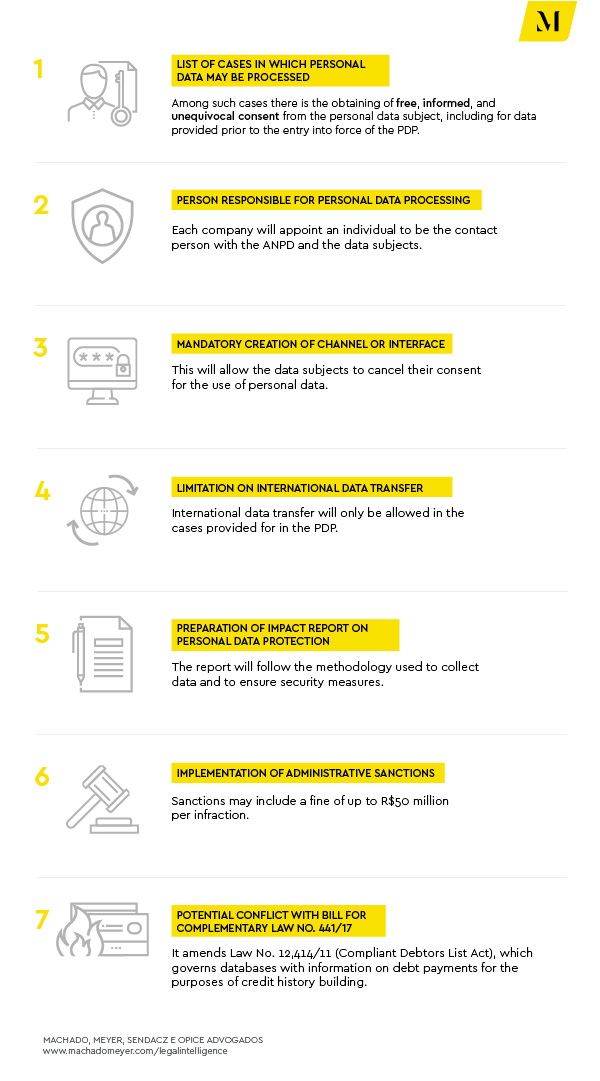
CLICK HERE TO DOWNLOAD THE E-BOOK WITH MORE DETAILS AND IMPORTANT CONCEPTS ABOUT THE LAW

- Category: Litigation
Among the significant changes in the framework of registered warrants (precatórios) promoted by Constitutional Amendment No. 99, of December 14, 2017, the fourth paragraph of article 101 of the Transitory Constitutional Provisions Act (ADCT) stands out, which gives the Federal Government the duty to make available to the states, the Federal District, and municipalities, as well as to their instrumentalities, foundations, and state-owned companies a special credit line for payment of registered warrants submitted to the new special payment system, that is, registered warrants due on March 25, 2015, and those that expire by December 31, 2024, the deadline to settle all these registered warrants.
According to the provision, the Federal Government should have the credit line available within six months of the entry into force of the new special payment system, that is, by June of 2018. However, the Minister of Planning, Development, and Management, Esteves Colnago, has already said that the Federal Government has no budgetary forecast to provide credit lines to the states, Federal District, and municipalities in order to subsidize the payment of registered warrants of these states and that it is not yet possible to know whether it will be able to meet the standard and if so, how.
The National Treasury Secretary, Mansueto Almeida, announced that, in the opinion of the Federal Government, the regulations implementing Constitutional Amendment No. 99/17 could be provided, but not the actual availability of the credit line to other federal entities within the period originally provided. This is because, according to the National Treasury, the possibility of granting a subsidy from the federal public coffers for this purpose before the 2020 fiscal year is not envisaged. Therefore, the other federal entities should seek their own funds to pay registered warrants.
The Federal Government had announced that it would conclude the preparation of the draft regulations of Constitutional Amendment No. 99/17 in order to submit it to the National Congress by June 30, 2018. However, so far, there is no news that this has happened.
Faced with the Federal Government's failure to comply with the constitutional norm, the state government of Minas Gerais submitted Bill No. 5,011/18 to the Legislative Assembly. The text proposes that the Executive Power be authorized to obtain credit from a federal official financial institution in the amount of up to R$ 2 billion for the state of Minas Gerais to apply such funds to the payment of registered warrants submitted to the new special framework.
Bill No. 5,011/18 was received by the plenary session of the Legislative Assembly of Minas Gerais on May 13, 2018. After receiving a favorable opinion from the rapporteur of the Commission on Constitution and Justice, Congressman Leonídio Bouças, on July 11, 2018, the bill is awaiting a vote in the first round in the plenary session.
In turn, the state government of São Paulo submitted Bill No. 801/17 to the Legislative Assembly, requesting an urgent procedure, proposing terms and conditions for offsetting registered warrants with state tax debts.
To that end, Bill No. 801/17 proposes that the offset should occur between (i) a debt claim that is for a certain, liquid, and enforceable amount against the state of São Paulo, its instrumentalities and foundations, provided that there is no challenge, appeal, or defense in relation to the amount of the debt claim; and (ii) debit of a tax nature or of any nature in which the state of São Paulo, its instrumentalities or foundations appear as creditor, registered as overdue debt by March 25, 2015, and that has not been subject to an agreement to installments that is in force.
Bill No. 801/17 was assigned to Congressman Marcos Zerbini, of the Commission of Constitution and Justice, as rapporteur, and has been on the agenda of the Legislative Assembly of São Paulo since October 10, 2017.
The state of Bahia also enacted State Law No. 13,930/18, authorizing the Executive Branch to contract for financing in the amount of up to R$ 1 billion for the payment of registered warrants subject to the new special framework with the financial institution that presents the best proposal to the Treasury of the State of Bahia.
In addition, Proposed Constitutional Amendment No. 100/11 (PEC No. 100/11), which allows the use of registered warrants in the payment of housing financing, regulates the assignment, in whole or in part, of payment of debt claims in registered warrants to third parties, including for the payment of housing financing to official financial institutions, provided that the holder of the registered warrant debt claim is not the owner of another residential property.
If approved, these bills and laws may serve as an incentive for other federal entities to adopt similar initiatives aimed at raising funds for the payment of registered warrants or reducing the volume of existing registered warrants and debt claims that will potentially be converted into registered warrants in the future. These initiatives are important, especially considering that all registered warrants submitted to the new special framework should be discharged by 2024 and that the Federal Government has no budgetary forecast to release the credit line provided for the payment of registered warrants to other federal entities in 2018 and 2019.
It is worth noting that under the terms of Constitutional Amendment No. 99/17, there is an express provision that, in relation to the contracting of loans to obtain funds to be used for the payment of registered warrants, "the indebtedness limits dealt with in items VI and VII of the head paragraph of article 52 of the Federal Constitution and any other limits of indebtedness provided for by law,” that is, such financing is not subject to the limits set forth in the Fiscal Responsibility Law and any other limits, in addition to being able to rely on real guarantees from public revenues.

- Category: Labor and employment
Among the changes introduced by Law No. 13,467/2017 (the Labor Reform), the introduction of fees for loss of suit (article 791-A of the Consolidated Labor Laws) has raised controversies not only regarding the timing of its application, but also its parameters for setting such fees.
As provided for in articles 22 and 23 of Law No. 8,906/94 (the Statute of Brazilian Lawyers and the Brazilian Bar Association), despite being paid by the parties (claimant and defendant), fees for loss of suit belong to the attorneys and aim to remunerate the provision of services in the course of each case.
To define the amount to be paid, article 791-A of the Consolidated Labor Laws establishes that fees for loss of suit shall be set between a minimum of 5% and a maximum of 15%: (i) over the amount resulting from the liquidation of the judgment; (ii) over the value of the economic advantage obtained; or (iii) over the updated value of the cause if it is not possible to measure the economic benefit.
The legal provision also established guidelines to be observed in setting these fees, such as the degree of care by the professional, the place of provision of services, the nature and importance of the case, the work performed by the attorney, and the time required for his service.
All this shows that the law has no criterion that justifies the adoption of different methods to determine fees for loss of suit owed by the parties.
It so happens that the large majority of decisions after the Labor Reform with an order to pay reciprocal fees for loss of suit has set different criteria for calculating them for the parties, without there being a justified reason in that regard:
- Case No. 1002224-91.2017.5.02.0073: 5% fees for loss of suit calculated over the value of the liquidation of the judgment, 70% of this amount in favor of the claimant's attorney and 30% in favor of the defendant's attorney.
- Case No. 1002429-79.2017.5.02.0604: 10% fees for loss of suit, calculated over the value of the liquidation of the judgment in favor of the claimant’s attorney and over the estimated value of the claims rejected in favor of the attorney of the respondent.
- Case No. 1000485-90.2017.5.02.0491: 5% fees for loss of suit, calculated on the value of the liquidation of the judgment limited to the amount of R$ 5,000 in favor of the claimant's attorney and on the value of the matter limited to the amount of R$2,000 in favor of the defendant's attorney.
- Case No. 1000247-46.2018.5.02.0391: 5% fees for loss of suit, calculated over the value of the liquidation of the judgment in favor of the attorney of the claimant and over the value attributed to the prayer for relief dismissed per an estimate in favor of the defendant's attorney.
From the examples above, cited as examples, one notes that, in favor of the claimant party's attorneys, the fees for loss of suit are set at higher percentages and based on the value of the liquidation, whereas those established in favor of the attorneys of the respondent party tend to to be set per an estimation or based on the value attributed to the cause (which, for suits filed prior to the Labor Reform, usually do not represent the totality of the prayers for relief submitted in the matter).
The practice shows that the labor courts have set fees for loss of suit according to protective principles of labor, such as weaker position of one of the parties, while ignoring that the setting of the amount is not linked to the socioeconomic condition of the worker, but only to the services provided by the parties’ attorneys in the course of the proceedings.
There is in article 791-A of the Consolidated Labor Laws no criterion that differentiates the payment of fees for loss of suit according to the condition of the worker, but only according to the form of service performance of the attorneys.
In fact, the application of different criteria is tantamount to recognition by the judge that the work of one attorney is more valuable than that of the other party, which is not supported by the law and is not consistent with the common reality of the proceedings.
The establishment of different criteria for assessing the attorneys' work without any express and grounded justification is a clear violation of constitutional rights, such as equality (article 5 of the Federal Constitution), the prohibition on discrimination between professionals (article 7, XXXII, of the Federal Constitution), and access to work (article 6 of the Federal Constitution).
On the other hand, in matters relating to procedural law, the use of a different basis for calculation runs counter to the principle of parity in the treatment of the parties in the course of proceedings (articles 7 and 139 of the Code of Civil Procedure), which enshrines the need to ensure to the parties equality of treatment between procedural rights and duties, which includes the payment of fees arising from loss of suit.
Therefore, especially in cases of reciprocal loss of suit, the fees for the parties should be estimated according to identical criteria, preferentially taking into account the economic benefit, since it represents the actual gains and losses: the amount to be paid by the claimant must be set based on the liquidation of the prayers for relief dismissed, while the amount to be paid by the respondent must be set on the basis of the prayers for relief granted.
If different parameters are set, it is legitimate to bring an appeal questioning the differentiation.

- Category: Labor and employment
On June 7, the Individual Disputes Section (SDI) of the Superior Labor Court (TST) decided to apply the three-year statute of limitations for civil suits in a suit filed by a deceased employee's family seeking damages caused by the death of the family member due to a workplace accident or occupational disease.[1]
The decision came to resolve the divergence of understandings among the circuit courts regarding the statute of limitations applicable in such cases: whether the one provided for in labor law or whether that of civil law.
According to the Justices of the SDI, in suits in which the successors seek, in their own name, moral or material damages resulting from the death of a family member due to an accident at work or an alleged occupational disease, labor rights of the former employee are not at issue, but rather the civil rights of the family members, whose injury originates in alleged wrongful acts committed by the employer of the deceased, albeit in a reflexive or indirect manner. For this reason, the statute of limitations applicable is three years, provided for in article 206, paragraph 3, item V, of the Civil Code.
On the other hand, the TST defined that, in suits in which the successors plead payment of compensation for damages caused to the deceased in the course of the employment relationship, because it is an action seeking compensation for damages suffered by the deceased, the debate is labor in nature, for which reason the position to be take is that the labor statute of limitations applies, which is two years as of the termination of the employment contract, per the terms of item XXIX, article 7, of the Federal Constitution.
With this understanding, the TST affirms that, although the jurisdiction for trying and adjudicating such suits is that of the labor courts by virtue of Constitutional Amendment No. 45/2004 and the final part of Precedent No. 392 of the Superior Labor Court, the substantive right in dispute is of a civil nature and, therefore, the statute of limitations is that provided for in civil law.
The recent decision handed down by the SDI of the Superior Labor Court points to a consolidation of the position of the highest labor court and certainly constitutes a precedent for decisions in cases similar to the one decided.
Considering that the understanding of some circuit labor courts is still that, for all matters within the jurisdiction of the labor courts, the limitations period for filing suit is the labor limitations period (two years), the recent decision by the SDI may generate impacts for the business community in similar situations that have not yet been reviewed by the Superior Labor Court.
Since this is a constitutional matter (whether or not the labor statute of limitations provided for in the Federal Constitution applies), the matter may still be discussed before the Federal Supreme Court.
1. Case No. 10248-50.2016.5.03.0165, published on June 15, 2018.

- Category: Tax
- Concept of logistics operator
According to article 1 of the ordinance, a logistic operator is considered to be a company whose economic activity is the provision of logistics services and that, predominantly, carries out the storage of goods from third-party ICMS taxpayers, with responsibility for the custody, conservation, and movement of such goods in the name and on behalf of third parties; - ICMS in the shipment of products to logistics operators
In accordance with article 5 of the ordinance, when the goods are shipped internally to a logistics operator, the depositor establishment must issue a tax invoice, which must contain, in addition to the other requirements set forth in the legislation: (a) the state registration of the logistics operator; (b) the nature of the operation: "Other Shipments - Remittance to Temporary Deposit"; (c) CFOP 5,949; (d) in the Supplementary Information field, the expression: "Shipment to Temporary Deposit - CAT Ordinance 59/2018"; and (e) highlighting of the ICMS, if the depositor establishment falls within the periodic calculation regime - RPA. - ICMS in the logistics operator's return operations
Pursuant to the terms of article 6 of the ordinance, on the occasion of the return of the goods to the depositor establishment, the latter shall issue the invoice related to the entry of the merchandise in its establishment, which shall contain, in addition to the other requirements set forth in the legislation: (a) the state registration of the logistics operator; (b) the nature of the operation: "Other Entries - Return from Temporary Deposit"; (c) CFOP 1,949; (d) in the Supplementary Information field, the expression: "Return from Temporary Deposit - CAT Ordinance XX/2018 (indicate the number of this ordinance)"; (e) highlighting of the ICMS, if the depositor establishment is included in the periodic calculation regime - RPA; and (f) an indication, in the group "Referenced Tax Document Information", of the access keys for the invoices related to the shipments for temporary storage that contain the items of the Return from Temporary Deposit. - Triangular operation (direct exit of the merchandise from the logistics operator)
Pursuant to the terms of article 7 of the ordinance, in the case of goods leaving directly from the facilities of the logistics operator to a person other than the depositor, the latter must:- issue an invoice containing, in addition to the other requirements set forth in the legislation: a) the value of the transaction; b) the nature of the operation; c) highlighting of the taxable amount, if due, if the depositor is included in the periodic calculation regime - RPA; d) indication that the merchandise will leave temporary storage - logistics operator, the address and the numbers of the state registration and CNPJ of the latter; e) indication of the number, series, and date of issue of the invoice referred to in item II;
- issue an invoice for the purposes of symbolic return from the temporary storage, observing the provisions of article 6, and explaining, in relation to the expressions contained in items II and IV of the article, that it is a "symbolic return";
- send to the logistics operator the data from the invoices referred to in items I and II, to be kept at the disposal of the Tax Authorities.
The Coordinator of the Tax Administration, in view of the provisions of article 489 of the ICMS Regulation, approved by Decree 45,490, of November 30, 2000, issues the following ordinance:
Article 1. Logistics Operators who do not carry out operations subject to ICMS, who receive goods belonging to taxpayers of said tax established in the São Paulo territory must observe, in addition to the other provisions set forth in the legislation, the provisions of this ordinance.
Sole paragraph. For the purposes of this ordinance, a Logistics Operator is considered to be a company whose economic activity is the provision of logistics services, primarily by storing goods from third-party ICMS taxpayers, with responsibility for the custody, preservation, and shipment of these goods, in the name and on behalf of third parties.
Article 2. Logistics Operators established in this State must register in the register of taxpayers of the ICMS with code 5211-7/1999 of the National Classification of Economic Activities - CNAE, through the use of the Online Collection - PGD Program of the CNPJ (CNPJ Web version) available on the website of the Brazilian Federal Revenue Service, however, in relation to the activity covered by this ordinance, the issuance and bookkeeping of tax documents and books is exempted, without prejudice to the joint and several liability provided for by law, especially in items XI and XII of article 9 of Law No. 6,374, of March 1st, 1989.
Article 3. The provision of the logistics services provided for in article 1 shall be documented by a private agreement between the depositor and depositary parties.
Paragraph 1. The depositor establishment shall prepare a monthly statement under the heading "Physical Control of Goods Stored with a Logistics Operator", which shall present at least the following information:
1 - access key, number, series, and date of the Invoices relating to the entry and exit of goods during the month; and
2 - amounts shipped for deposit, returns, and balance of stock held at the depositary establishment at the end of each month.
Paragraph 2. Logistics Operators shall maintain at the disposal of the Tax Authorities a computerized accounting and stock control system, which shall enable the monitoring of operations carried out in the manner governed in this ordinance, and shall demonstrate, in an individualized manner for each depositor, at least the following information:
1 - access key, number, series, and date of the Invoices relating to the entry and exit of goods during each month;
2 - date of actual receipt of the goods for deposit and, if applicable, the respective date of exit from the depository establishment; and
3 - amounts received for deposit, returns, and remaining balance of inventory at the end of each month.
Paragraph 3. The documents and information referred to in this article shall remain at the disposal of the Tax Authorities for the period provided for in article 202 of the ICMS Regulation, approved by Decree No. 45,490, of November 30th, 2000.
Article 4. The ICMS taxpayer that sends goods for deposit at the Logistics Operator's premises must indicate at least the following data from the contract referred to in article 3 in the book Registration of Use of Tax Documents and Model Terms:
I - the name of the company hired and the respective state registration;
II - the dates of commencement and termination of the contract.
Article 5. On the occasion of the internal shipment of merchandise destined to the Logistics Operator, the depository establishment shall issue an Invoice, which shall contain, in addition to the other requirements set forth in the legislation:
I - the state registration of the Logistics Operator;
II - the nature of the operation: "Other Exits - Shipment for Temporary Deposit";
III - CFOP 5,949;
IV - in the field Supplementary Information, the expression: "Shipment for Temporary Deposit - CAT Ordinance XX/2018 (indicate the number of this ordinance)";
V - highlighting of the ICMS, if the depositor establishment falls within the periodic calculation regime - RPA.
Sole paragraph. In the event that a depository establishment that collects ICMS under the simplified tax regime, taxation shall occur only on the exit referred to in article 7, in accordance with what is set forth in paragraph 1 of article 3 of Complementary Law No. 123, of December 14th, 2006.
Article 6. Upon the return of the goods to the depositor establishment, the latter shall issue an invoice relating to the entry of the merchandise in its facilities, which shall contain, in addition to the other requirements set forth in the legislation:
I - the state registration of the Logistics Operator;
II - the nature of the operation: "Other Entries - Return from Temporary Deposit";
III - CFOP 1,949;
IV - in the field Supplementary Information, the expression: "Return from Temporary Deposit - CAT Ordinance XX/2018 (indicate the number of this ordinance)";
V - highlighting of the ICMS, if the depositor establishment falls within the periodic calculation regime - RPA.
VI - indication, in the “Referenced Tax Documents Information" group, of the access keys of the Invoices related to the shipments for temporary deposit that contain the items of the Return from Temporary Deposit.
Paragraph 1. In the case of a depository establishment within the periodic calculation regime - RPA, it may be credited with the amount of the tax levied in the operations referred to in article 5, in the same period of calculation in which the return of the merchandise occurs.
Paragraph 2. In the event of a depository establishment that collects ICMS under the simplified tax regime, taxation shall occur only on the exit referred to in article 7, in accordance with what is set forth in paragraph 1 of article 3 of Complementary Law No. 123, of December 14th, 2006.
Article 7. In the event of exit of goods directly from the Logistics Operator's facilities to a person other than the depositor, the latter must:
I - issue an Invoice containing, in addition to the other requirements set forth in the legislation:
a) the value of the operation;
b) the nature of the operation;
c) highlighting of the amount of the tax, if due, if the depositor is included in the periodic taxation regime - RPA;
d) indication that the merchandise shall leave temporary deposit - Logistics Operator, the address and the state registration and CNPJ numbers of the latter;
e) indication of the number, series, and date of issue of the Invoice referred to in item II;
II - issue an Invoice for the purposes of symbolic return from temporary deposit, observing the provisions of article 6, and explaining, in relation to the expressions contained in items II and IV of said article, that it is a "Symbolic Return";
III - to send to the Logistics Operator the data from the Invoices referred to in items I and II, to be kept at the disposal of the Tax Authorities.
Paragraph 1. The merchandise shall be accompanied in its transportation by the Invoice provided for in item I of the head paragraph.
Paragraph 2. In the event that a depository that collects ICMS under the national simplified tax regime, the operation referred to in item I shall be included in the calculation basis for purposes of taxation under said regime.
Article 8. The Invoice referred to in article 6 or item II of article 7, as the case may be, shall be registered by the depository in the book Registration of Entries, according to the terms established in the legislation.
Article 9. In the internal exit of merchandise for delivery to the Logistics Operator, in the name of and to the account and order of the acquiring establishment, both located in this State, the acquiring establishment shall be considered the depositor, and the sender must issue an Invoice, which shall contain, in addition to the other requirements set forth in the legislation, the following information:
I - as addressee: the acquiring establishment;
II - as place of delivery: the establishment of the Logistics Operator, therein stating the company name, address, and state of registration and CNPJ;
III - highlighting of the ICMS.
Paragraph 1. The acquiring institution (depositor) shall:
1 - register the Invoice referred to in the head paragraph in the book Registration of Entries;
2 - issue an Invoice regarding the symbolic exit to the Logistics Operator, with emphasis on the tax, also stating the number and date of the tax document issued by the sender.
Paragraph 2. The acquiring establishment (depositor) and the Logistics Operator shall observe, as appropriate, the other provisions of this ordinance.
Paragraph 3. The credit of the tax, when applicable, shall be granted to the acquiring establishment (depositor).
Article 10. This ordinance shall enter into force on the date of its publication.