Publications

- Category: Infrastructure and energy
The National Electric Energy Agency (Aneel) approved, on August 6, the bid notice for Transmission Auction No. 1/2020, scheduled for December 17 of this year. It is an important step towards resumption of the pace of growth that the electricity sector was experiencing before the crisis. The event is the first to occur after the Ministry of Mines and Energy's decision to postpone energy and transmission auctions, announced at the beginning of the covid-19 pandemic in Brazil.
Eleven lots will be traded at the auction, spread over nine Brazilian states: Amazonas, Bahia, Ceará, Espírito Santo, Goiás, Mato Grosso do Sul, Minas Gerais, Rio Grande do Sul, and São Paulo. Investments of R$ 7.4 billion are expected, in addition to the contracting of 1,958 km of new transmission lines. The states of Rio Grande do Sul and São Paulo concentrate the largest number of new transmission facilities. According to the call notice, the deadlines for completion of works vary from 42 to 60 months.
Two of the lots contain projects to revitalize facilities currently managed by the Companhia Estadual de Geração e Transmissão de Energia Elétrica (CEEE-GT) and by Amazonas-GT. In the case of Amazonas-GT specifically, the assets will be auctioned because of the concessionaire's decision not to renew its concession contract.
As usual, the entities which may participate in the auction, as bidders, provided that they fully comply with the provisions of the public bid notice and the legislation in force, are: (i) legal entities under public or private law, domestic or foreign, and private equity funds, alone or combined in a consortium; or (ii) complementary welfare entities, combined in a consortium with private equity funds and/or another complementary welfare entity, provided that the consortium has the participation of one or more legal entities under private law that are not a private equity fund or supplementary pension entity.
The bid notice approved brings in a novelty: according to item 14.6, after the concession agreement is signed, transfer of corporate control of the concessionaire will be forbidden before the commercial operation of the facilities granted, except in cases where the transfer of corporate control is considered an alternative to the extinguishment of the concession with a benefit for the adaptation to the provision of the service, under the terms of article 4-C of Law No. 9,074/95.
This change represents a new position of Aneel in order to attract investors who will fully comply with the transmission line construction obligations. The restriction, however, may lead to less competition, as many investors who won transmission lots at auctions used transfer of corporate control as a means of raising funds for the construction of transmission lines.
Aneel also approved the possibility that Eletrobras and its affiliates participate in the auction. The bid notice will be sent to the Federal Accounting Court for review and, in case of changes in the text, to Aneel’s Executive Board for further consideration.

- Category: Tecnology
Approved by the Federal Senate on June 30 and still pending consideration by the House of Representatives, Bill of Law No. 2,630/2020 establishes the Brazilian Law on Freedom, Responsibility, and Transparency on the Internet, nicknamed the "Fake News Law". The text proposes to define "standards, guidelines, and transparency mechanisms" for social networks[1] and private messaging platforms,[2] but ends up establishing several obligations for providers,[3] who will have new roles and responsibilities in their operations and in the moderation of content.
Placed in a specific political and social context, the Fake News Bill of Law emerges as an attempt to stop the dissemination of fake news on the internet and to mitigate its impacts in the social, electoral, and public health spheres. However, the approved draft does not contain a definition of the term "fake news", directing its focus on inauthentic behavior of users accounts on social networks and on transparency regarding paid content, which will be moderated by application providers.
Even though the purpose of the law is legitimate, these moderation practices raise a number of concerns, among them: the extension of liability of application providers and the risk of censorship and violation of users' rights to information, freedom of expression, and privacy.
In this analysis, we highlight some of the obligations imposed by the Bill of Law on application providers and possible effects thereof.
Measures regarding accountability and transparency in the use of social networks
The Bill of Law establishes several measures that providers should adopt to protect freedom of expression and access to information, among which we highlight those related to (i) prohibition of inauthentic accounts; (ii) prohibition of automated accounts not identified as such; and (iii) obligation to identify promotional and advertising content.
- Inauthentic accounts are defined by the Bill of Law as profiles that assume or simulate the identity of third parties in order to deceive the public, with the exception of accounts that are explicitly humorous or parodies, as well as those that identify corporate names or pseudonyms. According to the Bill of Law, providers should adopt measures, within the scope and limits of their service, to prohibit the operation of such accounts with a view to protecting freedom of expression and the right of access to information, as well as promoting the free flow of ideas on the internet.
- The Bill of Law also provides that social networks should require the identification of automated accounts, which is to say, accounts managed by technology that simulates or replaces human activities in the distribution of content on social networks, popularly known as "robot accounts". If the automated account has not been identified as such to the providers or the public, the providers may request confirmation of identification by presenting a valid identity document, under penalty of deletion of the account..
In addition, the Bill of Law imposes on providers the responsibility to develop mechanisms to "detect fraud in the registration and use of accounts in breach of the legislation", as well as to track and control the behavior of automated accounts in order to confirm their authenticity.
- Finally, the Bill of Law provides that providers must identify promotional and advertising content in a prominent manner for the users, including when later shared, forwarded, or passed on. The identification of the promotional and advertising content must contain information regarding the account responsible for the action or the advertiser, including contact information.
The obligation to maintain this identification can be quite complex, since such content, even if initially identified, can be modified by users when the content is shared, making it difficult to control the changes and dissemination of the modified content.
In addition, the obligation to provide contact information of the responsible person or the advertiser to the users who request it, in a broad and undefined manner, may give rise to abusive, whith no legitimate interest, as well as cause damage to the privacy and freedom of expression of its owners.
Moderation and transparency proceedings
Also under the justification of guaranteeing the right of access to information and freedom of expression for users of social networks, the Bill of Law establishes "moderation proceedings" that must be complied by the providers.
It is important to highlight that the Brazilian lawsalready establish the obligation of providers to comply with the principle of transparency in offering their services, and to make available their terms of use in a clear language. The new regulation instituted by the Bill of Law would now oblige providers to also make available mechanisms for users to question their actions (as in the case of account deactivation), as well as notify the user regarding the application of the measure and the respective grounds.
There are situations, however, that would dismiss the notification of the user, such as in the case of violation of children's and adolescents' rights or if there is a risk of "immediate damage that would be difficult to repair". In such cases, it would be incumbent on the provider to make the account or content unavailable, without the need to notify users.
The Bill of Law further establishes that the provider shall be responsible for repairing, within the scope and technical limits of the services, any damage arising from erroneous moderation. However, it is not clear what form this remedy would take (whether it would only correspond to make the content mistakenly removed available again or whether it would include, for example, indemnification for moral and material damages), which leaves room for expansion of the providers’ liability.
The operations of the providers, as established in the Bill of Law, must be demonstrated based on the preparation of a report concerning the measures for moderation of content and accounts applied by the provider to be published quarterly. This report must contain information such as the grounds and methodology used to detect irregularities and the type of measures taken.
In addition to being released to the public, the report may be evaluated by the Internet Transparency and Accountability Board, a body that will be responsible for monitoring the measures established by the Bill of Law and suggesting guidelines on the subject.
Extension of providers’ civil liability and risks to users’ freedom of expression and right to information
Currently, the civil liability of application providers for content generated by third parties is regulated by Law No. 12,965/2014, popularly known as the Brazilian Civil Rights Framework for the Internet. According to this law, application providers may only be held civilly liable for damages arising from content generated by third parties if, after a specific court order, they have not taken the applicable measures to make unavailable the content indicated as infringing.
That is, under current legislation, application providers do not have the obligation to previously inspect content generated by third parties. They are only obliged to make such content unavailable if they receive a specific court order determining such removal.
However, Bill of Law No. 2,630/2020 changes this model by imposing to the social network providers and private messaging services the obligation to moderate the content posted by their users and to make it unavailable if it violates the platform's terms of use or the law, regardless of receiving a court order.
This new model increases the liability and power of application providers, as it removes from the judiciary and places on these companies the burden of analyzing the content published by users and determining who they consider to be in violation of the law or their terms of use. Two main problems arise from this:
- The first is the expansion of the platforms' civil liability, as they will now be held liable, irrespective of a court order, both for infringing content that they fail to remove and for content that has been mistakenly made unavailable. This expansion is quite problematic because it imposes a disproportionate burden on application providers, which may end up making their activities unfeasible.
- The second is the risk of censorship and violation of users' rights to information and freedom of expression, insofar as it gives application providers the power to determine what may or may not be published on their social networks, which today are one of the main means of communication.
Although the purposes of Bill of Law No. 2,630/2020 are laudable, the way it is proposed to combat the dissemination of fake news is quite problematic, as it ends up legitimizing situations of violation of the users’ rights to information, freedom of expression, and privacy perpetrated by private agents and, at the same time, it also increases the liability of these agents, which may render their activities unfeasible.
The fight against the misinformation aimed at by the Fake News Law is urgent, but hasty regulations can have serious consequences for internet freedom. As seen, Bill of Law No. 2,630/2020 is complex and encompasses sensitive topics that need to be discussed from different perspectives with civil society, in a manner similar to the one that occurred during the discussions regarding the Brazilian Civil Rights Framework for the Internet.
Society, as the most interested party, should be invited to participate in the discussions regarding the Bill of Law, helping the Legislature find alternatives to the management and moderation of content by providers, with the aim of guaranteeing fundamental rights in the virtual world, especially freedom of expression and right to information, the prohibition of censorship, and the protection of privacy.
[1] The term "social network" is defined in article 5, VIII, of Bill of Law No. 2,630/2020 as "an internet application that is designed to connect users to each other, allowing, and having as the center of activity, communication, sharing, and dissemination of content in the same information system, through accounts connected or accessible to each other in a connected manner."
[2] The term "private messaging service" is defined in article 5, IX, of Bill of Law No. 2,630/2020 as an “internet application that makes it possible to send messages to certain and determined recipients, including those protected by end-to-end encryption, so that only the sender and recipient of the message have access to its exclusive content, excluding those primarily intended for corporate use and electronic mail services.
[3] Bill of Law No. 2,630/2020 does not define the term "social network and private messaging service providers" (only the terms "social network" and "private messaging service" in article 5, subsections VIII and IX). From the wording proposed in the Bill of Law, we believe that the term “providers of social networks and private messaging services" may be treated as a synonym of application providers, defined by the Brazilian Civil Rights Framework for the Internet (Law No. 12,965/2014). However, the law is only applicable to application providers whose platforms have at least two million registered users (article 1, paragraph 1, of Bill of Law No. 2,630/2020).
- Category: Banking, insurance and finance
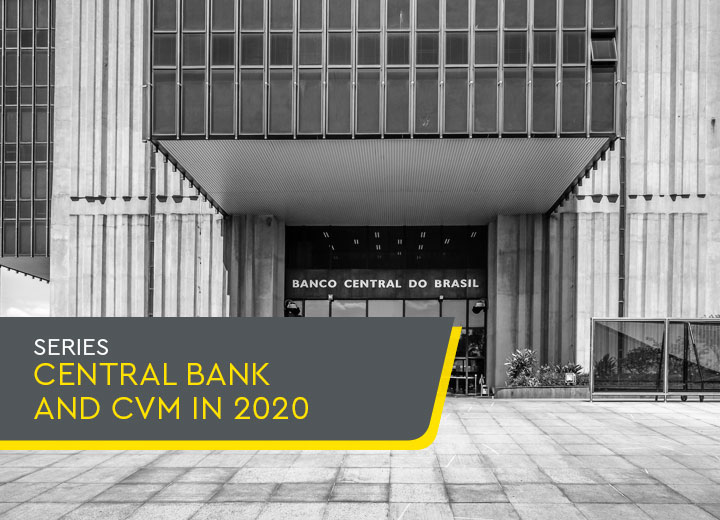
Central Bank Public Consultation Notice No. 77/20 proposes changes to the rules for authorizing the operation of payment institutions set out in BCB Circular No. 3,885/18. Published in early July, the draft brings in impact proposals for the Brazilian payments industry. Some of them have been long awaited by the market, such as the regulation of a new type of payment institution (creation of payment transaction initiator).
In this article we address three aspects of the public notice that deserve special attention from the industry.
Objective of payment transaction initiator
Inspired by the payment initiation service provider (Pisp), created under the open banking regulation in the United Kingdom, the BCB has been indicating since April of 2019 that the service of initiating payment transactions is one of those contemplated in the Brazilian open financial system (open banking).
The first regulatory provision of this service took place on May 4, 2020, with Joint Resolution No. 1 of the BCB and the National Monetary Council (CMN), which established the regulatory framework for open banking in Brazil. The rule defines what payment transaction initiating institutions are (article 2, VI) and that the service to be provided by them consists of enabling "the initiation of the instruction of a payment transaction, ordered by the client, in relation to a deposit account or pre-paid payment" (article 2, VII). In addition, the rule makes it clear that payment transaction initiators will be mandatory participants in open banking and must observe the rules applicable to them.
These definitions, however, are somewhat abstract in nature, an option commonly adopted by regulatory bodies to confer a legal framework to future and uncertain situations.
The market expectation was a more detailed rule on payment initiation services. However, as the notice shows, it seems that the BCB intends to follow an abstract definition that guarantees it a comfortable level of control over potential new entrants, even at the expense of greater predictability for the industry. This dilemma is commonplace in financial regulation and so far the BCB has shown no sign of changing strategy.
Even so, it is already possible to find some practical examples that give a more precise idea of how this service will work in practice. According to a note published on the BCB website, a payment transaction initiator will allow the client to make payments by debiting his deposit or payment account without using cards, that is, through any other existing systems, such as book transfers or PIX, the instant payment arrangement to be implemented by the BCB by the end of 2020.
Good examples of use are delivery applications, which currently facilitate payments with the use of cards, but may offer a debit service without having to manage a payment account or participate in the transaction settlement chain.[1]
The less detailed nature of the standard opens up an important range of options for implementing this service. Regardless of the means used for the transfer (debit card registration, provision of data on the source account itself, or another tool that allows for direct transactions between accounts), if the initiation involves a payment debit or deposit account, it is a regulated service.
Greater regulatory rigidity on the part of the Central Bank
A second highlight of the public notice is the greater restriction to be imposed on payment transaction initiators. In the proposal presented, payment transaction initiators will need to request prior authorization from the BCB to operate. The rule differs from the current system for payment institutions, which should only request authorization after reaching certain operational limits.
In addition, the BCB has proposed that payment transaction initiators may not store end-user credential data used to authenticate payment transactions with the account-holding institution, unless the initiators provide a cloud storage service to financial institutions under the regulations in force.
In practice, this means that people will have to input their information with each transaction carried out, if this proposal is implemented, which may compromise the user experience. Currently, one of the greatest features for using cards in online purchases, especially in e-commerce sites and delivery and transportation applications, is the possibility of registering and activating cards for future transactions, without the need to manually input information with each purchase.
The BCB's proposal responds to the growing concern for cyber security and personal data protection in the financial system. However, it also shows the weight that this factor has been having in the regulator's decisions: information security is taken as a priority, even though it may harm the end user experience.
Greater stringency with electronic money issuers
A third point to highlight is the tightening of the rules on the authorization of electronic money issuers (institutions offering pre-paid payment accounts) to operate.
Currently, these issuers need to apply for operating authorization from the BCB only after reaching R$ 500 million in payment transactions or R$ 50 million in client funds held in a pre-paid payment account.
The BCB proposed in the public notice that all new institutions falling into this category should apply for authorization before starting to operate and those already operating below the limit should seek authorization according to a predetermined schedule, depending on the operational volume of each institution. Thus, all issuers would be covered by mid-2023.
According to the note released by the BCB, the change has reasons of a competitive nature (to level the market conditions of the providers of this service), a regulatory nature (to improve the monitoring of transactions, especially for the purposes of preventing money laundering and terrorist financing), and prudential nature (to improve the risk management of popular savings accounts managed by these institutions).
In various countries, there is growing concern regarding the financial resilience of pre-paid payment account managers and e-money issuers. In the US, for example, where the regulation of these players is generally more flexible and varies according to the state in which the institution is organized, some authors advocate improving the institutional arrangement applicable to e-money issuers in order to increase the protection afforded to users’ funds.[2]
Regardless of the reason, there is a clear indication of the change in risk perception by the BCB, which will certainly transform the payments market in Brazil, which, after six years of development, is already showing signs of resourcefulness and attracting a growing number of consumers.
Regarding the payment transaction initiators, there is no exact measure of the size of this market in Brazil, but it is already possible to have an idea of its potential, evidenced, for example, by the recent controversy involving WhatsApp Pay.
The regulator’s expectation is that this new type of payment institution will make the market increasingly competitive, stimulating creativity and innovation, both from established players and possible new entrants. However, the exact effects of this are still uncertain. After all, if the brief history of payment initiation in Brazil has taught us anything, it is that its potential impact is of great proportions.
[1] A payment method already present in Brazil for purchases over the Internet is bank transfer via partner bank. In these cases, the online store provided a direct link to the internet banking of one or another partner bank for transfer with pre-filled-in data of the beneficiary. With the concept of the payment initiator, the expectation is that this model may be replicated more widely and in a centralized manner, with lower transaction costs.
[2] Awrey, Dan. Bad Money (February of 2020). 106 Cornell Law Review. Available at: https://ssrn.com/abstract=3532681.

- Category: Infrastructure and energy
On July 30, the Senate approved Conversion Bill (PLV) No. 30/20. The text will now go for presidential approval. At issue is the conversion into law of Executive Order No. 945/20, published on April 4, with the main objective of mitigating the effects of the covid-19 pandemic in the port sector, especially the removal and compensation of individual workers belonging to risk groups or with symptoms of coronavirus contamination.
During the process of consideration of MP 945 by the Brazilian Congress, however, the congressmen introduced a series of amendments to the original text, turning the final version of PLV 30/20 into a real reform of the legal framework of the port sector, with changes mainly to Law No. 12,815/13 (New Ports Law) and Law No. 10,233/01 (Law creating Antaq).
The matters dealt with by PLV 30/2020 were varied: from the inclusion of port activities in the list of essential services contained in Law No. 7,783 (Labor Strike Law) to the provision of targeted measures to remedy the effects of the pandemic (mirroring the original provisions of MP 945), such as the possibility for leased terminals to hire workers freely (in contracts limited to 12 months) whenever there is unavailability of freelance workers in the Labor Management Body (OGMO) to meet labor requisitions (including during strikes, stoppages, etc.). Mitigation measures are in force for 120 days or as long as the effects of the pandemic continue.
Some of the changes implemented by PLV 30/2020, however, have a truly structural nature, responding to the historical demands of the sector in an effort to relax the arrangement for occupation of public ports areas, with a view to promoting greater competitiveness in organized ports. In this regard, the recent Operational Audit Report of the Federal Accounting Court (TCU), which sought to identify the limitations of organized ports in relation to Private Use Terminals (TUPs) in terms of commercial dynamism and operational efficiency, should be highlighted. The report describes the trend of migration of public port investments and cargo, mainly due to their structural rigidity, which often prevents more rational use of their areas.
In this sense, PLV 30/2020 basically implemented a two-pronged structural reform for the port sector: (i) segmentation of the legal arrangements for the concession of organized ports and the leasing of port facilities; and (ii) consecration of new contractual instruments for the occupation of port areas and facilities in organized ports.
As to the first set of amendments, it should be emphasized that, according to the previous wording of Law No. 12,815/13, the concession and lease arrangements in the sector basically coincided, although, in practice, they referred to substantially different economic operations.
With the maturing of the initiatives for the privatization of organized ports, with Codesa in the final phase of studies and Codesp in the advanced phase of hiring consulting firms, important measures were effected to delimit specific arrangements for the concession of ports and the leasing of terminals.
In a first analysis, it is noted that PLV 30/2020 withdrew the lease term from articles 4 and 5 of the New Ports Law, reserving this arrangement exclusively to concession contracts. Also included is article 5-A to clarify that contracts entered into between the concessionaire and third parties, including those for the operation of port facilities, shall be governed by the rules of private law. No legal relationship will be established between the third parties and the granting authority. Although the new provision is directly inspired by article 25, paragraph 1, of Law No. 8,987/95 (Concessions Law), the measure seems to come at a good time since, in the specific framework of the port sector, a similar rule was not supported by provisions of law, but only by regulatory decree (Decree No. 8,033/13, article 21), generating challenges and some legal uncertainty regarding the legal reserve for the treatment of the matter.
However, although the consolidation of the legal arrangement under private law for contracts entered into by future organized port concessionaires is an important measure for the imminent implementation of port concessions, points relevant for the mitigation of possible insecurities in the model seem to persist. The transitional arrangement between lease contracts, once subject to the legal arrangement of public law and which, with the concession of the organized port, are now subject to private law, is noteworthy. Currently the matter is subject to article 22 (head section and paragraphs) of Decree No. 8,033/13. However, given the relevance of the provision for the certainty and attractiveness of port concessions, it would have been equally helpful to incorporate it into Law No. 12,815/13.
As for port leases, PLV 30/2020 also introduces into the New Ports Law articles 5-B and 5-C, inaugurating an autonomous arrangement for such contracts, with simplified provisions and a new specific process for waiving bidding procedures. In accordance with the sole paragraph of the new article 5-B, the direct contracting of leases may occur upon meeting the following requirements: (i) proven existence of a single party interested in the operation of the port facility, established by performing a public call by the port authority aiming at identification of potential interested parties; and (ii) compliance of the lease with the PDZ (Development and Zoning Plan) of the port.
In relation to the second prong of structural innovations in the legal framework of the port sector, PLV 30/2020 also introduced a new article 5-D, responsible for disciplining, on a legal level, temporary use of port facilities. According to the provision, port authorities may agree to use of the port with the party interested in the handling of cargo with a non-consolidated market (for an non-extendable period of 48 months) for port areas and facilities located within the land area of the organized port. Bidding will be waived and a simplified selection process may be carried out (along the lines of what is done today for transition contracts) in the event that there are multiple interested operators.
Once again, the merits of the measure is the incorporation of the institute of temporary use into the text of law. The measure had been provided for by Normative Resolution No. 7 of Antaq (National Agency of Water Transportation), but the Federal Courts of Espírito Santo suspended its effectiveness because of alleged excess in the regulatory power of the agency.
PLV 30/2020 also amends article 27 of Law No. 10,233/01, including in it subsection XXIX to ensure Antaq the competence to regulate other forms of operation of port areas and facilities not provided for in specific legislation. The change seems to put an end to the one size fits all model in force in the port sector, under which, regardless of demand, the granting power only had lease agreements to allow occupation of port facilities. Such rigidity, as noted in the Operational Audit Report of the TCU, was imposed at the expense of the competitiveness of organized ports.
It is also clear that, in addition to determining the measures applicable exclusively in the context of the exception and public calamity that arose from the covid-19 pandemic, PLV 30/2020, on the eve of the inauguration of the new organized port concessions, implemented relevant changes and improvements in the legal framework of the port sector, with the potential to resolve old deadlocks and boost the operation of Brazil's public ports.

- Category: Real estate
Executive Order (MP) No. 992/20, published on July 16, provides, among other issues, for the possibility of sharing a single fiduciary sale of real estate as collateral for more than one contract to open financial transactions within the Brazilian Financial System.
The innovation arises from the inclusion of certain provisions in the current Law No. 13,476/17, which deals mainly with credit facility agreements, and aims to facilitate the taking out of new loans without additional risks to financial institutions by allowing the sharing of the security interest in the property.
Although the additions have been made to the legislation on credit facility agreements, the new provisions are not clearly worded in such a way as to restrict their application to such agreements. On the contrary, the MP indicates that sharing can be done for "new and autonomous financing transactions of any nature", provided that such transactions are encompassed within the Brazilian Financial System. As a result, the scope of application of the new provisions may be subject to discussion and, ideally, should be clarified when the MP is converted into law.
Without prejudice to this discussion, the MP may benefit individuals and legal entities that have entered into financing transactions guaranteed by fiduciary sales of real estate with certain creditors (original transactions) and that wish to enter into new financing transactions within the Brazilian Financial System with the same creditors, using the same asset as collateral (derivative transactions). If an individual, the interested party may only do so for his own benefit or that of his family entity by declaring such information in a contract.
In order to be annotated in the real estate record as a derivative transaction under the terms of MP 992/20, the new contract must necessarily contain certain elements, as was already the case for the original financing transactions governed by Law No. 9,514/97. The amount of principal of the new transaction, the interest rate and charges incurred, the term and conditions for repayment of the financing to the creditor, the declaration regarding the use for his own benefit or that of his family entity (in the case of an individual), the grace period for arrears, the declaration that the property may be used freely by the debtor when in default of the obligations and requirements dealt with in article 27 of Law No. 9,514/97 are all essential requirements of the contract and must be expressly provided for.
Among the requirements, it is important to mention with emphasis that, in addition to the above-mentioned requirements, the contract must include a provision that provides that non-payment of any obligations in financing transactions guaranteed by the same fiduciary sale of real estate (both for original and derivative transactions) will allow the creditor to accelerate all obligations guaranteed under the shared fiduciary sale. This means that the changes introduced in Law No. 13,476/17 by Executive Order 992/20 allow the automatic inclusion of the due date cross-referenced with an accelerated maturity event in financial transactions previously carried out with the same creditor, even without the handling of contractual changes specific to the original transaction.
Another relevant inclusion is the specific provision that, for the purpose of sharing guarantees, provisions relating to automatic settlement of debt do not apply when the product resulting from the execution is not sufficient to settle the debt, with the exception made for transactions for financing housing. This point is certainly one of the most controversial when it comes to choosing fiduciary sale of real estate as collateral for transactions, especially when compared to the alternative of creating a mortgage, which does not have the same restriction.
Thus, the important changes introduced in the legislation certainly expand access to credit, as well as reduce lenders' exposure to risk and making the updating of collateral for new loans more dynamic. Before, the use of the same property as collateral for a new financing transaction required the undoing and redoing of the original security interest, with consequent cancellations and new real estate recordings.
Although the scope is limited to the Brazilian Financial System, the innovation brought about by MP 992/20 may encourage discussions on legislative changes to allow expansion of these provisions for the creation of a fiduciary sale of real estate as security for other types of financing. MP 992/20 still has to be submitted to the Legislature in order to be converted into law. In this process, changes to this legal arrangement may be implemented.

- Category: Corporate
In effect since July 1, Normative Instruction No. 81/20, published by the Brazilian Department of Company Registration and Integration (DREI), of the Ministry of Economy, repeals various previous normative instructions with the purpose of consolidating the rules relating to the public registration of companies and bringing in some innovations in the wake of Law No. 13,874/19 (the Economic Freedom Law).
Among the rules repealed is Normative Instruction No. 35/17, which contained provisions on "(...) acts of transformation, incorporation, merger and spin-off involving businessmen, companies, as well as the conversion of a simple company into a business company and vice-versa" and, in its article 30, it categorically mentioned that "the conversion of a business company into a non-profit company and vice-versa is prohibited".
The prohibition presented by IN 35 was based on the understanding that the legal framework of business companies was incompatible with the legal framework for non-profit associations, which cannot distribute profits and assets to their members. In such a situation, therefore, the association should be dissolved and a new business company set up. This is because according to article 61 of the Civil Code, in the event of dissolution of an association, the remainder of its net equity shall be allocated to the non-economic entity designated in the bylaws or to the municipal, state, or federal institution with identical or similar purposes. Transforming the association into a business company would mean creating a possibility of returning assets to the partners.
It was also argued that article 1,113[1] of the Civil Code would not apply to non-profit companies since it is included in the Special Part of the Civil Code, which refers to companies, and not in its General Part, which would apply to legal entities in general.
However, IN 81, in its Chapter V, called “Conversion of a partnership (sociedade simples) or association into a business company (sociedade empresária) and vice-versa", with a structure quite similar to Chapter V of IN 35, removed the prohibition on converting a non-profit company into a business company provided for in IN 35 and dealt, in its article 84, with the filing of an instrument of conversion of a partnership or association into an business company.
Under the terms of this article, the instrument of conversion must initially be registered with the Civil Registry in which the partnership or association is registered, and later, together with the amendment and restatement of the organizational documents of the respective corporate type, it shall be submitted for filing with the commercial registry of the same state of the federation or a different one. If the new corporate type is a corporation, the complete list of shareholders must be presented, with an indication of the number of shares resulting from the conversion, since such information would only appear in the corporate books, not in the bylaws (in the case of a limited liability company, the information on quotaholders is part of the articles of association).
From an analysis of the new regulations, it is clear that there has been a fundamental change in the position of the DREI regarding the change in the form of a legal entity from an association (or from a non-profit company type) to a business company.
In dealing with the change in the form of a legal entity as a "conversion" and not as a "transformation", it seems to us that the DREI sought to avoid discussion on the possibility of applying the institute of "transformation" to legal entities other than companies, focusing only on the possibility that a non-profit entity may become, through a simple formal act of registration, a for-profit entity.
Thus, IN 81, in its article 74, established that, after registration with the Civil Registry, the instrument of conversion of a partnership or association into a business company shall be filed with the commercial board of the headquarters, accompanied by the amendment and restatement of the organizational documents of the respective corporate type.
Thus, even though the conversion of a legal entity from an association into a business company has been accepted by the DREI from the standpoint of public registration, there are still controversies regarding its legal possibility, and some practical difficulties of an accounting and tax nature need to be faced.
For example, there are no legal parameters for the formation of the capital stock of the company, with the definition of the number and equity value of the quotas or shares newly issued, having an impact on equity accounts. Some associations have securities representing ideal fractions of their assets, corresponding to the contributions made by the members, so-called "equity securities", which would allow for a smooth transition from the association's equity accounts to the business company due to their similarity with the concept of quotas/shares and capital stock. Other associations, however, have no equity securities and so it will be impossible to determine the number of quotas or shares to be assigned to each member of the association.
In the demutualization process of the São Paulo Stock Exchange (Bovespa) and the Futures and Commodities Exchange (BM&F), such associations had equity securities representing their assets, held by the then associates, securities, and commodities and futures brokers. Demutualization was not implemented through transformation, but through the spin-off of associations and merger of the net assets into new companies. Each member received shares issued by such companies in the proportion and value of the equity securities they held in the associations.
Thus, if there are equity securities, the adequacy of the equity accounts as a result of their conversion into a business company would be feasible in proportion to the equity securities of the members, and the value of the capital stock of the company would correspond to the value of the equity of the association.
In the event that the association does not have net equity, it would be necessary for the members to subscribe, in the desired proportion, new quotas/shares for formation of capital stock (as in the incorporation of a company) to be paid up in accordance with the rules established in the subscription instrument.
[1] “Article 1,113. The act of transformation is independent of the winding up or liquidation of the company, and will obey the guiding principles themselves of the constitution and registration of the entity type into which it will be converted."