Publications
- Category: Banking, insurance and finance
Nei Schilling Zelmanovits, Eduardo Castro, Gustavo Rugani, Thales Tormin Saito, Thais de Gobbi, Vicente Piccoli M. Braga, Pedro Duarte Pinho, Rodrigo Chiaverini Albano, and Pedro Augusto Cunha
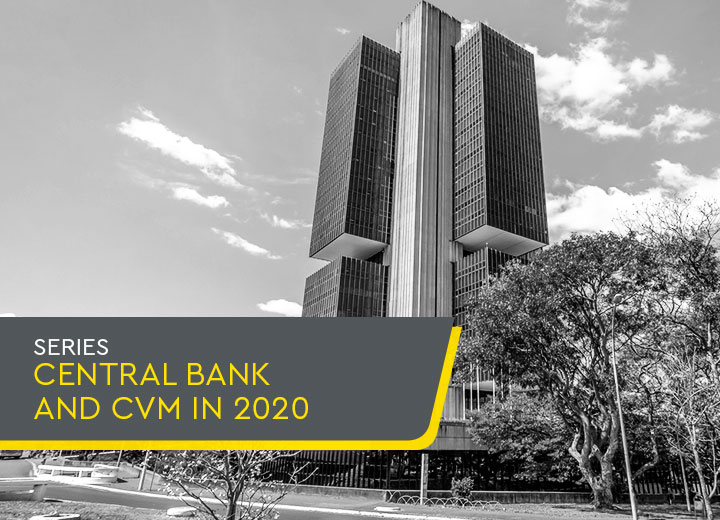
The Central Bank of Brazil (BCB) and the Brazilian Securities and Exchange Commission (CVM) presented, in early 2020, their regulatory agendas for the coming years. Inspired by the resumption of Brazil's economic growth, and with the encouragement of the federal government, the agendas include studies, innovative systems, and the promulgation of various rules to address the topics selected in the schedules of each regulator.
In the latter group, structural reforms that will generate significant impacts on the operations of various regulated agents stand out, such as the advent of the Open Financial System (Open Banking), the entry into force of the rules on the Prevention of Money Laundering and Financing of Terrorism (PLD/FT), the reform of foreign currency exchange legislation, the new system of banking resolution frameworks, the creation of the Regulatory Sandbox, the implementation of the system of instantaneous payments, the regulations of the Economic Freedom Law, and the regulation of the scenarios of internalization of orders in brokerage firms.
The long list of novelties shows that the coming years should bring important legislative changes, with major impacts throughout the National Financial System. Many learning and business opportunities will certainly arise, but market players may face challenges to stay well informed about advances.
To help you keep track of the changes, in the coming weeks we will publish a series of introduction and contextualization texts on all the major topics under discussion, with descriptions of the positions of the regulators, the current scenario for each topic, and the main changes intended, among other details. The first text in the series will be available next Monday and will address the CVM's new rules on cyber security.
The other texts will be published over the next few weeks and may be accessed at the portal’s start page.

- Category: Banking, insurance and finance
The Central Bank of Brazil (BCB) opened for public consultation, on November 28, drafts of a joint regulatory act of the National Monetary Council (CMN) and the BCB and a BCB Circular dealing with the introduction of a “Controlled Testing Environment for Financial and Payment Systems Innovations” (Regulatory Sandbox) under the National Financial System and the Brazilian Payments System.[1]
The draft CMN-BCB joint regulatory act sets out the general guidelines for the Regulatory Sandbox, while the draft BCB circular regulates in more detail the proposal for the first cycle of the Regulatory Sandbox under the BCB. The measures are in accordance with the regulatory strategy announced in Brazil in June of 2019, by means of a joint release[2] signed by the BCB, the Securities and Exchange Commission (CVM), the Private Insurance Superintendency (Susep), and the Special Finance Bureau of the Ministry of Economy.
In general terms, the strategy envisages the creation of an experimental regulatory environment that seeks to encourage innovation in the financial, capital, and insurance markets by granting temporary authorizations to institutions that have innovative business models. The companies selected may fulfill fewer regulatory requirements for a given period, but will be subject to the limits and conditions set by regulators, which should act in a coordinated manner if activities undertaken by a venture fall within the regulatory purview of more than one entity.
The objective of the measures is to give greater effectiveness to the provision of article 3, VI, of the recently promulgated Law No. 13,874/2019 (the Economic Freedom Act), which gives everyone the right to “develop, execute, operate, or market new types of products and services when regulatory standards become outdated by virtue of internationally established technological development, under the terms set forth in a regulation governing the requirements for the measurement of the specific situation, the procedures, the timing, and the conditions of the effects.”
Far from being a peculiarity of the Brazilian legal system, today the sandbox strategy is an international trend. According to a survey conducted between February and April of 2019 with the support of the World Bank,[3] many countries already have provisions on the sandbox model, including Australia, Canada, Singapore, the United States, the United Kingdom, Russia, and Switzerland. Various others are already considering adoption of this model, such as South Africa, Brazil, Spain, Japan, and Mexico.
Among the sandbox initiatives adopted in other countries, those of the United Kingdom and Singapore stand out, which have established themselves at the forefront of regulatory innovations and point to interesting ways for putting the Brazilian sandbox model into operation.
In the United Kingdom, the financial system regulator, the Financial Conduct Authority (FCA), operates the sandbox strategy by opening pre-established registration periods for interested parties. In the call notice for each of these periods, the FCA highlights proposals and technologies whose applications will be prioritized, but does not rigorously restrict potential participants. Initiatives entering into each period follow a specific six-month testing cycle.
In Singapore, for its part, the Monetary Authority of Singapore adopts a sandbox model that segregates interested entities into two groups. The first, called Sandbox, is for more complex business models that require customization to balance the project’s risks and benefits. The second, called Sandbox Express, has fast approvals and predefined rules, and is aimed at businesses that pose low risk and are already known in the market.
Meanwhile, in Brazil, the Regulatory Sandbox is rehearsing its first steps with the advantage of being able to observe results from international experience. In addition to the aforementioned public consultation initiated by the BCB, the CVM submitted a draft regulatory instruction for public hearing in the second half of 2019, while Susep submitted drafts of a circular and a resolution from the National Private Insurance Board (CNSP). The main points of the three proposals are compared in the table below:
|
CMN-BCB |
CVM |
Susep |
|
|
Target Audience |
Legal entities that offer an innovative design, understood as one that represents a technological innovation or improvement, such as gain in efficiency, reach, capillarity, reduction in cost, or increased safety (article 2, I and II, of the draft CMN-BCB joint regulatory act) At each cycle some topics/activities are defined as strategic priorities, and the relevance of the proposal serves as a tiebreaker criterion if the number of eligible entities exceeds the maximum number of participants (article 30 of the draft joint CMN-BCB regulatory act and article 7 of the draft BCB circular) |
Legal entities operating in the Brazilian securities market that (i) promote some sort of technological innovation, (ii) provide new products or services, or (iii) promote gains in efficiency, cost savings, or increased access by the general public to products or services in the securities market (article 2, IV, of the ICVM draft) |
Legal entities presenting an innovative project, understood as being one that develops products and/or services in the insurance market based on a new technology, or on existing technology applied differently (article 1 and 2, III, of the draft CNSP resolution) Insurance and pension plans structured in financial capital allocation and capitalization systems are excluded (sole paragraph of article 1 of the draft CNSP resolution). |
|
Eligibility criteria and formal requirements |
According to article 4 of the draft CMN-BCB joint regulatory act, the formal criteria are: I - Be a legal entity; and II - Assume the form of an association, company, sole proprietorship (Eireli), notary and registry service provider, public companies, and government-controlled companies. Moreover, article 28 brought in the following requirements: I - Unblemished reputation of officers and directors and controlling shareholders; and II - Adequacy of the discontinuity plan, understood as being the sequence of measures promoted by the participant upon termination of its participation in the Regulatory Sandbox. |
According to article 5 of the ICVM draft, the criteria are: I - The innovative business model must be conducted primarily within the Brazilian securities market, even if its activities may expand into other jurisdictions; II - The applicant must demonstrate sufficient technical and financial capacity to carry out the activity intended; III - The officers and directors and direct or indirect controlling shareholders of the applicant may not (i) be disqualified or suspended from managing institutions authorized by the regulatory bodies, (ii) have been convicted of the offenses provided for in the draft, or (iii) be prevented from managing their assets or disposing of them by reason of a judicial or administrative decision; IV - The applicant may not be prohibited from contracting with official financial institutions or participating in bidding; and V - The applicant must have adopted internal policies, procedures, and controls that, at a minimum, establish mechanisms to protect against cyber attacks and improper logical access to its systems and that relate to the production and keeping of records and information, including for the purposes of performing audits and inspections. |
According to articles 5 and 6 of the draft CNSP resolution, the criteria are: I - Use of remote means in operations related to its insurance plans, as provided for in applicable regulations; II - Presentation of analysis of the main risks associated with its performance, including those related to cyber security, and plan for mitigation of any damages to its customers; III - Have headquarters in Brazil; IV - Be duly organized and registered with the National Registry of Corporate Taxpayers (CNPJ); and V - Have officers and directors and direct or indirect officers and directors that (i) are not disqualified or suspended from holding a position at financial institutions or other entities authorized to operate by the CVM, BCB, Susep, National Supplementary Health Agency (ANS), or by the National Supplementary Pension Superintendency (Previc), (ii) have not been convicted of the crimes provided for in the draft, and (iii) not be prevented from managing or disposing of their assets as a result of a judicial or administrative decision. |
|
Procedure to join |
1. BCB issues call notice containing the rules for the cycle (article 26 of the draft joint CMN-BCB regulatory act). 2. Interested parties must register and present the documents required by the regulations and the call notice (article 27 and 28 of the draft joint CMN-BCB regulatory act). 3. BCB conducts a preliminary review based on the formal requirements set forth above and, if the number of applicants is equal to or less than the total number of participants admitted, reviews the other requirements and issues the authorizations (articles 29 and 31 of the draft joint CMN-BCB regulatory act). 4. If the number of applicants exceeds the number of participants admitted, the BCB, after a preliminary review of the formal requirements, classifies the candidates according to the strategic priorities of that cycle, project maturity, risks involved, and technical and operational and governance capacity. After classification, it evaluates the best placed registrants according to the other requirements, up to the maximum number of participants expected for that cycle, and issues the authorizations (articles 30 and 31 of the draft joint CMN-BCB regulatory act). |
1. Sandbox Committee coordinates the procedures for the beginning of the cycle, including the deadlines for registration (article 3 of the ICVM draft). 2. Proposals must be submitted with information about the activity and regulatory exemptions intended, among other information (article 6 of the ICVM draft). 3. Proposals are evaluated by the Sandbox Committee (article 7 of the ICVM draft). 4. A report is presented to the board (article 9 of the ICVM draft). 5. Board approves temporary authorizations (article 12 of the ICVM draft). |
1. Susep will publish a notice for a selection containing the general conditions for granting temporary authorization (article 2, VII, of the draft Susep circular) 2. Interested parties request authorization with the documents required in the regulation and in the public notice (article 9 of the draft Susep circular). 3. Evaluating committee issues an opinion on each participant within 60 days after the end of the call notice (article 6 of the draft Susep circular). 4. Susep issues approval (article 10 of the draft CNSP resolution). 5. Within 90 days after the authorization, the participants must be organized, elect officers and directors, submit corporate acts for approval by Susep, and prove the origin of the funds invested in the project (article 10 of the draft Susep circular). 6. Susep issues temporary authorization (article 11 of the draft Susep circular). |
|
Relevant prohibitions and scenarios for cancellation of authorization |
Contracts signed with customers may not have their expected maturity dates after the period provided for the duration of the Regulatory Sandbox (article 10, VII, of the draft joint CMN-BCB regulatory act). Participants may not hire correspondents to supply products or services in Brazil (article 12 of the draft joint CMN-BCB regulatory act). In the case of participants in the foreign exchange market, it is forbidden (article 22 of the draft joint CMN-BCB regulatory act). I - Carry out a foreign currency purchase or sale transaction with a foreign financial institution; II - Maintain deposit accounts in national currency of persons resident, domiciled, or headquartered abroad or accounts in foreign currency for customers served in the Regulatory Sandbox; III - Use funds in cash for the delivery or receipt of Brazilian Reais or foreign currency; and IV - Change and cancel the foreign exchange transactions performed in the Regulatory Sandbox. The BCB may cancel the authorization due to (article 40 of the draft joint CMN-BCB regulatory act). I - Failure to comply with the terms of the authorization granted; II - Increased risks arising from the participant's activities, such that they are no longer compatible with the Regulatory Sandbox system; III - Failure to prove the legal origin of the funds used in the project; IV - Non-compliance with the deadline for the beginning of the execution of the project; and V - Receipt of excessive complaints from users. |
Authorization may be canceled in the following scenarios: I - Failure to comply with the obligations to report to investors and customers, as well as those related to the CVM's special monitoring (article 18, I, of the ICVM draft); II - Existence of serious operational failures (article 18, II, of the ICVM draft); III - generation of excessive risks not previously foreseen by the Sandbox Committee (article 18, III, of the ICVM draft); IV - Failure to meet any eligibility criteria (article 18, IV, of the ICVM draft); and V - Commission of irregularities (article 18, V, of the ICVM draft). |
Authorization may be canceled in the following scenarios (article 49 of the draft Susep circular): I - Complaint rate found to be above 1%, cumulatively; II - Occurrence of harm to consumers; III - Non-compliance with the conditions for risk limits or items subscribed; IV - Inadequate creation of technical provisions; V - Insufficient collateral assets; VI - Application of funds from technical provisions in disagreement with what is established by the CMN and the criteria established for insurance companies; VII - Book equity, net of any intangible assets and deferred acquisition costs, lower than the minimum required capital; VIII - Offer or sale of product and/or service in disagreement with the innovative project approved by Susep; IX - Breach, without acceptable justification, of the business plan; X - Increase in the risks associated with the activity carried out, such that they are no longer compatible with the authorization framework for a given time; XI - Serious failures in the business model developed; and XII - Existence of evidence of wrongdoing through intent or fraud. |
|
Duration of the cycle |
Defined by the BCB, with a maximum limit of one year, which may be extended for up to one year (article 7 of the draft joint CMN-BCB regulatory act) |
Defined by the Sandbox Committee, with a maximum limit of one year, which may be extended for up to one year (article 3, III and paragrpah 3, of the ICVM draft) |
Defined in the call notice, with a maximum limit of 36 months (article 4, I, of the draft CNSP resolution). |
|
Status of the consultation |
Open until January 31, 2020 |
Closed on October 12, 2019 |
Closed on October 30, 2019 |
[1] Public Consultation Notice No. 72/2019. https://www3.bcb.gov.br/audpub/DetalharAudienciaPage?1&pk=321
[2] Statement {Release}: implementation of model regulatory sandbox in Brazil. http://www.economia.gov.br/area-de-imprensa/notas-a-imprensa/2019/06/comunicado-conjunto-de-13-de-junho-de-2019
[3] CGAP-World Bank: Regulatory Sandbox Global Survey, 2019. Available at: https://www.findevgateway.org/sites/default/files/publication_files/surevy_results_ppt_cgap_wbg_final_20190722_final.pdf

- Category: Labor and employment
The Labor Reform (Law No. 13,467/17) amended article 899, paragraph 11, of the Consolidated Labor Laws (CLT) to, among other things, enable the use of a judicial surety bond or bank surety to substitute for an appeal deposit, an alternative that had already been accepted by the Labor Courts to guarantee enforcement of judgment.
However, over the past two years, starting with the enactment of the Labor Reform, the Labor Courts have resisted the use of these new instruments, especially the judicial surety bonds substituting for appeal deposits. Decisions handed down by the circuit courts across Brazil and the Superior Labor Court (TST) followed different paths, removing the supposed legal certainty brought about by the new paragraph 11 of article 899.The decisions in question basically fell into three distinct groups: one that found it impossible to use the insurance policy, another that recognized the possibility of use, but conditioned it on some requirements not provided for by law, and a third that affirmed the full possibility of using such a guarantee regardless of any requirement.
Faced with this legal uncertainty, the TST and the Superior Review Board for the Labor Judiciary issued Joint Act No. 1, which now regulates the use of surety bonds within the framework of the Labor Judiciary, both in the appeal phase and in the execution phase.
The joint act provides objective requirements for the use of the judicial surety bonds already contemplated by procedural law, such as the need for the initial insured amount to be equal to the amount of the judgment, plus 30%, subject to the limits established annually by the TST for each type of appeal.
In addition to this requirement, the regulation provides for the specificities that need to be carefully observed by the parties and insurers, such as the provision for updating the judgment per the legal indices applicable to labor debts (a sensitive issue in the labor sphere and routinely modified), the reference to the lawsuit for which the amount will be guaranteed, and the minimum term of the bond of 3 years.
Another important piece of news for those who intend to use surety bonds are the guarantees given by the insurer itself, since, after the promulgation of Law No. 13,467/17, a market of insurers was created for this purpose, some of whom have not been accredited and registered. Thus, in addition to presentation of the surety bond itself, the TST also began to require proof of registration of the policy with Susep and the insurance company's certificate of good standing with that body.
The act also allows parties, if they need to file successive appeals, to also supplement the appeal deposit by means of a surety bond, which should specifically include the remaining amount of the judgment, plus 30%.
With the creation of objective requirements for the use of judicial surety bonds, the labor community expects the courts to accept and guarantee the effectiveness of this instrument, removing once and for all the legal uncertainty of the last two years and ensuring that companies may exercise their rights of defense with the lowest possible burden.

- Category: Tax
The decision regarding the exclusion of ICMS tax from the PIS and Cofins tax calculation bases, currently one of the most anticipated tax issues in Brazil, was postponed by the Federal Supreme Court (STF) on November 28 and there is no forecast for when it will be handed down. As issue is the judgment of the motion for clarification filed by the National Treasury in the case Imcopa (RE 574706), in which the theory was set that there was general repercussion in whether the ICMS tax is not a part of the calculation basis for the assessment of the PIS and Cofins taxes. Among allegations of omissions and contradictions, the National Treasury requested softening of the effects of the judgment, so that it produce effects only after the judgment of the motions for clarification. Due to the enormous relevance of the case, once again the softening effects has gained prominence in the Brazilian tax scenario.
In order to ensure legal certainty and protect social interest, softening of effects may be adopted so as to determine that a ruling of the STF has prospective effectiveness or as of a date set by the court, when an understanding of the STF modifies a prior position of the court or declares a certain law to be unconstitutional. Thus, the Supreme Court may decide, on a case by case basis, when its decision will take effect, considering issues pertaining to the judgment.
The Supreme Court stated that the motion for clarification is the appropriate instrument to claim softening of the judgment,[1] since, as a rule, decisions declaring the unconstitutionality of a law have retroactive effects, respecting the idea that an unconstitutional law is born unconstitutional. Thus, based on the establishment of provision in positive law for softening in Law No. 9,868/99,[2] the STF applied this method in some of its decisions, considering its response according to the statement of facts and explanatory memorandum of the movant party.
The institute of softening gained strength with the advent of the New Code of Civil Procedure, which made it possible to establish a time frame for the purposes of decisions that alter the court’s prevailing case law.[3] Thus, although recent, the provisoin of the NCPC has been applied by the Supreme Court, including by Justice Marco Aurélio, who, notably, has always been opposed to softening.[4]
In RE 643247,[5] the Justice assured the application of the provisions of the Code of Civil Procedure of 2015 and softened the effects of the decision stating that "(...) paragraph 3 of article 927 admits, in the case of change in the prevailing case law of the Supreme Court, softening of the effects of the ruling, provided that it is founded on social interest and legal certainty. Considering the warning to use parsimony in the observance of the institute, when the requirements of the provision are met, softening of the effects of the decision should be allowed, in order to consecrate good faith and trust in the judiciary.[6]
Justice Gilmar Mendes also has a firm position on softening, which manifests itself as a rule by considering the impact that this mechanism can have on the public coffers.[7]In a recent judgment (RE 870947), for which the appellate opinion has not yet been published,[8] the Justice voted in favor of softening due to the financial and budgetary impact that the absence thereof would entail. However, the dissent inaugurated by Justice Alexandre de Moraes prevailed, in which it was stated that softening would empty out the practical effects of the judgment.
On the other hand, in the case of the ICMS Cesta Básica (RE 635688), the theory argued by the taxpayer and unsuccessful in the merits of the judgment, Justice Gilmar Mendes, writing for the court, stated that softening of effects would express a reversal of the effective outcome of the judgment.[9]
In the case of Imcopa, the Federal Government's arguments in favor of softening the effects are mainly economic, stating that there would be a financial and budgetary impact in the amount of billions. However, the STF has been rejecting purely economic grounds, asserting that, by themselves, such grounds do not constitute the social interest necessary for the softening of effects to occur.[10] This technique, therefore, could render the decision of no effect.
The STF has also stated that a change in the case law is essential in order to set a new time frame for the effectiveness of the decision.[11]
There are specific situations in which the STF has given a transition period to laws declared unconstitutional, as in ADIs 429 and 4171. In the first one, there were questions regarding provisions of the Constitution of the State of Ceará that granted tax exemptions for some products and certain types of individuals and legal entities. Although it ruled that the provisions were unconstitutional, the STF granted prospective effectiveness to a provision that had not been suspended by the granting of an injunction in a prior ruling.[12]
ADI 4171, in turn, challenged provisions of ICMS Agreement 110/2007 that provided for reversal of the credit in the form of withholding of the amount corresponding to the ICMS tax deferred and not via write-off. As these provisions were deemed unconstitutional, the STF, en banc, found it advisable to grant a period of six months for states to adopt a new model, given that recognition of unconstitutionality would be detrimental to some of them.
In general terms, it may be said that the STF only applies modulation of effects taking into consideration the circumstances surrounding each case, when there are issues relating to legal certainty,[13] and relevant social interest,[14] which requires an adequate demonstration by the requesting party. The STF has ensured exceptions in cases in which effects were softened via the granting of an injunction, ensuring their effectiveness for ongoing actions.[15] Thus, even though there is no standardization of the technique, there are well-defined criteria so as not to surprise the parties or other groups that will be impacted by the decision.
As for the Imcopa case, it will be incumbent on the STF to weigh the arguments presented by the National Treasury and the factual reality of the judgment, which was nothing more than a reaffirmation of case law arising from the Auto Americano case (RE 240785).[16] Considering the scenario outlined in this article, it seems that, based on the precedents, the softening requested will not occur, since this is not a question of change in the case law and it is essential to ensure legal certainty. And, as Justice Gilmar Mendes said in the case of the ICMS Cesta Básica, softening would mean a reversal of the outcome of the judgment.
[1] ADI 2797 ED, opinion on motion drafted by: Justice Menezes Direito, appellate decision drafted by: Justice Ayres Britto, en banc, decided on May 16, 2012, DJe-039. Released: February 27, 2013. Public: February 28, 2013. Headnotes VOL-02678-01 PP-00001.
[2] Article 27. In declaring the unconstitutionality of a law or regulatory act, and for reasons of legal certainty or exceptional social interest, the Federal Supreme Court may, by a two-thirds majority of its members, restrict the effects of that declaration or decide that it takes effect only as of the final judgment or any other time as it may determine.
[3] Article 927. Judges and courts must observe the following:
Paragraph 3. In the event of changing in the prevailing case law of the Federal Supreme Court and of the superior courts or of that arising from judgment of repetitive cases, there may be softening of the effects of the change in the social interest and in the interest of legal certainty.
[4] Justice Marco Aurélio voted several times against softening, as in REs 560626, 55943, 680089 (Topics 2, 3, and 615) and ADIs 4481 and 4628.
[5] Topic 16 RG - fixed theory: “Public safety, with fire fighting and fire prevention, is carried out, in the field of primary activity, by the state of the Federation, and, as an essential service, it is viable via collection of taxes, and Municipalities are not permitted to create a tax for this purpose” (appellate decision published on December 19, 2017, DJe 292, released on December 18, 2017.
[6] RE 643247 ED, opinion drafted by: Justice Marco Aurélio, en banc, decided on June 12, 2019, electronic appellate decision DJe-140. Released: June 27, 2019. Public: June 28, 2019.
[7] See REs 560626 and 680089 (Topics 2 and 615 RG).
[8] The judgment on the motions for clarification in RE 870947 ended on October 3, 2019.
[9] RE 635688 ED-second, opinion drafted by: Justice Gilmar Mendes, en banc, decided on May 9, 2019, electronic proceeding DJe-114. Released on May 29, 2019, and published on May 30, 2019.
[10] See RE 559937 (Topic 1 RG) and ARE 957650 (Topic 891 RG).
[11] RE 651703 ED, opinion drafted by: Justice Luiz Fux, en banc, decided on February 28, 2019, electronic proceeding DJe-093. Released on May 6, 2019, and published on May 7, 2019.
[12] A 12-month a transition period was granted for the tax benefit provided for in article 192, paragraph 2, of the Constitution of the State of Ceará.
[13] In this sense, REs 560626, 559943, 593849 (Topics 2, 3, and 201 RG, respectively) and ADIs 4481 and 4171.
[14] In this sense, ADIs 3796 and 4171.
[15] In this sense, ADI 4628 and RE 639856 (Topic 616).
[16] RE decided on October 8, 2014. Appellate decision published on December 16, 2014, DJe 246, released on December 15, 2014.

- Category: Infrastructure and energy
Approximately 20 years after the first federal and state programs for highway concessions for the private sector, the concession agreements then entered into between the public administration and the operators of these sections will soon expire and there is much expectation regarding what measures will be taken in relation to them.
The context at the time when these highways were granted was one of economic, political, and institutional instability and a reduction in the role of the state in the management of public infrastructure, which led both the federal and state governments to prioritize the delegation of its most profitable assets, the true “crown jewels”, with high internal rates of return (IRRs), compatible with the macroeconomic situation of the 1990s.
This work involved initiatives in three dimensions: in politics, the promulgation of Federal Law No. 8,987/95 and State Law No. 7,835/92; in economic terms, the implementation of the Brazilian currency plan the Real Plan and the reduction of inflation and risco Brasil [risk of doing business in Brazil]; and in the technique, structuring, and monitoring of complex contracts with which the Brazilian Public Administration was unfamiliar.
Currently, a possible alternative for the management of this infrastructure would be early extension of concession agreements in accordance with the rules provided for in Federal Law No. 13,448/17 and State Law No. 16,933/19. In this case, and as an assumption of public policy for early extension, new investments would be included in the contracts, which should also be in line with current best regulatory practices. Without going into the merits of the public policy decision, based on what has been observed thus far, however, both governments have opted to again conduct public tenders for these assets, with the inclusion of new stretches of road, rather than extending the concession contracts in advance. The decision creates new business opportunities and extends the quality of road infrastructure to other regions.
Among the stretches of highway that were part of the first stage of the federal highway concession program (Procrofe), we highlight the 346 km of BR-116/RJ/SP - Presidente Dutra Highway, which connects Rio de Janeiro to São Paulo and whose concession agreement will expire in March of 2021. The Investment Partnership Program (PPI) is considering bidding for this highway again, but with the inclusion of the 23 km stretch of BR-465/RJ and another 266 km of BR-101/RJ/SP. That is, considering all the investments already made in the stretch of BR-166 currently granted under a concession and its high traffic volume, the government intends to connected highway stretches for which a single concession would not be viable.
In addition to Dutra, the 121 km stretch of the BR 290/RS highway, which represents an important link in the state of Rio Grande do Sul, was initially granted to Concepa, controlled by the Triunfo Group. However, at the beginning of last year, this highway was again bid (to ViaSul, controlled by the CCR Group), with the inclusion of stretches of the BR-101, BR-448, and BR-386 highways, which expanded the stretches to 472 km.
The state of São Paulo has followed the same tendency. An example is the 74 km stretch of the SP-310 highway, which connects São Carlos to Cordeirópolis, and the 144 km stretch of the SP-225 highway, which connects Bauru to Itirapina, currently granted to Centrovias, controlled by the Arteris Group. Soon there will be new public tender for the concession of these highways. It will include sections of the highways SP-294, SP-425, SP-284, SP-331, SP-293, SP-261, SP-304, SP-197, SP-191 and SP-308, which will increase the total granted under concession to 1,201 km.
The decision to conduct rebidding for the highways with the inclusion of new sections needs to be reviewed carefully to justify the advantage thereof over extension of an existing concession. The federal government and the São Paulo state government have presented a justification for the decision to conduct a public tender, first, because there is already a consolidated history of technical data regarding these assets (traffic level and geological conditions that may affect the pavement, among others), which significantly reduces the risks for potential winning bidders. Secondly, the inclusion of new stretches may contribute to the development of other regions, which to some extent also benefits the future concession with a possible increase in traffic.
Contrary to the public policy decision adopted in other logistics modalities, such as railways and ports, where the tendency is to conduct an extension (whether or not in advance) of existing contracts, the highway sector seems to have a propensity to rebid current contracts. This, however, does not prevent the decision by the public authorities to be otherwise in certain cases, thus allowing for extension of existing contracts on the basis of justifications demonstrating an advantage over rebidding.

- Category: Real estate
Resolution No. 4,661/18 of the National Monetary Council (CMN) will reach one and a half years since its publication and will enter into effect on November 29. Even after the time that has elapsed, some rules established for investment in what was previously called the “Real Estate Segment” are still under discussion. Appropriate regulation on the subject in order to guarantee legal certainty for real estate transactions carried out by closed-end private pension entities (EFPC) is lacking.
Resolution 4,661/18 established restrictions on real estate investment by EFPCs, prohibiting direct acquisition of real estate and forcing these entities to dispose of their direct property within 12 years (by May 28, 2030). Much has been discussed, however, regarding what the correct interpretation would be of the prohibition on "direct acquisition of real estate."
Acquisition of real estate means acquisition of ownership of immovable property which, in Brazilian law, occurs in three ways: by adverse possession, registration of title, or accession. For the analysis conducted in this article, only direct acquisition of property by registration of the title is of interest, that is, through registration of a transfer of title over the property (deed of sale and purchase, donation, exchange, accord and satisfaction, deed of sale), among others) at with competent Real Estate Registry Office in favor of an EFPC.
By prohibiting direct acquisition of real estate by EFPCs under any circumstances, a discussion arises as to whether the provision of real estate collateral in favor of EFPCs would also be prohibited, such as collateral security (AFG). In an AFG, fiduciary ownership and indirect possession of the property are transferred to the fiduciary creditor as collateral for a debt and, in order to start the foreclosure process in the event of non-payment of the secured debt, prior consolidation of ownership of the property in the name of the creditor is required, including via payment of ITBI (Real Estate Transfer Tax) and registration with the Real Estate Registry Office.
This discussion is further divided into two lines: for new transactions entered into after the beginning of the entrance into force of Resolution No. 4,661/18, in which it may be understood that it will not be possible to create an AFG; and for the execution of real estate guarantees (AFG and mortgages) for transactions entered into before May 29, 2018, but foreclosed on after the expiration of Resolution No. 4,661/18. In the latter case, would it be possible to award or grant via accord and satisfaction properties offered as collateral to the EFPCs?
In the case of property mortgages, the possibility of creation of real estate collateral is not addressed because, unlike with AFG, the creation of a mortgage does not transfer ownership (even fiduciary ownership) to the lender, nor is the beginning of foreclosure of the guarantee addressed, since there is no consolidation of ownership of the property in the name of the creditor for subsequent sale at auction. However, there is still discussion regarding the possibility of awarding the property when there is no third party interested in the auction and regarding the possibility of emptying the equity value of the real estate as a result of this restriction, which harms the interests of EFPCs and their participants.
This discussion on the correct interpretation and scope of the prohibition on direct acquisition of real estate by EFPCs gives rise to many questions:
- How does one put into operation, in practice, the execution of an AFG set up in favor of an EFPC that requires prior consolidation of ownership of the property in the name of the creditor before subsequent sale in extrajudicial auction that may even result in the awarding of the property to the creditor itself?
- Will an EFPC be able to consolidate ownership of the property in its name, pursuant to Resolution No. 4,661/18, even though the AFG was created before May 29, 2018, for the purposes of execution?
- Will the EFPC be able to have the property given as collateral awarded and become its owner, even if temporarily, considering the obligation to dispose of all properties or pay them up in FII within 12 years?
- If it is found that it is possible to consolidate and award the property because the secured interest in the real estate was created before May 29, 2018, this property, when acquired by an EFPC, may the concept of “stock” be included so as to eliminate the concentration limit per issuer of up to 25% of shareholders' equity in the event of subsequent payment of the property by the EFPC in an FII?
Although Resolution No. 4,661/18 has been in force for a year and a half, all of these questions remain unanswered, which makes EFPCs’ activities and new investments in the real estate segment more difficult.
From a literal interpretation of the resolution (which does not provide for any exceptions), it seems obvious that EFPCs may no longer directly purchase any property after May 29, 2018, even as a result of foreclosure (mortgage or AFG) or accord and satisfaction with real estate arising from debts agreed upon or created prior to the entrance into force of Resolution No. 4,661/18. However, this does not appear to have been the intention of the CMN when it formulated the resolution, and EFPCs have been seeking alternative solutions to enable real estate collateral to be foreclosed on in order to balance both their actuarial objectives and their profitability and obligations imposed on them by the rule in question.
A literal interpretation of the letter of the law does not, in fact, seem to be the best way out, considering that, the objectives of EFPCs include precisely the guarantee of return on their investments and solvency of their assets in order to assure to their participants an adequate return and therefore, a satisfactory benefit. Seeking to preserve a minimum of legal certainty, foreclosure on real estate guarantees, including through the direct awarding of properties given as collateral, and accord and satisfaction itself for these properties in transactions entered into before May 28, 2018 (even if foreclosed on after the entry force of Resolution No. 4,661/18) should continue to be legally supported in the name of preserving the interests of the EFPCs themselves and their participants and beneficiaries.
At the present time, however, the lack of clarity on how the issue will actually be dealt with by Previc (National Supplementary Pensions Bureau), the body responsible for the interpretation and supervision of Resolution 4,661/18, and by the Judiciary creates a scenario of great legal uncertainty. Considering the vagueness surrounding Previc itself, which may possibly merge with Susep (the Private Insurance Bureau), there is no clear outlook as to when we will have a definitive solution for the issue. On a case-by-case basis, the recommendation that has been given to EFPCs is to formalize prior consultations with Previc in order to validate transactions arising from foreclosure on real estate guarantees.