Publications

- Category: Litigation
A novelty brought in by the New Code of Civil Procedure (NCPC), the chapter regarding partial dissolution of companies presents some controversies that we propose to analyze in this article, as we point out in summarized form below.
I- Partial dissolution of corporations
The first innovation of the NCPC is in its article 599, which expressly authorizes partial dissolution actions also for a “privately-held corporation", provided that the shareholder or shareholders holding at least 5% of its share capital demonstrate that it "cannot fulfill its purpose" (paragraph 2). This is a novelty of a material nature, insofar as both the Civil Code and the Brazilian Corporations Law provided only for the possibility of total dissolution of corporations, in accordance with what was previously determined by the Commercial Code and the Civil Code of 1916. The provision has already been subject to criticism because procedural law does not lend itself to governing substantive law, and such inclusion is outside the norm. Moreover, if a company is not fulfilling its purpose, that would relate not only to the dissenting partner, but to all partners. Therefore, the question should be treated as a scenario for total dissolution, and not partial, as provided for by the Brazilian Corporations Law. In any case, the Superior Court of Justice (STJ) has already had the opportunity to issue a judgment recently whereby it admitted, for example, the partial dissolution of a corporation that, in twelve fiscal years, only generated profit in three and distributed dividends in one of them. While the legal provision has received criticism for supposedly going beyond what it should, it is also the target of objections for having fallen short of what it could. This is because, for more than a decade, case law has admitted the possibility of partial dissolution of certain corporations with intuitu personae, privileging content over form. These are, for example, family businesses, usually of a small or medium size, styled as a corporation, but often with evident affectio societatis. However, the NCPC was silent on this point, having lost the opportunity to govern a scenario that had long been consolidated by case law.
II - Criteria for determination of assets
The criterion for determination of assets is possibly the point that most interests those involved in a partial dissolution of a company. In accordance with the Civil Code and the Draft Commercial Code, the NCPC determined that the provision contained in the articles of association would be observed. However, in spite of an express provision in this sense, it is not uncommon for case law to relax this point on the grounds that it considers a particular contractual provision to be unconscionable, or even asserting that the criterion chosen in the articles of association would only prevail in the event of consensus. However, in the event of omission in the articles of association, the NCPC establishes that the equity criterion for the determination of assets should be observed through a determination of the balance sheet, which should consider not only tangible assets but also intangible assets. This is a material change in relation to the provisions of the Civil Code, which, despite setting forth the equity criterion, is silent regarding the consideration of intangible assets. However, it is important to be alert to a tendency in case law to also relax this provision. Although most decisions comply with the provisions of the NCPC, many assert that the equity criterion cannot be adopted in isolation. They thus determine that the discounted cash flow method be observed after a determination of the balance sheet.
III - Date of dissolution of the company
Finally, attention is drawn to item IV of article 605 of the NCPC, which establishes as the date of dissolution of the company, in the event of judicial exclusion of a partner, the date of “a final and unappealable decision to dissolve the company." Notwithstanding the commendable effort by the legislator, the new rule, in practice, causes more harm than good. Unfortunately, conditioning the determination of assets on a final and unappealable judgment not only opens up space for perpetuation of the conflict but also for the possibility of manipulating the best date for a determination of assets by means of successive appeals. Given this, one has already observed a certain relaxation of the legal provision by case law, not least because article 607 allows for review of the date and the criterion for determination of assets, provided that "at the request of the party, at any time before the commencement of the court-appointed expert’s examination." The state courts, for example, have already set the date of dissolution as being the date of service of process in the suit or the sending of a notice stating the evident breach of affectio societatis. As summarized above, the NCPC did well to discipline partial dissolutions of corporations, a gap that was felt in the previous law. However, the aforementioned chapter has already been the subject of controversy, since it brought in innovations of a material nature and failed to explicitly set forth provisions governing issues that, in practice, had already been defined. Thus, we have it that, as before, one can expect that case law will have the role of answering questions on the matter.

- Category: Labor and employment

- Category: Litigation
Because of its economic and strategic relevance to national security, port activity has always been conducted exclusively by the Federal Government through legal and contractual relations, sometimes marked by conflicts, with concessionaires, permit holders, and other companies authorized to perform public services.
For years, the disputes in the sector were settled exclusively by the Brazilian Judiciary, which implied a delay in the resolution of these controversies, thereby hindering the renewal of contract and making the continuity of investments in infrastructure difficult. To solve these problems, Law no. 12,815 (the Ports Law), which governs the direct and indirect operation of ports and port facilities by the Federal Government, was enacted in 2013.
Among the innovations brought in by the Ports Law, paragraph 1 of article 62 allowed disputes relating to debts (namely, those debts listed in the head paragraph of the same article) of port concessionaires, lessees, licensees, and operators to be settled through arbitration, pursuant to Law no. 9,307/1996 (the Brazilian Arbitration Act).
The specific regulations on the application of arbitration to the port sector came with Decree no. 8,465/2015, which, although subject to some criticism, represents a significant stimulus to the adoption of arbitration by the Public Administration in the port sector, since it regulates important issues such as objective arbitrability, publicity, choice of arbitrators, and institutions, among others.
Decree no. 8,465/2015 provides for the possibility of debating, in the context of an arbitration, issues related to defaults on contractual obligations by any of the parties, as well as port charges and other financial obligations of the port concessionaires, lessees, licensees, and operators vis-à-vis the port’s administration and the National Waterway Transportation Agency (ANTAQ) (article 2).
It is also provided that disputes related to the recomposition of the economic and financial balance of contracts will be resolved by arbitration, but Decree no. 8,465/2015 restricts access to arbitration in these cases by establishing that the matter can only be subjected to arbitration by a submission agreement, signed after dispute has arisen (that is, it cannot be covered by an arbitration clause - article 2, II).
Decree no. 8,465/2015 also allows conflicts already brought in court to “migrate” to arbitrations, through the drafting of an arbitration agreement (article 9, paragraph 4). In addition, it is possible to extend the duration of contracts while an arbitration is pending, provided that the legal and regulatory requirements are met and provided that the party contracting with the Public Administration: (i) has paid in full the undisputed amounts due; (ii) has paid or deposited an amount corresponding to the amount in dispute; and (iii) undertakes to pay the entire amount that it may be ordered by the arbitral tribunal to pay within a time limit not to exceed five years (article 13).
Although Decree no. 8,465/2015 provides that the Brazilian Arbitration Act should be applied to arbitration proceedings arising in the port sector, some rules included in Decree no. 8,465/2015 represent important modifications to the Brazilian Arbitration Act and, therefore, create a different procedure for port arbitrations from the procedure applied to arbitral proceedings in general under the Brazilian Arbitration Act.
Among the novelties included, the text (i) establishes that cases involving more than BRL 20 million will be settled by at least three arbitrators (article 3, V); (ii) grants both parties a minimum time period of 45 days to submit their respective defenses (article 3, VI); (iii) in an obvious violation of party equality, imposes on private parties the burden of advancing all expenses for the arbitration proceedings, even if the arbitration is initiated by the Public Administration (article 3, VII), in which case the contracting party will only be entitled to reimbursement if the Public Administration is defeated (article 12); and (iv) bars the payment of legal fees by the defeated party (article 3, IX).
Arbitration under Decree no. 8,465/2015 may be institutional or ad hoc (article 6, paragraph 4). However, the preference is for the management of the proceeding by an arbitral institution, and the option for ad hoc arbitration is considered an exception and must be justified. Institutional arbitration will necessarily be administered by a Brazilian chamber (article 4, paragraph 2).
After more than two years since the enactment of Decree no. 8,465/2015, it is still not possible to determine whether the changes it brought in fact contributed to greater efficiency in the resolution of conflicts related to the port sector, especially since there are still no precedents on the issue.
Since its enactment, only one arbitration has been initiated based on Decree no. 8,465/2015. The case involves Libra Terminal S/A, the terminal operator of the Port of Santos, in São Paulo. In September 2015, Libra Terminal S/A signed a submission agreement along with the Government, through the Secretariat of Ports (SEP), and the State of São Paulo Docks Company (Companhia Docas do Estado de São Paulo - CODESP), with the assent of ANTAQ.
The signing of the agreement, which represented the parties’ withdrawal from nine lawsuits (some of which had already been pending for 15 years) was very well received, as it was considered a landmark in arbitration involving the Public Administration.
However, after more than two years, CODESP has not even appointed its representative in the case, which involves more than BRL 1 billion and is pending before the Center for Arbitration and Mediation of the Chamber of Commerce Brazil-Canada (CAM-CCBC).
Thus, arbitration in the port sector is still a blank canvas. This indicates that the excessive bureaucracy created by Decree no. 8,465/2015 makes proceedings slow and may even discourage parties from resorting to arbitration to settle port disputes.
- Category: Infrastructure and energy
After lengthy discussions, at the end of November the Federal Senate approved two presidential decrees that alter the legislative environment of the mining sector. MP 789, which modifies the rules of Financial Compensation for the Exploration of Mineral Resources, CFEM, and MP 791, which creates the National Mining Agency to replace the National Department of Mineral Production. The final texts of Conversion Bills Nos. 38/17 and 37/17, submitted for presidential approval, were finally converted, respectively, into Laws No. 13,540/2017 and 13,575/2017, published in the Official Federal Gazette on December 19 and 27. The proposal approved by the Senate and converted into Law No. 13,540/2017, which deals with CFEM, generated since the publication of its original text in July 2017 (in the form of MP 789), severe reactions on the part of companies and experts in the sector, who claim that the new structure for collection of CFEM greatly increases the costs of a sector already heavily burdened by taxes. Among the changes approved, we highlight:
- the change in different CFEM rates:
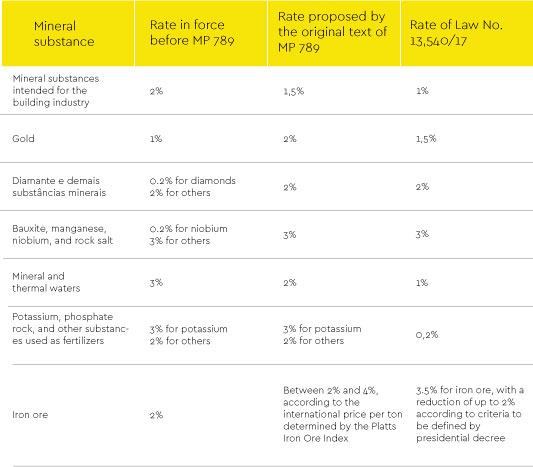
- expansion of the calculation basis for CFEM, which is no longer calculated based on net sales (subtracted from expenses with transport, insurance, and sales taxes), but rather on gross revenue, with taxes applicable to marketing and sale deducted.
President Temer, upon approving Law No. 13,540/2017, exercised his prerogative of veto for two material provisions. The first veto resulted in the exclusion of "municipalities socially impacted by mining activity" among those that would be entitled to a share of the CFEM, on the grounds that the criterion "socially impacted" is too subjective. The second veto excluded the point two percent (0.2%) rate proposed for the extraction of gold and diamonds under the framework mines, previous stones, and colored cuttable stones, in addition to limestone as a soil corrective, potassium, rock salt, phosphate rocks, and other fertilizers, these materials being subject to the rate described above. The reason for the veto, according to the President’s office, was that reduction in the tax rate would result in a significant loss of resources for part of the municipalities that are entitled to a share in the CFEM, in addition to impacting on the transfer to the Federal Government, constituting a renunciation of revenue without an indication of compensatory revenue. The new law also brought in changes that have resolved various legal clashes over the last few years in a manner favorable to the government and to the detriment of companies. An example is the obligatory collection of CFEM when purchasing mineral assets at public auction. The new law also innovated when defined mining waste and tailings resulting from the exploration mining rights as mineral goods for CFEM collecting purposes. The CFEM rate applied to these mineral assets will be halved if the tailing is used in other production chains. It is also worth mentioning the adoption of a mechanism to define the base price for minerals by the sector's regulatory agency in order to guarantee a higher value-added calculation basis for collection of CFEM at the time of transactions transferring between establishments of the same company, or from the same economic group. This same mechanism also provide that the CFEM will apply at the time of consumption or effective sale of the mineral asset, another topic that may lead to new debates, given the difficulty of delimiting the new concept of consumption brought about by the legislative change, as well as the various stages related to the industrial transformation of mineral goods. MP 791, converted into Law No. 13,575/2017, in turn, sets forth the creation of the National Mining Agency, a federal agency that replaces the former National Department of Mineral Production, DNPM. Although the agency is still below the Ministry of Mines and Energy, the measure was positive since it aims to amend a previous legislative distortion that allowed the creation of an agency for each of the main economic sectors (telecommunications, with ANATEL, oil and gas, with the ANP, electric power, with ANEEL, among others), but left out the mining sector. Although it was well regarded by participants in the industry, the mere creation of a new agency, with the absorption of staff and budget of the predecessor agency, does little to alter the regulatory and oversight panorama of the mining sector, which lacks investments to supply retained work demand, especially in the light of new environmental and rules and regulations for mining dams in response to the Mariana accident. It is a consensus that if the agency's regulations are not accompanied by an increase in its budget allocation for new contracts and modernization of its equipment and systems, the measure may have little impact. The decree that will regulate the new agency and detail its regulatory limits is still pending publication, as well as is the definition of its budget. The new Law No. 13,575/2017 has already been published with some expansion of the DNPM's previous regulatory allocation. However, the decree that will regulate the new agency should detail its role, which will determine whether its new duties will be able to remedy the existing flaws in the actions of the predecessor agency. Lastly, MP 790, issued by the president together with the two others presented here and, in fact, the only one of the presidential decrees that dealt with material changes in the current Mining Code, did not succeed in the National Congress. The text was not voted in due time by the National Congress and lost its effectiveness, which represented a defeat for participants in the mining sector who defended its approval as essential for legal security brought about by the set of presidential decrees and for the necessary modernization of the current regulatory framework. The uncertainty in the sector is therefore maintained as to possible new legislative changes in the future and the understanding of a considerable part of the investors and agents in the mining sector is confirmed to the effect that the government’s measures were predominantly for revenue purposes, without any relevant upside for the industry.

- Category: Labor and employment
Law No. 13,467/2017 (the Labor Reform) eliminated the obligatory nature of ratification of termination of employment contracts by the trade union representing the category or the Ministry of Labor and Social Security (MTPS) for employees with more than one year of service. With the repeal of the provision, regardless of the duration of employment, no termination of employment after the entry into force of the Labor Reform is subject to any type of ratificfation as a validity requirement, except for cases in which the collective bargain agreement applicable to the category so establishes. Because of this change, many questions have been asked about the procedures for withdrawing FGTS, since in the period prior to the Labor Reform, the Termination of Employment Agreement (TRCT) ratified by the competent entity (trade union and/or MTPS) was considered requirement to the process. There is even news of an impediment to withdrawal of FGTS by workers without the submission of a duly ratified TRCT. In order to resolve doubts and avoid controversy over the collection procedures, Caixa Econômica Federal changed its "FGTS Manual - Movement in Restricted Accounts", which became established as mandatory documentation for withdrawing deposits:
- For termination of employment contracts formalized as of 11/11/2017: original and copy of CTPS, provided that the employer has reported to Caixa Econômica Federal the date/code of movement for Social Connectivity or in the Form for Termination Collection.
- For termination of employment contracts formalized before 11/10/2017: TRCT duly ratified.
The established transition rule provides that, for terminations formalized after the entry into force of the Labor Reform, the worker must only submit the CTPS, but it is the duty of the employer to correctly report to Caixa Econômica Federal the date/Social Connectivity movement code or the Form for Termination Collection. It is important to note that the employer's failure to comply with this obligation will make it impossible for the employee to withdraw FGTS, giving rise to complaints and inquiries by competent bodies, including the Labor Courts. Therefore, the requirement should be rigorously and correctly observed.

- Category: Infrastructure and energy
Among the mechanisms to foment development provided for by the law, the authorization for the Federal Government to participate in a fund set up exclusively to finance specialized professional technical services that will support the structuring and the development of concession projects and public-private partnerships stands out. Subject to the framework of the State-owned Companies Act (Law No. 13,303/2016), the hiring of these professionals must be regulated by means of internal regulations on bids and contracts to be observed by the fund, including with respect to the scenarios for dismissal and unenforceability of bidding.
The fund, which will have a private nature and equity separate from that of its unitholders, will be created, managed, and represented by a financial institution controlled directly or indirectly by the Federal Government. In addition to federal entities, any individual or legal entity, public or private, under public or private law, may be a unitholder. An initial fund payment of R$ 40 million is expected, in 2017, plus R$ 70 million in each of the next two years.
In addition to the payment of units, the assets of the fund may be constituted through (i) donation from foreign states, international and multilateral organizations; (ii) reimbursement of amounts spent by the managing agent in the contracting of professional services, per the purpose of the fund; (iii) funds arising from the sale of assets and rights or from publications, technical material, data, and information; and (iv) financial proceeds obtained from the investment of its funds.
Law No. 13,529/2017 also introduces significant changes in the legal framework for public-private partnerships, the Growth Acceleration Program (PAC) and the Brazilian Agency for Guarantee and Guarantee Fund Management (ABGF). Thus, an amendment is introduced for article 4, item I, of Law No. 11,079/2004, in order to reduce the minimum amount of administrative and sponsored concessions contracted to R$ 10 million, half of that originally fixed by the PPP Law. Regarding the PAC, Law No. 11,578/2007 allows the program to benefit from the transfer of funds identified in the budget law as of the type “remnants to be paid", whether or not inserted via parliamentary amendments. Finally, the scope of the ABGF was expanded, allowing the Infrastructure Guarantee Fund to cover risks in public-private partnerships even when contracted by municipalities, and not only by the Federal Government and the states, per the initial version of Law No. 12,712/2012.
In short, the conversion of MP 786 complements the list of regulatory tools available to the public administration to stimulate privatization processes. Since projects modeled on concessions and public-private partnerships are only able to attract investors when properly structured from a technical-operational, economic-financial, and legal-institutional point of view, a new standard of quality is expected in the next call for proposals to be published, especially by the states and municipalities.