
- Category: Real estate
Full capacity consists in the ability of an individual to acquire rights and exercise duties in the civil order. Minors under the age of 16 are considered absolutely incapable due to not being able to carry out the acts of civil life in person and in themselves. In turn, those who are subjected to a certain restriction in their acts, or in the manner and exercise them, i.e., (i) young people between 16 and 18 years old, (ii) habitual drunks and those addicted to drugs, (iii) those who, for transient or permanent reasons, cannot express their will and (iv) the prodigals are considered relatively incapable.
In order to recognize the relative incapacity of the last three groups mentioned, it is necessary to interdict them through the institution of guardianship through specific legal action. The guardian judicially elected to assist the relatively incapacitated is responsible for the role of administering his assets,for his benefit, in order to assist him in the practice of the acts of civil life.
The validity of the entire legal transaction requires the full capacity of the parties involved or, in support of those considered relatively incapable, the proper assistance of their guardian, in order to ensure that the manifestation of will actually meets the interests and expectations of those involved. This premise is also essential in all real estate transactions: purchase and sale, leasing, institution of usufruct, and donation of real estate properties.
In March 2021, the 1st Chamber of Private Law of the Court of Justice of São Paulo upheld a ruling that annulled a donation of property made by the elderly who, a few months before being legally recognized as relative incapable due to mental disability, had donated his only real estate property, in which he resided, to his neighbor, with a lifetime enjoyment reserve for himself. The medical report produced proved that the elderly already lacked lucidity at the time of the donation, which justified the annulment of the legal business.
At the time of the trial at first instance, the bad faith of the donee was recognized in the transaction, since it was clear the low cognition of the donor about the acts of life in general. As a consequence, the beneficiary was ordered to pay compensation for moral damages in favor of the elderly fixed at R$ 10,000.
The important point of this decision is the recognition that the donation of a real estate property by relatively incapacitated is subject to annulment, even if the judicial interdiction procedure is not yet completed at the time of the transaction to acknowledge the relative incapacity of the donor.
Any real estate transaction must have the prior verification of the fulfillment of the requirements for the conclusion of a legal business, starting with the capacity of the agents involved. The fact that a person is not legally prohibited, therefore, does not prevent the annulment of a real estate contract if it is found that, at the time of the transaction, he already manifested inability to perform certain acts alone, or in the way of exercising them.
This court decision sets a precedent for families to seek the annulment of previously concluded real estate transactions in the course of the interdiction process in order to protect the one who has not yet been declared incapable at the time of the transaction. In turn, on the other side of the contractual relationship, there is a need to act more diligently to ensure that the person who negotiates cannot be considered relatively incapable, which would jeopardize the validity of the intended legal business.
Although such a decision may create legal uncertainty, in view of the subjectivity in the characterization of relative disability not yet enacted, we believe that the protection of the relatively incapable not yet recognized as incapable should prevail. Also, the conduct of a robust real estate due diligence, including obtaining a negative certificate of interdictions and guardianship on behalf of the counterparty, mitigates possible risks of future questioning of the validity of the legal transactions. In the case of transactions with individuals, whenever there is doubt about the civil capacity of any of the parties, it is recommended that the signing of contracts take place in person and without representation by prosecutors.

- Category: Infrastructure and energy
Approved by Congress after more than seven years of processing and signed by the Brazilian President on April 1, the New Public Procurement Law will replace, after two years of vacatio legis, Law No. 8,666/93, which has been in force for almost thirty years, and other disparate laws regarding procurement and administrative contracts.
No law is perfect, and the New Public Procurement Law could perhaps have implemented further advances on many points. In any case, and with the caveat that its actual effect will only be better known over time, from the interpretation and application reiterated by legal scholarship, the Judiciary and the Public Administration itself, among other law enforcement operators, it is possible to identify in it some positive developments.
It would be unfeasible to describe all these innovations in this brief article, but it may be informative to draw attention to some of the main pillars of the text:
- Consolidation and simplification. Although the New Public Procurement Law has more articles than Law No. 8,666/93 considered alone (191 vs. 126), it seeks to implement an important simplification and rationalization of public procurement legislation, by consolidating provisions previously disciplined in Law No. 8,666/93 and other disparate laws, such as the Law of the Differentiated Contracting Regime and the Auction Law, incorporating positions already settled in the case law.
It is also clear that the New Public Procurement Law will not apply to state-owned enterprises, which will continue to be governed by their own statute (Law No. 13,303/16).
- Modernization and adaptation of the law to new technologies. The new law seeks, correctly, to adapt to the digital world and new technologies. While this concern permeates a number of its provisions, it is worth noting the general rule that "bids will be held preferably in electronic form", assuming in-person sessions only exceptionally and subject to due grounds (art. 17, §2), or the provision that allows the electronic execution of contracts (art. 91, §3). They are not exactly innovations, although electronic formalization was not expressly included in specific public procurement laws and administrative contracts, but these measures undoubtedly consist of relevant steps to break our bureaucratic red tape culture.
As for new technologies, article 19, §3, according to which, "in the bidding for works and services of engineering and architecture, (...),Building Information Modelling (BIM) will preferably be adopted or similar or more advanced integrated technologies and processes that will replace it".
- Environmental sustainability and diversity. In addition to the purely economic criterion and the defense of the equal protection nature of the bidding, the New Public Procurement Law deepens other values already provided for by specific public procurement laws and administrative contracts, among other laws to encourage diversity and environmental sustainability. Examples of provisions that promote innovation, diversity, inclusion, and other social aspects:
- Article 5, by contemplating sustainable national development as one of the guiding principles of the new law;
- Article 11, by establishing as the objective of the bidding process "encouraging innovation and sustainable national development";
- Article 25, §9, by authorizing the notice to require that a minimum percentage of the labor responsible for the fulfillment of a particular contract be made up of " women who are victims of domestic violence" or by people "from or discharged from the prison system";
- Article 60, III, assuming as a tiebreaker, the "development by the bidder of actions of equity between men and women in the workplace ";
- Article 45, VI, by providing that bids for works and services must comply with the rules relating to "accessibility for people with disabilities or reduced mobility";
- the various standards that provide for micro-enterprises and small businesses.
- Integrity, compliance and prevention. As a legacy of Lava Jato and other anti-corruption measures, the new law establishes as an express objective of bidding processes "avoiding overpriced or manifestly unenforceable prices and overbilling in the execution of contracts". In bids for large-scale works, the notice must be "provide for the mandatory implementation of an integrity program by the winning bidder" (art. 25, §4). The "development by the bidder of an integrity program, as directed by the control bodies" is expressly permitted as a tiebreaker criterion (art. 60, IV). , The " implementation or improvement of an integrity program, in accordance with the standards and guidelines of the control bodies" is envisaged, as a criterion for sizing the sanction (art. 156).
- Strengthening the obligation of compliance with the contract by the customer and the vendor. In recent years, various issues of administrative contracts have been discredited. On the one hand, there were frequent situations of non-compliance with the contract by the Government or, at least, suspension of its performance without due cause, resulting in stoppage and deterioration of works, payment obligations brought to the judiciary, and increased stock of sham bidding. This scenario discourages serious bidders or the presentation of a more efficient proposal. This also contributed to bidders treating the bidding and contract as mere formalities to be assumed unfulfilled, submitting unenforceable proposals, with the certainty that they could be renegotiated, throughout the performance of the contract, from the most ancillary conditions to those most characteristic of that type of contracting, creating an industry of artificial revisions and rebalancing.
The New Public Procurement Law seeks to correct this situation. Among other provisions aimed at ensuring compliance with the contract by the private sector, in contracts for works and engineering services of great size, it allows vendors to be required to ensure faithful compliance with the contract in the amount of up to 30% of the value of the contract. The new law also gives insurers who have issued this guarantee the right to monitor the contract and, where necessary, intervene in it to ensure compliance. It is an important innovation, because Law No. 8,666/93 contemplated as a maximum guarantee the value of 10% of the contract, which did not encourage insurers to act more proactively in monitoring the contract.
Responsible planning was also implemented, through mandatory preparation of the Annual Contracting Plan (Art. 12, VII and §1) and the express responsibility of the senior management of the contracting body or entity by "promoting a healthy and reliable environment, ensuring the alignment of contracting with strategic planning and budget laws" (art. 11, single paragraph).
It is also worth mentioning the institution of the duty of the Public Administration to strictly observe chronological order in the realization of payments due from it in its administrative contracts. This order will be verified by contract category: supply of goods, leases, provision of services, and execution of works. The agent responsible for approving payments may be personally liable in the event of non-compliance with this chronological order. This reduces the scope for favoritism.
- Efficiency, flexibility and debureaucratization. The new law consolidated disparate legal provisions that promote the efficiency of bidding processes and procurement, as against merely formal issues.
For example, in evaluation of bids, the new law allows the price criterion to take into account not only the nominal value of the tender, but the lowest overall expenditure for the government, considering "indirect costs, related to the expenses of maintenance, use, replacement, depreciation and environmental impact of the object tendered, among other factors linked to its life cycle" (art. 34, §1).
With similar inspiration, the new law introduced as a criterion for judgment the "higher economic return", reserved for efficiency contracts, in which the remuneration of the vendor will consist of a percentage of the savings provided to the government.
Also as an unfolding of this search for greater efficiency, the new law offers greater flexibility in the bidding process, admitting a broader set of procurement modalities available to the Public Administration (integrated contracting, semi-integrated contracting, efficiency contract, etc.), judgment criteria and bidding alternatives. Some of these instruments were already available to state-owned enterprises and, depending on the adoption of the differentiated procurement regime, even for other state agencies and entities, but have now been raised to legal tools unquestionably applicable to the entire Public Administration, including direct, local, and foundational.
In parallel with the extension of the scope of some procurement modalities, the new law was noteworthy for creating the concept of competitive dialogue. Unthinkable in times more attached to our bureaucratic tradition, this modality of procurement allows discussion of solutions between the Public Administration and private stakeholders in intermediate phases of the bidding process, aiming to achieve the most efficient solution to meet the public interest.
- Objective risk allocation. Finally, we highlight the provisions of the new law in order to honor the objective allocation of risks, including through the preparation of a risk matrix in contracts, bringing the law closer, in this respect, to other more modern statutes, such as PPPS legislation. Again, although the instrument was already legally available to state companies, there were doubts as to whether it could be used by the direct administration, local or foundational.
In addition to offering greater clarity to contracts regarding the distribution of responsibilities between the parties, the objective allocation of risks also seems to enable more flexible solutions to be designed according to the specificities of each contract. In that regard, Law No. 8,666/93 seemed much more rigid in that regard, in that way, to the extent that certain risks should, according to its predominant interpretation, necessarily be allocated to one party or the other, without much room for sharing or creating exceptions.
It is important, however, that this sharing of risks is done efficiently in each case, allocating the risks to the party with the greatest capacity to manage and mitigate them.
In parallel to these undeniable advances, some presidential vetoes to the law passed by the Brazilian Congress deserve attention. Twenty-six original provisions were rejected by the Executive Branch in the signed version of the New Public Procurement Law. Among them, we highlight the following:
- a) the right to receive legal advice from public law: the new law recognizes the duty of public law to represent judicially or extrajudicially public agents who have their acts questioned in the administrative, supervisory, or judicial spheres, provided that such acts have strictly observed guidance contained in the legal opinion. In the original version of the new law, this right was exceptional in the event that the legal opinion was drafted by a non-permanent professional of the Public Administration.
This exception was vetoed. In practice, if the legal opinion is emanating from a professional outside the Public Administration, the public agent will not be able to be represented judicially or extrajudicially by public law.
The veto seems appropriate to us. In addition to the original provision contrary to the professional prerogatives of lawyers, regardless of public or private careers, external legal opinions undergo internal procedures of approval and receipt by government attorneys. There is no reason to demote an external legal opinion, duly scrutinized through this procedure, just because the lawyer does not belong to the permanent staff of the Public Administration.
- b) Restriction of competitive dialogue: the original version of the new law limited the application of competitive dialogue to cases in which the modes of open or closed dispute did not allow proper assessment of the variation between the proposals. This restriction was also vetoed, and also in good time.
In practice, the limitation would intimidate the application of competitive dialogue, as it would be very difficult to justify why the open or closed mode of dispute was not adopted. The evaluation of the variation between proposals is the result of a process pertaining precisely to the stage of dialogue. In the end, the Public Administration may eventually come to the conclusion if there is the possibility of variation between the proposals of the pre-selected bidders and how this variation will be assessed.
- c) Monitoring competitive dialogue: in the version of the new law approved by the Legislative Branch, the Court of Auditors was allowed to follow and monitor competitive dialogues, opining, within a maximum of 40 business days, on the legality, legitimacy, and economic advantage of the procurement, before execution of the contract. This provision has been vetoed. Although we agree with the reasons for the veto, for which this duty of the Court of Auditors, in addition to going beyond the rigid list of Article 71 of the Constitution of the Republic, would harm the principle of separation of powers, in practice it is known that the control bodies have exerted a real and comprehensive interference in public procurement. The original rule had the merit of seeking to discipline this interference, which may occur incidentally and extemporaneously through representations, complaints, or audits by a jurisdiction or sampling, which inevitably imply the participation of the Court of Auditors in administrative contracts.
Other laws have already predicted prior involvement of the Court of Auditors in the more complex administrative procurement processes, and it seems to us that these measures have only brought about more legal certainty for public-private businesses.
- d) Escrow account: the new law seeks to strengthen the obligation of the contracting public power. Among other measures, the original version contained the provision that "in the procurement of works, the sending of the service order for the execution of each stage will necessarily be preceded by a deposit into an escrow account of the financial resources necessary to pay the expenses corresponding to the step to be performed" (art. 115, §2). In other words, work would not be started without cash and segregated in that regard.
The provision was vetoed. The veto reasons pointed out that the mandatory deposit into an escrow account as a requirement for sending a service order in the execution of works brings about the risk of pooling of resources, performing the financial relocation that may prove necessary or even to meet urgent or unexpected demands.
The new law aimed to prevent precisely this flexibility in the management of resources destined for the payment of service orders. If it is true that the issuance of the commitment note continues to be a requirement for the realization of public expenditure, it is not for the issuance of the service order. The New Public Procurement Law did not condition the issuance of the service order on the issuance of the commitment note, and the version signed did not do so even in relation to the deposit into an escrow account, which would be an even more effective measure for the vendor's safety. These absences will subject the vendor to the various disadvantages of discretionary or mandatory contingencies, encouraging opportunistic behavior by public administrators.
- e) Leniency agreement with the participation of the Court of Auditors: finally, the vetoes covered a provision pursuant to which, under the possibility executing a leniency agreement, under the Anti-Corruption Law, the Public Administration could exempt the person concerned from the administrative sanctions of the new law and, in the event of a favorable response by the Court of Auditors, also those sanctions provided for in the organic law of that body.
The provision was helpful. The execution of leniency agreements without binding other authorities entitled to the application of sanctions is the main risk for those concerned and certainly the factor that most causes a hindrance to collaboration in investigative procedures involving illegal acts vis-à-vis the Public Administration. The provision only implemented the possibility of cooperation between some of these legitimate authorities. There was no obligation. And facilitating this cooperation could bring about more legal certainty for the practices of leniency agreements.
In the case of the errors and successes of the New Procurement Law and the vetoes of the President of Brazil, there seems to be reason for us to believe that the new law may, in fact, constitute an important step towards a healthier and more efficient public procurement environment.

- Category: Litigation
The current understanding of the Superior Court of Appeals (STJ) regarding the best interpretation of the concept of payment contained in Art. 523 of the Code of Civil Procedure (CPC) and regarding the effectiveness of the judicial deposit of the amount executed as a way to eliminate the fine, the fees of Art. 523, § 1, of the CPC, and the other late charges may increase the efficiency of the execution phase of the proceeding. By creating economic incentives for debtors to spontaneously comply with their obligation, the understanding in case law that has been crystallizing in the Supreme Court seeks to induce debtors to evaluate the cost/benefit of challenging the execution of judgment. The objective is to try to limit discussions at this stage to cases where debtors believe they have a good enough claim to justify taking the financial risks associated with his resistance to complying with the judgment.
Art. 523, head paragraph and § 1, of the CPC sets the period of 15 days for voluntary payment by debtors of the amount established by a creditor in the petition initiating the execution of judgment, under penalty of a fine of 10% and attorneys' fees for loss of suit to the same percentage of 10% over the value of the principal obligation. After this period, with or without attachment and regardless of new summons, a new time period of 15 days begins for the presentation of a challenge to execution of judgment, pursuant to Art. 525 of the CPC.
Thus, the timeline established by the legal text provides that debtors, before challenging the execution of judgment, must effectively make payment of the debt within the time limits stipulated by the creditor or risk seeing their debt automatically increased by 20%, due to the application of a fine and attorneys' fees. This is because, according to the current case law of the Supreme Court, the judicial deposit for the purpose of guaranteeing the judgment does not avoid the application of the fine of Art. 523, § 1, of the CPC, while the existence or the value of the debt for definitive execution of judgment is under discussion.
Justice Nancy Andrighi found, when deciding Special Appeal No. 1.834.337/SP, that there "are two criteria to be said of the application of the fine provided for in Article 523, § 1, of the CPC: the summons for payment or resistance manifested in the suit for execution of judgment. These two criteria are linked to the technical requirements of the procedural rule, since they deny or the period of 15 business days set out in head paragraph or voluntary action of payment". In other parts, it attests that "the fine referred to in Art. 523 of the CPC shall be excluded only if the judgment debtor voluntarily deposits the amount due in court, without conditioning its withdrawal on any discussion" and that "there needs to be effective resistance by the debtor through the filing of an objection to then authorize the application of the fine of § 1 of Art. 523".
Analogous reasoning is applied by the understanding established by the STJ, which, in Precedent 517, established that "attorneys' fees are due in the execution of judgment, whether or not there is an objection, after the deadline for voluntary payment, which begins after the summons of the lawyer of the judgment debtor".
That is, unless the debtor voluntarily pays the debt – without contesting it – the legal fine of 10% will be levied, in addition to fees for loss of suit, also stipulated at 10% over the amount of the debt. The resistance of the debtor who does not spontaneously comply with the judgment may generate more work for the creditor's lawyer, either to litigate the issues brought in the objection or to locate assets that can be executed to pay off the debt.
Added to this is the fact that, recently, the Supreme Court has also been reviewing the case law until then predominant in relation to the effect of the judicial deposit of the amount executed, to suppress the legal burden of the arrears.
In 2014, the STJ had set, in judgment of the special appeal representing controversy No. 1.348.640/RS,[1] topic 677, to the effect that "in the execution phase, judicial deposit of the amount (in whole or in part) of the judgment extinguishes the debtor's obligation, within the limits of the amount deposited." At the time, the plea adopted by the Supreme Court and crystallized in Topic 677 was that, after the deposit of the amounts, the responsibility for the remuneration of the amount would be transferred from the debtor to the depository financial institution. Thus, the creditor who potentially wanted to compensate himself for the difference between the amount of the judicial deposit – adjusted for inflation by the saving account rate – and what would be paid to him, under the enforcement order, should make an application against the bank that maintained the judicial deposit, in the case in which the amounts were deposited.[2]
However, recently, a question of order was received under Special Appeal No. 1.820.963/SP,[3] in the Third Panel of the STJ, to establish a review procedure for Topic 677, aiming to define: "if, in the execution, the judicial deposit of the amount of the obligation, with the consequent application of interest and adjustment for inflation borne by the depository financial institution, exempts the debtor from the payment of the charges arising from the default, provided for in the judicial or extrajudicial enforcement order, regardless of the release of the amount to the creditor."
Despite the controversy surrounding the previous understanding of the STJ – which assigned to the depository institution the burden arising from a legal relationship to which it was never a party – it is a fact that the proposal to review the jurisprudential topic 677 – which may be assigned to the debtor who deposited the amount executed the responsibility for payment of the difference between the adjustment rates of the judicial deposit and those contained in the enforcement instrument[4] – it may encourage the debtor to make voluntary payment of the debt or, at the very least, not delay the discussion indefinitely in the enforcement of judgment, just because it has secured the enforcement instrument.
By making spontaneous payment of the debt before the expiry of the period of Article 523, § 1, of the CPC, without an objection, the debtor avoids increase of the debt by 20%. If it chooses to file an objection – at the risk of having to pay a fine and fees on the debt – it must do so knowing that it may be held liable for interest and adjustment for inflation, under the terms of the instrument executed, up to the date of the actual payment, even if it has made the deposit in full of the amount stipulated by the creditor.
This configuration does not go outside the objectives of the legislator, since there are other financial incentives in the Code of Civil Procedure for debtors to meet their obligations in a timely manner, to accelerate the recovery of the debt executed. Examples are the mechanisms for discount on attorney's fees - art. 827, § 1, of the CPC[5] – and installment of the debt - art. 916 of the CPC - applicable to the execution of extrajudicial security for a sum certain.[6]
Nor is it possible to say that the imposition of penalties that increase the value of the debt excessively harms the debtor. The logic of abbreviating the definitive execution of judgment by this route also involves the fact that the debtor's broad defense, more often than not, was ensured in the trial phase – before the formation of the instrument that is now sought to be fulfilled. In addressing the provisional fulfillment of judgment, the legislator took care to establish that judicial deposit of the full amount of the debt removes the application of the fine of Art. 523, § 1, of the CPC (art. 520, § 3, cpc). To access this amount or perform any other act of expropriation, the creditor must provide a suitable security deposit and will be liable for any damages (art. 520, I and IV of the CPC), if the instrument on which the provisional execution of judgment is based is amended in favor of the debtor.
[1] REsp 1348640/RS, opinion drafted by Justice PAULO DE TARSO SANSEVERINO, SPECIAL COURT, decided on July 5, 2014, published in the electronic gazette of the Judiciary on May 21, 2014
[2] "This Superior Court of Appeals has a settled understanding that the responsibility for adjustment for inflation and interest, after the judicial deposit is made, is assigned to the financial institution where the cash was deposited (Precedent 179 and 271 of the STJ). This position applies even if it is an attachment of money for the guarantee of execution. Thus, the judicial deposit in the amount of the execution ceases, the debtor's liability for such charges ceases" (STJ, AgRg no EDcl no Ag 1298725/SP, opinion drafted by Justice Nancy Andrighi, Third Panel, decided on May 10, 2010). In the same direction: STJ, AgRg no Ag 1228560/RJ, opinion drafted by Justice Aldir Passarinho Junior, Fourth Panel, decided on October 19, 2010; STJ, REsp 1665819/DF, opinion drafted by Justice Herman Benjamin, Second Panel, decided on August 8, 2017.
[3] Question of Order raised in REsp 1820963/SP, opinion drafted by Justice NANCY ANDRIGHI, SPECIAL COURT, decided on October 7, 2020, published in the electronic gazette of the Judiciary on October 28, 2020, going on to be processed under the procedure set forth in arts. 256-S and 256-T ristj (Special Repetitive Appeal).
[4] It should be noted that the proposal for a revision of Topic 677 stems from the fact that the case law of the Supreme Court on the subject had already been changing in recent years, culminating in the Question of Order that effectively proposed revision of the topic. To this effect are the following judgements: STJ, REsp 1475859/RJ, opinion drafted by Justice João Otávio de Noronha, Third Panel, decided on August 16, 2016; STJ, AgInt no AgInt no REsp 1404012/PR, opinion drafted by Justice Luis Felipe Salomão, Fourth Panel, decided on February 7, 2019; STJ, AgInt no AgInt no AREsp 1687672/SP, opinion drafted by Justice Marco Aurélio Bellizze, Third Panel, decided on December 7, 2020.
[5] Art. 827. Upon dismissing the complaint, the judge shall then set the attorney's fees of 10%, to be paid by the judgment debtor.
- 1 - In the event of full payment within three days, the amount of the attorneys' fees shall be halved.
[6] Art. 916. Within the period for a motion for clarification, recognizing the credit of the judgment creditor and proving the deposit of 30% of the amount in execution, plus costs and attorneys' fees, the judgment debtor may request that he be allowed to pay the remainder within up to six monthly installments, plus adjustment for inflation and interest of 1% per month.

- Category: Succession planning
Widely used abroad as a vehicle for estate and succession planning , the trust is not provided for in Brazilian law. It is a typical instrument of British law and countries that adopt the common law (as opposed to the Roman-Germanic system/civil law adopted in Brazil and in countries such as Italy, Germany, Portugal and France). It allows an individual (Settlor) transmits assets to a third party (trustee) for the company to administer them in favour of certain beneficiaries according to rules defined in a contract (trust agreement/trust deed).
The Settlor defines the scope of the trust at the time of the contraction, i.e. the rules for the management of the assets, their beneficiaries (who may be third parties or the Settlor) and events where there will be transfer (partial or total) of assets to beneficiaries.
There are many situations allowed in this contractual modality, from the management of assets in favor of minor children or legally incapacitated persons, professional administration of assets, management of assets in case of incapacity/interdiction of the Settlor, until the delivery of the assets in the event of death. The trust thus functions as a legitimate legal instrument of succession and estate planning.
Given the lack of regulation on the subject in Brazil, there is a wide use of the trust in other jurisdictions by Brazilians who hold assets abroad. As a result, so that the estate planning can be structured in Brazil, is in the process in the House of Representatives The Bill No. 4.758/20, authored by Deputy Enrico Misasi. The objective is to include in our legal system the "General Fidúcia Regime" to regulate fiduciary property in the national territory.
In justifying the project, Mr Misasi expressly refers to the trust as an inspiring source of the project, in addition to defining as its main objective the segregation of the assets of the parties to the contract through the creation of the assets of allocation, fundamental for the legal certainty of the fidúcia contract by differentiating the assets of the instituter from the assets of the administrator.
The draft law defines the trust, in Article 2, as the "juridical transaction by which one of the parties, called trustor, transmits, under fiduciary regime, present or future assets or rights, to the other, called fiduciary, so that the fiduciary administers them for the benefit of a third party, called beneficiary, or the trustor himself, and transmits them to them or to third parties, in accordance with the provisions of the respective constitutive act" , a structure similar to that of the trust.
The great innovation is the creation of the assets of allocation, pursuant to Article 3 of the project: "The assets and rights transmitted in trust, as well as their fruits and income, constitute fiduciary property, subordinate the powers inherent to them to the restrictions and limits established in the law or in the respective act of constitution". In accordance with Paragraph 1 of the same article, fiduciary property shall last until the implementation of a resolutive condition or advent of a term, both defined in the contract, at which time the assets shall be transmitted to the beneficiaries, as provided for in § 2.
The assets transmitted in trust constitute autonomous assets, not responsible for debts of the trustee, but only for debts linked to fiduciary property, the content of § 3 of Article 3, being legally established the segregation of assets between the parties of the contract and the subject matter of the agreement, except in cases of fraud.
In addition, the fiduciary may not use the assets received in trust to his advantage, and must comply with the rules of the contract and the rules established by the trustor, as in the relationship between trustee and Settlor in the contracts of trust.
Another important characteristic of the fiduciary relationship is the possibility of institute it by unilateral act, with a revocable character or not. It is possible to create it, therefore, through a will, which makes it an important succession planning tool.
Although fiduciary property is already provided for in specific legislation, such as those regulating real estate development, securitization of credits and fiduciary guarantee, the bill would bring significant legal progress through the creation of the Trust contract, which could be used in various ways and with different objectives. This applies both to the management of assets in various situations and to the succession of assets, including extending to the management of the heir's assets in situations where such action is recommended, as currently occurs with the trust.
The bill was received on March 10 in the Finance and Taxation Committee and, after analysis, will proceed to the Constitution and Justice and Citizenship Committee.

- Category: Environmental
Over the last few years, the state of São Paulo has adopted several measures to restrain the practice of field burning – traditional agropastoral techniques in which a vegetation is set on fire to clean off the site – in areas of sugarcane cultivation. In 2017, for example, the Greener Ethanol Protocol (Protocolo Etanol Mais Verde) was executed between the Environmental Agency of the State of São Paulo (Cetesb) and the sugar-energy sector. One of its technical directives is the elimination of the use of fire as a pre-harvest agricultural method for the processing of sugarcane in certified areas. The aim is to reduce greenhouse gas emissions, protect riparian vegetation and headwaters, and stimulate the adoption of good practices for soil conservation.
Recently, on February 11, 2021, the 2nd Chamber Reserved for the Environment of the Court of Justice of the State of São Paulo (TJSP) approved the extrajudicial agreement executed between Cetesb and the sugar-alcohol sector, represented by the Sugarcane Agroindustry Union of the State of São Paulo (Unica) and the Organization of Associations of Sugarcane Producers of Brazil (Orplana).
The agreement, which represents a pioneering initiative of Cetesb, aims to address the environmental debts arising from the issuance of Infraction Notices with the imposition of fine (INs), related to infractions arising from fires in sugarcane cultivation areas of the state of São Paulo: "The object of this Extrajudicial Agreement is to formally continue the settlement of pending debts that have not been registered in Active Debt arising from Infraction Notice with the Imposition of Fine Penalty issued due to fires in areas of sugarcane cultivation which have been issued until 31.12.2019." According to environmental legislation, forest fire is considered as every fire that uncontrollably advances on vegetation.
The settlement negotiations were carried out due to the various ongoing lawsuits questioning the validity of INs related to fires in the cultivation areas. The most recent rulings from TJSP indicate a trend of alteration in the understanding relating to the INs issued by Cetesb, and the Court has repeatedly passed decisions stressing the absence of a chain of causation between the conduct of the defendants (owners and possessors of the areas and even sugarcane mills) and the occurrence of fires in cultivation areas.
Therefore, in order to solve the assorted ongoing judicial demands and the controversy over the INs related to fires in the sugarcane cultivation areas, Cetesb proposed the execution of the agreement, aiming to give the opportunity to those who had been fined to settle the debts arising from the INs issued until December 31, 2019, provided that they are not yet enrolled in active debt.
Amongst the most relevant obligations of the agreement there are:
- the obligation to pay the amount of the fine in a single quota or in up to 18 monthly installments;
- the waiver of filing any appeals in the administrative proceedings before Cetesb; and
- the discontinuance of the lawsuit in which the validity of the INs issued by Cetesb is discussed.
At the same time, Cetesb is committed to express its agreement with the withdrawal of lawsuits filed by the entrepreneurs.
If the interested party decides to pay the debt in a single quota, the discount applied on the corrected amount of the debt is 75%. If the party decides to pay the amount in installments, a 50% discount is applied on the corrected amount of the debit.
In a video presentation of the context and provisions of the agreement made available by Cetesb on March 17, 2021, additional details were disclosed on the developments of the agreement, amongst them, we highlight that the execution of the agreement: (i) will not be considered for the purpose of ascertaining recurrence in an administrative infraction, since new parameters have been adopted for the year of 2020; and (ii) does not constitute a confession to committing the alleged offence.
The agreement and the discount granted by the environmental agency do not imply the waiver of any obligation to recover environmentally degraded areas. Cetesb also reported that, as of 2020, the applicable procedure for identifying the chain of causation related to fires will be based on different parameters, based on Cetesb's Board Decision No. 29/20, in consonance with the modification of the understanding expressed by the TJSP in recent trials.
Cetesb's change of stance ensures greater legal certainty and demonstrates a commitment to the sugar-alcohol sector, which plays an important role in the climate change agenda. In the future, the agreement could even be used as a case of success to guide and support the drafting of new agreements between environmental agencies and other economic sectors that also present a significant number of ongoing legal disputes to discuss penalties applied in the administrative sphere.

- Category: M&A and private equity
Clarissa Freitas, Rafael Costa Silva and Tathiana Litter Bussab
Provisional Measure No. 1,040, published on March 30 of this year, promotes legislative changes with the aim of fostering the business environment and improving Brazil's position in the ranking Doing Business, developed by the World Bank.
Among the changes, Provisional Measure 1,040 included provisions in the Brazilian Corporate Law with new rules on the protection of minority shareholders, applicable primarily to publicly-held companies. It is expected that, with such measures, the business environment will become more attractive to investors.
We sumup the following the main changes in Law No. 6404/76 made by Provisional Measure 1.040:
- Expansion of matters of competence of the general meeting of publicly held companies
With the inclusion of item X in Article 122, it becomes the obligation of publicly-held companies to deliberate at the general meetings on:
- the disposal or contribution to another asset company, if the value of the transaction corresponds to more than 50% of the value of the total assets of the company contained in the last approved balance sheet; and
- the conclusion of transactions with related parties that meet the criteria of relevance to be defined by the Brazilian Securities and Exchange Commission (CVM).
- Change of the rule of convening the general meeting of publicly held companies
The new wording of article 124, §, item II, indicates that, for publicly held companies, the minimum period in advance for the first call has become 30 days. Furthermore, pursuant to the amendment to paragraph I, § 5, art. 124, the CVM may "declare which documents and information relevant to the resolution of the general meeting were not timely made available to shareholders and determine the postponement of the meeting for up to 30 days, from the date of availability of such documents and information to shareholders".
Because of Article 9 of CVM Instruction No. 481, several companies already convened the ordinary general meetings in advance. This article recommends that, in cases of ordinary general meetings , publicly held companies provide shareholders with the relevant documentation for the resolution of the meeting at least 30 days in advance. Thus, Provisional Measure 1,040 extends this rule to any and all meetings, whether ordinary or extraordinary.
Despite recognizing the benefits of such a change for the capital market, CVM issued CVM Resolution No. 25 on March 30 of this year, with the intention of improving the transition process and adaptation to the provisions of Provisional Measure 1,040. Thus, publicly held companies may continue to follow the minimum period of 15 days in advance for the first call for general meetings, provided that they have already been or are convened by April 30 of this year.
The permission given by CVM Resolution 25, which entered into force on the date of its publication, aims to avoid a possible disagreement between the new minimum period in advance for the convening of general meetings and that established in Article 132 of Law No. 6,404/76. It was then approved that:
- the 30-day period provided for in item II of § 1 of Article 124 of Law No. 6,404/76 shall be applied to the general meetings convened from May 1, 2021; and
- the general meetings already convened or those that may be convened by April 30, 2021 may observe the period of 15 days in advance of the first call".
- Prohibition of the accumulation of positions
Pursuant to Article 138, §3, publicly held companies may not allow the accumulation of the positions of chairman of the board of directors and chief executive officer of the company. The standard is already provided for in the B3 regulation of companies listed on the Novo Mercado and, from the publication of Provisional Measure 1,040, reaches all publicly held companies, regardless of B3's listing segments. Paragraph 4 of the same article indicates that CVM may exceptional the seal in lower billing companies.
- Independent directors
The participation of independent directors in the composition of the board of directors of publicly held companies became mandatory with the inclusion of §2 in Article 140. This standard is already provided for in the B3 regulation of companies listed in the Novo Mercado and, from the publication of Provisional Measure 1.040, reaches all publicly held companies, regardless of B3's listing segments.
Because it is a Provisional Measure, the rule has a maximum term of 60 days, extendable for the same period, and will lose its effectiveness if it is not transformed into law by the National Congress.

- Category: Capital markets
The agribusiness sector has just gained a new financing instrument for its production chain. This is the Investment Fund in Agroindustrial Production Chains, or FIAGRO, created by Law No. 14,130, of March 29, 2021.[1]
In 2020, Brazil remained one of the main suppliers of commodities agriculture in the world, according to IPEA (Institute of Applied Economic Research). Soybeans in grains and bran, beef, pork and chicken, sugar, coffee and cotton were highlighted. Factors such as the devaluation of the real against the dollar, the increase in global demand and local production (there was a record soybean harvest in the 2019/2020 biennium), the trade war between the U.S. and China and the crop failure of competing countries boosted the good performance of the sector,[2] which is the most relevant in terms of positive contribution to the Brazilian trade balance.
As explained in the explanatory memorandum to the bill that created FIAGRO,[3] agribusiness has been seeking a transition from a financing model based on government subsidies to one that relies on private credit, since the federal government's fiscal restrictions impose increasing reduction of available resources. This is already happening with large producers that have easier access to the financial and capital markets. As an example, in 2020, the primary market for Agribusiness Receivables Certificates (CRAs) reached an all-time high of R$ 15.81 billion.[4] Although strongly concentrated on corporate debt of a single debtor, this alternative also shows growth potential for pulverizes risk credits and financing from small and medium-sized producers.[5] Another example of the industry's progress in this direction was the editing of the Law No. 13,986/20 (as a result of the conversion of a Provisional Measure focused on Agribusiness sector into law), which should still show its full potential for the expansion and consolidation of agribusiness financing by the private sector in the coming years.
Thus, FIAGRO emerges as an alternative to expand the financing of Brazilian agribusiness, after a quick process in the National Congress and partial presidential sanction, with a veto. Its main characteristics are explained below.
- Regulation by CVM: FIAGRO's shares are securities, thus attracting the regime of Law No. 6,385/76,[6] and the competence of the Brazilian Securities Commission (CVM) to authorize, discipline and supervise the constitution, operation and administration of the fund. It is expected that, soon, the CVM will issue a regulation to discipline FIAGRO, subject to the law’s guideline.
- Target assets: FIAGRO may invest in the assets listed below:[7]
- rural properties, which may be leased or disposed of by the fund;
- shares of companies that explore activities that are part of the agro-industrial production chain;
- financial assets, credit securities or securities issued by individuals and legal entities that are part of the agro-industrial production chain (including, thereby, the Rural Product Card (CPR), the Agribusiness Credit Rights Certificate (CDCA), the Agribusiness Letter of Credit (LCA), the Agricultural Deposit Certificate (CDA), the Agricultural Warrant (WA), the Rural Real Estate Note (CIR);
- agribusiness credit rights and securitization bonds issued backed by agribusiness credit rights, including CRAs and Credit Rights Investment Fund quotas (FIDCs) - standardized and non-standardized - that invest more than 50% of their equity in credit rights agribusiness;
- real estate credit rights relating to rural properties and securitization securities issued backed by these credit rights, including CRAs and Credit Rights Investment Fund quotas - standardized and non-standardized - that invest more than 50% of their equity in said real estate credit rights; and
- investment fund shares that apply more than 50% of their equity to the assets listed in the assets listed above.
- Administration: as occurs with Real Estate Investment Funds (FIIs), FIAGRO must be managed by an administrator institution authorized by CVM that is necessarily a multiple bank with an investment portfolio or with a real estate credit portfolio, investment bank, real estate credit company, brokerage company or a company distributing bonds and securities, or other legally equivalent entities.[8] The institution will have the competence to represent FIAGRO actively and passively, judicially and extrajudicially and also to respond personally for the eviction of rights, in the event of the sale of property by the fund[9], in addition to being responsible for mismanagement, reckless management, conflict of interests, non-compliance with the regulation of the fund or determination of the general meeting of shareholders.[10]
FIAGRO's assets will be acquired by the administrator, on a fiduciary basis, and the real estate, and fruits and income arising therefrom, will be held under the administrator's fiduciary property. FIAGRO's assets and rights do not communicate with the assets of the administrator and, therefore, (i) are not part of its assets, (ii) are not directly or indirectly liable for any of its obligations, (iii) are not part of its assets and rights, for the purpose of judicial or extrajudicial liquidation, (iv) cannot be pledged as a guarantee for the debit of its operations, (v) are not subject to execution by any of its creditors, however privileged they may be, and (vi) cannot any real liens on the properties may be incurred. [11] Consequently, the administrator is required to include in the purchase title the restrictions indicated in the items above and that the property acquired is FIAGRO's property, noting that this must also be included in the registration of the rural property at the Real Estate Registry Office[12]. Since the property is FIAGRO's property, the administrator does not need to present the Certificate of Debts Relating to Federal Tax Credits and the Active Debt of the Union on the occasion of the sale of the property in question.[13]
In addition, considering that the administrator is responsible for good management, according to a standard of conduct guided by objective good faith, the same limits were adopted to ensure an adequate management of the resources of the quota holders who will invest in FIAGRO, being prohibited, in this sense, that the administrator:
- grant loans, future income to shareholders or open credits under any modality;
- provide surety, surety, acceptance or co-obligation in any form;
- invest abroad funds raised in the country;
- invest the funds in the acquisition of quotas of the fund itself;
- sell the installment of the fund's quotas, allowing the division of the issuance into series;
- promises predetermined income to shareholders;
- carry out operations of the fund when there is a conflict of interest between the fund and the managing institution, or between the fund and the entrepreneur.[14]
- Payment of quotas: FIAGRO's quotas can be paid in assets and rights, and payment in rural properties is permitted provided that they have been previously evaluated by a professional or by a specialized company[15]. Initially, it was considered a deferral of the taxable event of the capital gain on the quotas paid in with rural property for the date of sale of these quotas, instead of the moment of payment. But, as we will see below, the provision was vetoed by the President of the Republic based on the Fiscal Responsibility Law (although the veto may still be overturned by the National Congress). In principle, if the veto is not lifted, the payment of FIAGRO's quotas with a rural property assessed by a professional or by a specialized company is a taxable event of the capital gain, as is currently the case with Investment Funds in Participations.
In FIAGRO, as in Real Estate Investment Funds, the investor is protected from liabilities arising from the rights in rem that are part of the fund's portfolio, since he will not personally answer for any legal or contractual obligation in relation to the rural properties belonging to FIAGRO or its administrator, nor may he exercise real rights over the properties in question. The obligation of the investor is, therefore, limited to the payment of the quotas subscribed by him, serving the subscription bulletin as an extrajudicial enforcement order capable of supporting an execution action for collection by the administrator, or the sale of unpaid quotas to third parties.[16]
- Form: FIAGRO may be constituted in the form of an open or closed condominium.[17]
- Categories: the standard made room for the regulation of FIAGRO categories according to the target audience and the nature of the fund's investments.[18]
- Fund regulation: as with other fund modalities, FIAGRO will be structured through a bylaws, the minimum content of which is disciplined by law:
- qualification of the managing institution;
- investment policy that establishes, with precision and clarity, the definitions of the assets that will make up the fund's assets to meet its objectives;
- entrance fee or criteria for fixing it;
- remuneration of the administrator;
- disclosure of information to shareholders, observing the deadlines set by the CVM;
- expenses and charges of the fund;
- competence and quorum for deliberation of the investors' general meeting;
- criteria for subscription of shares by the same investor;
- the term of the fund and the conditions for redemption for the purpose of settlement;
- other specifications, aiming at market surveillance and clarity of information, in the form of regulations to be edited by the CVM; and
- criteria related to the distribution of income and capital gains.
All of these requirements are also applicable to Real Estate Investment Funds[19].However, it is important to highlight that, unlike Real Estate Investment Funds, FIAGRO has an advantage because it is not obliged to distribute to its investors the minimum of 95% of the profits earned, calculated according to the cash regime, based on balance sheet or half-yearly balance sheet. Thus, the taxation of gains and income can be postponed until the moment of amortization, redemption or sale of shares, differently from what happens with Real Estate Investment Funds.
- Taxation of FIAGRO's portfolio:
- Withholding Income Tax (IRRF) in financial investments: the net income and gains earned by FIAGRO on financial investments of fixed or variable income are subject to the incidence of Withholding Income Tax, observing the same rules applicable to legal entities submitted to this form of taxation.[20]
- Capital gains earned by FIAGRO: as in the Real Estate Investment Funds, capital gains earned by FIAGRO are exempt from Financial Transaction Tax (IOF) and Income Tax (IR).[21]
- Taxation of income of quota holders:
- Withholding Income Tax in the amortization or redemption of quotas: income and capital gains earned, when distributed by FIAGRO, are subject to the Withholding Income Tax at the rate of 20%.[22]
- Capital gain in the sale and redemption of quotas: capital gains on the sale or redemption of FIAGRO quotas are subject to the incidence of income tax at the rate of 20% at source, in the case of redemption, or, in other cases, to the same rules applicable to capital gains or net gains earned in variable income operations.[23]
- Due to the extension of Article 16-A of Law No. 8,668/93 to FIAGRO, it seems that the legislator's idea was to provide that the tax withheld at source may be offset against that withheld by FIAGRO, on the occasion of the distribution of income and capital gains. Thus, as it is better explained below, due to the veto in § 5 of 16-A of Law 8,668, the income tax withheld from the quota holders will be considered (i) anticipation of the due in the declaration, in the case of a legal entity beneficiary taxed based on the actual, presumed or arbitrated profit; or (ii) exclusive taxation, in other cases.
The President of the Republic sanctioned Law No. 14,130 in part, with veto of certain provisions[24], discussed below. Such vetoes will still be submitted to the National Congress, which has the power to overthrow them.
The exemption from Withholding Income Tax was vetoed for income earned by FIAGRO whose quotas are traded on a stock market or over-the-counter market and which are distributed to individuals. Similar to what happens with Real Estate Investment Funds, the initial proposal demanded that, in order to be entitled to this benefit, FIAGRO should have at least 50 investors, and the individual benefiting from the exemption could not have quotas that represent 10% or more than the totality of the quotas issued by FIAGRO, or whose quotas give you the right to receive income greater than 10% of the total income earned by FIAGRO. The reason for the veto was Art. 113 of the Transitional Constitutional Provisions Act, which requires that the legislative proposal that creates or changes mandatory expenditure or waiver of revenue be accompanied by an estimate of its budgetary and financial impact. It was also pointed out as the basis for the veto the Art. 137 of the Budget Guidelines Law of 2021, according to which the term of validity of tax benefit must be limited to five years[25].
Also, as mentioned above, a provision that provided for the deferral of the taxable event for payment of income tax arising from the capital gain on the quotas paid in with rural property by a natural or legal person for the date of sale of these quotas, or at the time of their redemption, in the case of liquidation of the fund, observing the payment of the deferred tax proportionally to the amount of quotas sold, was vetoed. This forecast would be a major driver for the sector, since it would allow the structuring of FIAGRO by rural owners in a less costly way, also considering the illiquidity of the assets.
Finally, the veto in § 5 of Art. 16-A of Law No. 8,668/93 makes the investment, through the FIAGRO structure, in Agricultural Deposit Certificate (CDA), Agricultural Warrant (WA), Agribusiness Credit Rights Certificate (CDCA), Agribusiness Letter of Credit (LCA), Agribusiness Receivable Certificate (CRA) and Financial Rural Product Note (CPR-F), unattractive, since it will not be up to the applicable Withholding Income Tax exemption applicable when the investment in these assets are carried out by individuals. Thus, it would be more advantageous for investors who are individuals to invest directly, in accordance with Art. 3, IV and V, of Law No. 11,033/2004, and not through a FIAGRO. Therefore, by virtue of the veto, the securities above that make up the FIAGRO portfolio will be subject to Withholding Income Tax at the rate of 20%. The Withholding Income Tax incentive is very similar to what was granted to the Real Estate Investment Funds to invest in these bonds, which was a great incentive for the wide adoption of the Real Estate Investment Fund.
[1] This law amended Law No. 8,668/93 to include this new form of fund within the norm that currently regulates the constitution and tax regime of Real Estate Investment Funds - FII.
[2] KRETER, Ana Cecilia; PASTRE, Rafael; BASTOS FILHO, Guilherme Soria. Carta de Conjuntura - Número 50 – Nota de conjuntura 29 – 1º trimestre de 2021. Instituto de Pesquisa Econômica Aplicada (Ipea). Published on March 31, 2021. p. 1, 4, 5, 6, 7, 9 e 10.
[3] Justification of Bill Project No. 5,191/20, presented on 11.18.2020. Author: Mr Arnaldo Jardim, Cidadania/SP. Available on: https://www.camara.leg.br/proposicoesWeb/fichadetramitacao?idProposicao=2265295>. Access: 31.03.2021.
[4] Anuário UQBAR CRA 2021. Disponível em: https://www.uqbar.com.br/anuarios2021/cra.php. Access on March 31,2021.
[5] Anuário UQBAR CRA 2021, ..., op cit.
[6] See Art. 3 and 20-F of Law No. 8,668, as amended by Law No. 14,130. Depending on the assets in which they invest, they may fit the definition of item V or IX of Art. 2 of Law 6,385 / 76, and, if they fit in item IX, they will need to have their first issuance of quotas offered publicly, just as the CVM understands that must occur with the Real Estate Investment Fund.
[7] See Art. 20-A, caput and items, and § 3 of the Law No. 8,668, as amended by Law No. 14,130.
[8] See Art. 5 and 20-F of Law No. 8,668, as amended by Law No. 14,130.
[9] See Art. 14 and 20-F of Law No. 8,668, as amended by Law No. 14,130.
[10] See Art. 8 and 20-F of Law No. 8,668, as amended by Law No. 14,130.
[11] See Art. 6, 7 and 20-F of Law No. 8,668, as amended by Law No. 14,130.
[12] See Art. 9 and 20-F of Law No. 8,668, as amended by Law No. 14,130.
[13] See Art. 7, §3 and 20-F of Law No. 8,668, as amended by Law No. 14,130.
[14] See Art. 12 and 20-F of Law No. 8,668, as amended by Law No. 14,130.
[15] See Art. 20-E, caput, e § 3º of Law No. 8,668, as amended by Law No. 14,130.
[16] See Art. 13 and 20-F of Law No. 8,668, as amended by Law No. 14,130.
[17] See Art. 20-B of Law No. 8,668, as amended by Law No. 14,130.
[18] See sole paragraph of Art. 20-B of the Law No. 8,668, as amended by Law No. 14,130.
[19] See Art. 10, caput, and 20-F of Law No. 8,668, as amended by Law No. 14,130.
[20] See Art. 16-A, and 20-F of Law No. 8,668, as amended by Law No. 14,130.
[21] See Art. 16 and 20-F of Law No. 8,668, as amended by Law No. 14,130.
[22] See Art. 20-C of Law No. 8,668, as amended by Law No. 14,130.
[23] See Art. 20-D's Law No. 8,668, as amended by Law No. 14,130.
[24] Law No. 14,130(veto). Message No. 111 of March 29, 2021. Published in Official Gazette - Section 1 - 30/3/2021, Page 15 (Veto). Available in: https://www2.camara.leg.br/legin/fed/lei/2021/lei-14130-29-marco-2021-791204-veto-162570-pl.html. Access on March 31, 2021.
[25] Law No. 14,130 (veto). Message No. 111 of 29 March 2021, ..., cit op.

- Category: Labor and employment
After a meeting between the heads of the state and municipal executive powers over the weekend, acts of the mayor and governor of Rio de Janeiro were published on March 22 and 24, restricting the movement of people and the operation of various companies from different sectors of the economy.
State Law No. 9,224/21 instituted as new holidays the days 26 and 31 march and April 1 and anticipated for the days 29 and 30 March the holidays of Tiradentes and São Jorge, celebrated on April 21 and 23, respectively.
As a way of maintaining the activities of companies that provide essential services and those that act remotely, the law excludes the application of holidays to these categories, so that the employee must provide his services on a regular basis, nothing being owed to him. In these cases, the original dates of the holidays that were anticipated and the full enjoyment of the day off by the employees are maintained.
Furthermore, the sole paragraph of Article 4 of the law determines that it is up to the State and Municipal Executive Authorities, within their respective competences, to establish the rules and prohibitions of operation during the holiday period. If there is a conflict between state and municipal rules, the one that imposes more restrictive measures should prevail.
In addition to state law, State Decree No. 47,540 provides for measures to combat the spread of Covid-19. The decree allows the operation of companies operating in key sectors, such as the oil industry, engineering activities, among others. It also allows the operation of shopping malls and shopping centers, between 12 h and 20 h, with capacity limit of 40%, being mandatory the use of masks and the supply of alcohol gel.
The fine for non-compliance with the restrictions is R$ 3,705.30 for citizens in Rio de Janeiro and R$ 37,053 for companies.
Prior to the state government's rules, the City Hall of Rio de Janeiro had published Municipal Decree No. 48,644/21, which also institutes measures to combat health attacks, with restriction orders stronger than those instituted by the state government.
As a way to ensure the population's access to essential services, the municipality of Rio allowed the operation of supermarkets and food trade (with on-site consumption fence), essential health services, industries, banking establishments, construction activities, hotels, wholesale trade, supply chain and logistics, vehicle rental services, among others.
Although the state decree allowed the operation of shopping malls and shopping centers with limited hours and capacity, the municipal decree limited the opening to those who perform economic activities considered essential, such as pharmacies, pet shops and veterinarians. Bars and restaurants may also work, but are limited to home delivery systems (delivery) and withdrawal.
The decree of the City of Rio recommends that establishments that carry out activities indoors, in particular supermarkets, should expand the opening hours and consider the alert level 3 (very high risk) for the entire territory of the city, with the application of restrictive measures and corresponding health protocols.
The two decrees prohibit recreational activities that may cause the agglomeration of people.

- Category: Tax
The Supreme Federal Court (STF) concluded, in March, the analysis of an important tax issue involving the exclusion of presumed credits of Tax on Circulation of Goods and Services (ICMS) from the calculation bases of PIS and Cofins. This is the judgment of an extraordinary appeal brought by the Union, RE No. 835.818/Theme 843 of the General Repercussion – Possibility of excluding the pis and cofins calculation base from the amounts corresponding to presumed ICMS credits arising from tax incentives granted by the states and the Federal District. Although the trial was paralyzed by the request for the view of Minister Dias Toffoli, the votes cast by the other ministers already form a majority by the dismissal of the appeal.
The discussion is not new, but the theme gained prominence with the recognition of its repercussion, which will impact everyone who is subject to this taxation. The trial also drew attention for inserting itself in the new avalanche of tax issues judged by the Supreme Court in 2021.
Regarding the discussion, the taxpayers defended the exclusion of the presumed ICMS credits from the pis and cofins calculation bases. The claim is that these credits could not be considered revenue or billing, which are the basis for calculating the contributions in question.
Another important foundation was pointed out for the non-taxation of these values by PIS and Cofins. The presumed iCMS claim would actually be a tax waiver by the taxing authority (state). Thus, any attempt to tax these amounts could result in violation of the federative pact and emptying of the tax benefit itself.
In turn, the National Treasury argued that the granting of the presumed iCMS credit would lead to a reduction in costs and expenses, which would result in an increase in taxpayer revenue, even if indirectly. From this point of view, the amounts relating to presumed ICMS credits should form the basis for calculating PIS and Cofins.
The National Treasury also maintained that there would be no legal provision for the exclusion intended by the taxpayer, because this exclusion is not included in the list of Art. 1, § 3 of Law No. 10,637/02 and the same article and paragraph of Law No. 10,833/03. For the agency, the non-taxation of presumed ICMS claims by PIS and Cofins would violate Article 150, § 6 of the Federal Constitution of 1988 (CF/88).
The theme, therefore, goes through the question of the concept of billing and revenue for the purposes of pis and cofins incidence, a discussion that is not unprecedented in the Supreme Court.
In other opportunities, the Supreme Court considered that the ICMS could not be the basis for calculating the aforementioned contributions, since it does not constitute the taxpayer's own wealth (it is mentioned, for example, RE No. 574.706/PR and RE No. 240,785/MG, which analyzed the exclusion of the ICMS from the pis and cofins calculation bases).
Reiterating the understanding already established by the Supreme Court, the vote of Minister Marco Aurelio, rapporteur of the case, for whom the presumed credits of ICMS are not confused with the concept of revenue or billing, bases for calculating these contributions (art. 195, I, "b" of the CF/88).
Minister Marco Aurelio suggested the fixation of the following thesis: "It appears incompatible, with the Federal Constitution, the inclusion, in the basis of calculation of Cofins and the contribution to the PIS, of presumed credits of the Tax on Circulation of Goods and Services - ICMS."
The written vote of Minister Edson Fachin was also made available. In addition to accompanying the rapporteur, the Minister examined the subject from another perspective, which involves the very concept of subsidy and the express exclusion of the investment grant (category in which presumed ICMS credits are included) from the pis and cofins calculation bases, provided for by laws no. 10,637/02 and 10,833/03, with the changes promoted by Law No. 12,973/2014 and Complementary Law No. 160/2017.
According to Minister Edson Fachin, the law itself would have already been able to exclude investment subsidies from the calculation bases of pis and cofins, precisely because they are not characterized as revenue. For this reason, the taxation sought by the Union is also, according to the Minister, incompatible with the Federal Constitution.
The disagreement was opened by Minister Alexandre de Moraes, who asserted that the exclusion sought by the taxpayer would not find legal support (art. 1, § 3 of laws no. 10.637/02 and 10.833/03). Making an interpretation "averse" to the federative pact, the minister understood that the granting of presumed ICMS credits by the states could not prevent taxation by the Union in relation to the part that "is its".
The rapporteur accompanied the ministers Edson Fachin, Rosa Weber, Carmen Lucia, Ricardo Lewandowski and Roberto Barroso. Ministers Alexandre de Moraes, Gilmar Mendes, Nunes Marques and Luiz Fux voted unfavorably to the taxpayer. The Minister Dias Toffoli asked for a view of the case, interrupting the trial.
At least to date, a possible modulation of the effects of the decision by the Supreme Court has not been mentioned. If there is no modulation, the decision is valid to ensure future and future values.

- Category: Tecnology
Diego Gualda, Vinicius Venancio Costa and Matheus Perez Matsuno
The Third Panel of the Superior Court of Justice (STJ) upheld the decision of the TJ-SP to fine Microsoft Informática Ltda. $310,000 because the company did not provide access information to a specific user's email address. In this case, a director of a brazilian company in Brazil received through his corporate e-mail threats in English from an email account user offered by the provider (the connection provider is outside Brazil).
The threatened director filed a lawsuit against the company to provide the information that would allow him to find the author. The court of first instance granted in advance guardianship the requests of the author, determining the identification of the person responsible for the e-mail account under penalty of daily fine set at R $ 10 thousand. After the decision was not complied with, the execution of the daily fine, which was appealed by the ombudsman, began. The TJ-SP maintained the conviction. The company then filed a special appeal with the STJ challenging that the Brazilian Court was not competent to request the supply, because webmail had as provider the parent company located abroad.
The above case is just the latest in a discussion not yet fully addressed within the judiciary: whether it is legitimate to compel a subsidiary in Brazil to provide information from users who hire a service with another company of the economic group outside Brazil.
Dealing with the scope of Article 11 of the Civil Framework of the Internet (MCI), in this, as in other cases, the Supreme Court considered that there was no offense to the law. According to the court, any operation of personal data, records or communications by internet connection providers and applications that occurin Brazil makes Brazilian law applicable to the case, regardless of whether there is only one device located in the country or the activities carried out are company based abroad. Therefore, for the Supreme Court, there is no way to disagree that the domicile of the demand under discussion is Brazil.
A similar case was also cited in a question-of-order judgment involving Google Brazil and Google Inc.[1] in the criminal sphere, which forced Google Inc., a foreign company, to submit to Brazilian sovereignty in cases where its subsidiary (located in Brazil), Google Brazil, is referred to in proceedings. Thus, in the case under analysis, the STJ understood that the Brazilian provider is a representative and acts on behalf of its foreign parent company.
The objective of this article is to discuss some perspectives that have not been considered by the Supreme Court in these decisions, in addition to considering the relevance of the entry into force of Law No. 13,709/18 (General Law for the Protection of Personal Data − LGPD) and a recent decision of the Supreme Court recognizing the protection of personal data as a fundamental right.
A first point concerns the legitimacy of the passive pole in the process: should the company based in Brazil be responsible for the requests, considering the context of the right to data protection and the processing of data by the foreign company?
In ADIs 6,387, 6,388, 6,389, 6,390 and 6,393,[2] in a decision that suspended the effectiveness of Provisional Measure (MP) No. 954, the Supreme Federal Court (STF) recognized the confidentiality of data as an autonomous fundamental right, and consequently as a constitutional guarantee. It also noted the need for data sharing to take into account due process, not only in its formal dimension, but also substantive. In addition to procedural guarantees, the decision requiring sharing must be proportionate in the specific case, taking into account the fundamental rights of the data subject himself. Forcing the sharing of data between companies based in different countries, at risk of causing conflicts of jurisdiction and violation of foreign law to comply with a court decision in Brazil, is this a proportionate measure from the point of view of the protection of personal data? How can we consider the principles of adequacy and necessity in this context?
Regarding the substantive dimension of due process, it seems necessary to evaluate more accurately the implications of considering the Brazilian subsidiary responsible for obtaining and making available the personal data of a user who hires a company from the same group outside Brazil.
A second aspect is related to Article 11 of the MCI, which does not have the jurisdiction of Brazilian courts, so it is not a procedural rule, but material. That is, the article regulates a rule of application of Brazilian law in the specific case. In addition, it is possible to notice technical flaws in the interpretations of §1. The situation of the rule brought by law concerns the case in which an international application provider located outside Brazil carries out the processing of the personal data of a holder located in Brazil. It is for this reason that the article mentions that one of the terminals must be located in Brazil.
However, in the concrete case mentioned above and judged by the STJ, the relationship established between the controller and the holder of the personal data should be better understood and it is necessary to observe whether the concrete evidence indicates whether the person who made the communication object of the breach of confidentiality has any point of connection in Brazil. To illustrate, if a user based in a foreign country hires an international provider and sends an email to a user located in Brazil, the law applicable to the processing of foreign data (located outside Brazil) is not Brazilian law. This does not mean that the Brazilian justice does not have jurisdiction to investigate the case and even require the breach of data confidentiality. But Brazil cannot impose the application of its law on a relationship maintained between two parties (the foreign contractor of the service and the respective provider) without any concrete element of connection with the national territory. With the transmitter located outside Brazil, it would be necessary to observe the inapplicability of the standard due to the absence of the connection element (there is no terminal located in Brazil). Thus, the evaluation of the application of Article 11, §1, of the MCI should consider the condition of the person who has his data confidentiality decreed and not only the fact that he communicated with someone in the national territory. This important nuance seems to have been overconsidered by the Supreme Court.
In addition, Article 11 of the MCI exists to protect the processing of personal data of the data subjects. Its purpose is to ensure that foreign companies are obliged to protect the personal data of holders located in Brazil, according to the parameters of Brazilian law. That is why it sounds at least strange that the device is used as a foundation for breaking data confidentiality. Article 11 values precisely the observation of due process. Therefore, using it with the justification of enabling access to personal data of holders who have contracted services with foreign companies, in any aspect, can be seen as a misimage of their own purpose. Misstatement that only worsens in the face of the recognition of the protection of personal data as a fundamental right, according to the recent decision of the Supreme Court cited above. Thus, not only the Executive and Legislative Branches, but also the Judiciary, in the exercise of jurisdiction, need to carry strictly the principle of due process in its substantive dimension.
The protection of fundamental rights cannot be relativised by a procedural convenience. We need to consider the scope of data protection within the parameters defined by the LGPD and in accordance with the Federal Constitution. Taking these terms seriously means avoiding the temptation to follow procedural shortcuts that weaken the guarantees of rights.
[1] EDcl on Inq 784/DF, rel. Minister Laurita Vaz, Special Court, tried on 05/15/2013, DJe 08/28/2013
[2] "STF suspends data sharing of telephone users with IBGE" In SUPREME COURT. Available from: <http://www.stf.jus.br/portal/cms/verNoticiaDetalhe.asp?idConteudo=442902&caixaBusca=N.> Last accessed: 24 Mar. 2021.

- Category: Infrastructure and energy
André Camargo Galvão e Frederico Morais Menezes Abdul-Hak Antelo
Through the virtual judgment closed on March 5, the plenary of the Supreme Federal Court (STF) decided, by a majority of votes, that Petróleo Brasileiro S.A. (Petrobras) is not subject to Law No. 8,666/93 (Bidding Law), a rule that provides for the bidding regime of the Public Administration.
The decision was given in the event of Extraordinary Appeal, brought by the Fleet of Oil Tankers of Sul Ltda. (Petrosul) and Brasilmar Navegação S.A. (Brasilmar), which sought to reform the decision of the Court of Justice of Rio Grande do Sul (TJ-RS) which considered valid (i) the termination by Petrobras in 1994 of a contract for chartering vessels for cargo transportation, concluded between Petrobras and Petrosul; and (ii) the subsequent contracting by Petrobras of another company without compliance with the provisions of the Bidding Law. At the time of the decision, the TJ-RS understood that Petrobras would not submit to art. 1, sole paragraph, of the Bidding Law.[1]
The majority of the Ministers of the Supreme Court followed the vote of the rapporteur, Dias Toffoli, by disavowing extraordinary appeal (RE) no. 441280, thus consolidating the understanding of the Supreme Court regarding the absence of the need for Petrobras to observe the procedures provided for in the Bidding Law. This decision was founded on Article 173, §1, of the Federal Constitution,[2] the wording of which establishes the subjection of mixed-economy companies to the own regime of private undertakings.
The rapporteur minister also stressed that the contracts concluded by Petrobras for the acquisition of goods and services should follow the Regulation of the Simplified Bidding Procedure of Petrobras, regulated by Decree No. 2,745/98.
According to the vote of the minister rapporteur, the regime provided for in the Bidding Law is incompatible with the performance of Petrobras, because mixed economy companies (petrobras case) are required to have their own agility of companies operating in the private market, driven by intense competition between companies:
"Therefore, I believe that it is inapplicable to mixed-economy companies that exploit the economic activity of private companies, thus competing in the market, with the narrow regime established in Law No. 8,666/93, because it is not possible to reconcile the regime provided for in Law No. 8,666/93 with the agility of this type of market, which, as we know, is driven by intense competition between the companies operating in it.
The agility required of companies operating in the market is absolutely incompatible with a rigid bidding system, such as this imposed by said Law No. 8,666/93."
Ministers Luiz Fux, Ricardo Lewandowski, Celso de Mello (retired), Gilmar Mendes and Alexandre de Moraes followed the vote of the rapporteur minister. They were against the ministers Marco Aurélio Mello, Edson Fachin, Rosa Weber and Carmen Lucia.
[1] Art. 1 - This law establishes general rules on bids and administrative contracts relevant to works, services, including advertising, purchases, disposals and leases within the powers of the Union, states, the federal district and municipalities.
Single paragraph. The regime of this law, in addition to the organs of direct administration, special funds, municipalities, public foundations, public enterprises, mixed-economy companies and other entities directly or indirectly controlled by the Union, States, Federal District and Municipalities are subordinated.
[2] Art. 173, § 1 - The law shall establish the legal status of the public company, the mixed-economy company and its subsidiaries that exploit economic activity of production or commercialization of goods or services, with:
(...)
II - the subjection to the legal regime proper to private companies, including civil, commercial, labor and tax rights and obligations;

- Category: Litigation
The National Congress partially overturned, on March 17, the vetoes of the President of the Republic to Bill No. 4,458/20, which promoted the reform of the Law on Recoveries and Bankruptcies (Law No. 11,101/05 or LRF). From this deliberation, some provisions approved by the National Congress, but vetoed by the president, will be reinserted in the reform of the LRF, which is already in force.
The partial overthrow of vetoes represents a strengthening of the principles of preserving productive activity and overcoming the economic and financial crisis, both of which are provided for in Art. 47 of the LRF. In addition, there is an effective stimulus to the business environment in Brazil, especially at a time of severe economic, financial and sanitary crisis.
The National Congress maintained vetoes related to the provisions that disciplined (i) the possibility of the Ministry of Agriculture, Livestock and Supply to define which events can be characterized as fortuitous acts and force-greater force for the purpose of possible submission of credits and guarantees linked to rural product notes (CPRs), with physical settlement, to judicial recovery; and (ii) the suspension of labor executions against co-obligations of recoverers.[1] These issues will therefore be left out of the LRF reform.
In addition to a specific point on cooperatives[2] and the recognition of non-submission to the effects of judicial recovery of claims and guarantees linked to CPRs with physical settlement, in case of partial or full anticipation of the price, or representative of exchange operation for insums (Barter)[3], the vetoes overturned by the National Congress involve relevant tax issues and the absence of succession of the acquirer of the debtor's assets. These two aspects are best described below:
- ABSENCE OF SUCCESSION OF THE ACQUIRER OF ASSETS – 60, single paragraph,[4] and art. 66, §3,[5] of the LRF
The two new provisions leave no room for doubt that the asset disposed of during the judicial recovery will be free of any encumbrance and that the acquirer will not succeed the debtor in his obligations. Environmental, labor, regulatory, administrative, criminal and anti-corruption obligations were expressly included in these obligations. The tax obligations were already exceptional in the original wording of the LRF.
The previous wording of the LRF was not clear on the subject. It was discussed, first, whether the shield would only apply to cases of sale of isolated production unit (UPI) or to subsidiaries, with the respective provision in judicial recovery plan. In addition, there were doubts as to whether environmental and anti-corruption obligations would be excluded.
Although they had already judged and[6] who adopted an ampliative interpretation for both points, there were questions whether the sale of other assets through judicial authorization in the form of Art. 66 of the LRF would also be covered by non-succession.
The inclusion of §3 of art. 66 in the LRF closes any discussion and establishes that sales made with judicial authorization are also shielded from encumbrance. Furthermore, the amendment to the sole paragraph of Article 60 makes it clear that the absence of succession refers to all obligations of the debtor, including environmental and anti-corruption obligations.
All of these devices give greater predictability and security to those interested in assets of companies in judicial recovery. As a result, an increase in the number of interested parties for this type of asset is expected, more facility to sell them and an increase in the value of offers to recoverers.
The two provisions stipulate, in summary:
- the non-application of the limit of 30% provided for in the tax legislation to offset tax losses with capital gain due to the sale of assets within the context of judicial recoveries and bankruptcies or with gain arising from debt reduction;
- the disregard of accounting revenuestemming from the application of debt discounts such as tax revenues for the purposes of pis and cofins; And
- the deductibility of the obligations assumed in the judicial recovery plan of the calculation bases of corporate income tax (IRPJ) and the Social Contribution on Net Income (CSLL).
The forecasts mentioned above will have a broad practical effect on judicial recoveries, as significant discounting to creditors and the sale of assets by the recovering debtor are among the main means of recovery adopted by debtors.[9]
The overthrow of vetoes to these devices also represents an important and fair portion of the Tax Code's contribution (which was largely strengthened with the reform of the LRF – as already addressed Previously) for debt restructuring and overcoming the economic and financial crisis, as well as the others involved (debtors and their shareholders, creditors, employees, suppliers and customers) in these processes.
More details on the implications of these tax provisions can be found Here.
[1] The implications of maintaining the veto on the suspension of labor executions have already been addressed in detail Here.
[2] The National Congress also overturned the veto on §13 of Article 6 of the LRF, which provides: "§ 13. The effects of judicial recovery are not subject to the effects of judicial recovery, the contracts and obligations arising from cooperative acts committed by cooperative societies with their cooperative members, in the form of Article 79 of Law No. 5,764 of December 16, 1971, consequently, not applying the prohibition contained in item II of Art. 2. when the operating company of health care plan is a medical cooperative."
[3] Another veto overturned by the National Congress involves the amendment of Art. 11 of Law No. 8,929/94, which establishes: "Art. 11. The claims and guarantees linked to cpr with physical liquidation, in the event of partial or full anticipation of the price, or representative of exchange transaction for insums, shall not be subject to the effects of the judicial recovery.Barter), the creditor shall be entitled to the restitution of such goods which are in the possession of the issuer of the ballot or of any third party, unless the fortuitous case or force greater which is proven to prevent partial or total compliance with the delivery of the product."
[4] "Single paragraph. The object of disposal shall be free of any encumbrance and there shall be no succession of the bidder in the obligations of the debtor of any nature, including, but not exclusively, those of an environmental, regulatory, administrative, criminal, anti-corruption, tax and labor nature, subject to the provisions of § 1 of Art. 141 of this Law."
[5] "§ 3º Provided that the disposal is carried out in compliance with the provisions of § 1 of Art. 141 and article 142 of this Law, the object of the disposal shall be free of any encumbrance and there shall be no succession of the acquirer in the obligations of the debtor, including, but not exclusively, those of an environmental, regulatory, administrative, criminal, anti-corruption, tax and labor nature."
[6] In this sense, Statement No. 104 of the III Business Law Day of the Federal Court Of The Council establishes: "There will be no succession of the acquirer of assets in relation to pecuniary penalties applied to the debtor based on Law No. 12,846/2013 (Anti-Corruption Law), when the disposal occurs on the basis of Art. 60 of Law No. 11,101/2005.
[7] Art. 6b. The percentage limit of which the arts are treated does not apply. 15 and 16 of Law No. 9,065 of June 20, 1995, to the calculation of income tax and the Social Contribution on Net Income (CSLL) on the portion of the net income resulting from capital gain resulting from the judicial disposal of assets or rights, which deal with the arts. 60, 66 and 141 of this Law, by the legal entity in judicial recovery or with decreed bankruptcy.
Single paragraph. The caput provisions of this article do not apply in the event that the capital gain swerves from a transaction made with:
I - legal entity that is controlling, controlled, affiliated or interconnected; Or
II - natural person who is a controlling shareholder, partner, holder or administrator of the debtor legal entity."
[8] "Art. 50a. In the case of renegotiation of debts of a legal entity in the context of judicial recovery proceedings, whether or not the debts are subject to it, and the recognition of their effects on the financial statements of the companies, the following provisions shall be observed:
I - the revenue obtained by the debtor will not be computed in the calculation of the calculation basis of the Contribution to the Social Integration Program (PIS) and to the Program for The Formation of the Public Servant's Assets (Pasep) and the Contribution to the Financing of Social Security (Cofins);
II - the gain obtained by the debtor from the reduction of the debt will not be subject to the percentage limit of which the arts deal. 42 and 58 of Law No. 8,981, of January 20, 1995, in the calculation of income tax and CSLL; And
III - expenses corresponding to the obligations assumed in the judicial recovery plan shall be considered deductible in determining the actual profit and calculation basis of the CSLL, provided that they have not been the subject of a previous deduction.
Single paragraph. The caput provisions of this article do not apply to the assumption of debt with:
I - legal entity that is controlling, controlled, affiliated or interconnected; Or
II - natural person who is a controlling shareholder, partner, holder or administrator of the debtor legal entity."
[9] By statement, the Insolvency Observatory, on the initiative of the Center for The Study of Insolvency Proceedings (NEPI), puc-sp, and the Brazilian Association of Jurimetria (ABJ), found, in judicial recoveries processed in the state of São Paulo, that (i) 82.7% of the judicial recovery plans stipulated discount to chiropractic creditors, and the average discount verified corresponds to 70.8% of the respective claims and (ii) about 35% of the plans approved in specialized courts from 2018 were expected to sale of UPI. This data was extracted from the February 2021 report.

- Category: Competition
The Administrative Council for Economic Defense (Cade) has been analyzing the fine line between legitimate and anticompetitive market intelligence practices, and deepened the discussion on the subject in an investigation initiated on March 17 on the exchange of sensitive information in the area of Human Resources (HR) between healthcare companies.
This is the first time that Cade examines the theme, which has gained prominence on the international stage. In 2016, U.S. antitrust agencies published an antitrust guide for Human Resources professionals (Antitrust Guidance for HR Professionals); in 2018, the antitrust agencies of Japan and Hong Kong released studies that also sought to provide parameters for the activities of Human Resources professionals (Report of the Study Group on Human Resource and Competition Policy And Competition Concerns Regarding Certain Practices in the Employment Marketplace in Relation to Hiring and Terms and Conditions of Employment); and in 2019, the Organization for Economic Cooperation and Development (OECD) published a note on antitrust concerns in labour markets (Competition Concerns in Labour Markets).
According to the General Superintendence of Cade, there would be indications that healthcare companies would have systematically exchanged sensitive information about compensation, pay adjustments and benefits offered to their current and future employees. In addition, they would occasionally have fixed prices and commercial conditions with respect to conditions for hiring labour and HR management.
The agency considered that companies compete with each other for the hiring of employees and thus can be considered rivals in a labour contracting market, even if they do not compete in the manufacture of products or the provision of services.
Based on this premise, the exchange of non-aggregated and non-outdated information relating to current and future intentions, would eliminate uncertainties as to the strategic behavior of competitors, reason why the practice would be a serious infringement that could be analyzed under the per se approach applicable to cartels. This means that in order to establish antitrust liability and impose fines Cade would not be required to verify whether the companies involved enjoyed a dominant position or to assess the anticompetitive effects of the exchange of competitively sensitive information. It would suffice to prove that the practice actually occurred.
The General Superintendence of Cade was clear by pointing out that the antitrust exemption granted to collective labour negotiations conducted through unions due to their social objective (improving working conditions) cannot be viewed as a safe harbour for practices related to the conditions of hiring labour and HR management.
In this sense, the following conducts involving labour issues, when practiced by competing companies, can be considered illegal from an antitrust perspective:
- wage fixing agreements;
- no-poach agreements; and
- exchanges of competitively sensitive HR information.
In view of the fact that the labour market is subject to Cade’s scrutiny, the debate over the antitrust impacts of labour issues is still beginning and a number of questions are yet to be answered. How to calculate the market shares of companies in the labour hire market? What is the level of substitutability between certain jobs and functions ? Does the exchange of information on wage and benefits in markets where professional qualification and investments in intellectual capacity are not relevant factors confer some kind of competitive advantage? Is it possible to speak of "pricing" of work by companies in the face of the concrete effects of collective labour negotiations? These are examples of questions that need to be answered from an interdisciplinary analysis that brings labour law to the antitrust debate.

- Category: M&A and private equity
Clarissa Freitas, Rafael Costa Silva e Bernardo de Barros Castro
The Cvm's Superintendence of Business Relations (SEP) took a stand against the proposal to change Vale S.A.'s bylaws that sought to change the system of election of the members of the company's board of directors, introducing the possibility of negative voting (or rejection). Under the new system, only candidates who obtained more favorable than negative votes from the company's shareholders would be eligible.
Understanding that the proposal did not represent the best governance practices adopted by true corporations, an independent board member of the company filed with CVM on February 4, a consultation on the lawfulness of the proposed changes in the election system that would be appreciated by the company's shareholders at an extraordinary general meeting convened with this and other objectives.
More precisely, the object of the consultation was restricted to the analysis of items V and VI of the new §10 of Article 11 of the company's bylaws, transcribed below:
"V – Candidates with the highest number of favorable votes will be considered elected, provided that the number of favorable votes are higher than the number of negative votes; in the event of a tie, the candidate who has received the least negative votes or turns out to the oldest will be considered elected successively;
VI – In case there is not candidates in a number corresponding to the composition approved for that mandate eligible according to item V above, a new election will be held in another meeting for the unfilled positions, with the preparation of a new list of candidates , in a number of at least equal to the positions to be filled, and in that period the Board of Directors shall operate with the members already elected."
In the understanding of the board member who made the consultation, the implementation of the negative voting system would make it difficult for minority shareholders to elect candidates on the board of directors, since Vale still has many major shareholders, even though it has become a dispersed capital company. Thus, the candidates nominated by minorities would already count, at first, with a significant amount of negative votes (conferred by the large shareholders). Most likely, this would make them ineligible without further repercussions. It is important to note that this negative voting system would apply only to the "general" election of members of the board of directors. It would not be valid for multiple voting and separate voting modalities.
In addition, the board member pointed out that, in a similar case analyzed by CVM in 2015 (CVM Administrative Procedure No. RJ2015/2925, involving Usiminas), SEP would have already concluded that there would be no negative votes, for the purposes of quorum deliberation, in elections of members of the board of directors.
Defending the proposal, the company argued that, given the absence of any legal fence, the changes would be lawful and, therefore, could integrate its bylaws. Furthermore, it argued that the Usiminas case had never been the subject of scrutiny by the CVM Collegiate, having been analyzed only incidentally.[1] Finally, it was based on a recent thesis of former CVM director Gustavo Machado Gonzalez that the elections of the companies' boards of directors – according to Law No. 6,404/76 – would not be restricted to the majority voting system. It would be up to each company to adopt the model that would be most convenient for it.[2]
In its manifestation, SEP stressed that, despite the similarities between the Usiminas case and Vale's, it cannot be concluded that the former represents a precedent for the second. This is mainly because the express prediction that a candidate for the board of directors cannot be elected if he has obtained more negative votes than approvals is, it seems, unprecedented for our corporate law.
The SEP also understood that the amendment proposed by Vale would fragment the procedure of elections to the council, something not provided for in the applicable rules. In the "new" system, those candidates whose vote balance was negative would be excluded. In a second moment, the new advisors would be chosen from among the remaining candidates.
In addition, SEP pointed out that the negative voting system could generate distortions, since one candidate could be elected even if he received fewer favorable votes than another, which would represent a distortion of the election process and the will of shareholders. In this sense, the SEP based that the changes in the elections to the board of directors intended by Vale were not compatible with the system of Law No. 6,404/76, and therefore rejected the lawfulness of the contrary vote.
After SEP’s decision, Vale chose to give up presenting the proposed amendment to its shareholders. The matter was not analyzed by the Collegiate, but it is likely that this decision of the technical area already serves as a disincentive to other companies that want to introduce the system of negative voting in their bylaws.
Under the current CVM's understanding, companies may allow shareholders to vote against a particular candidate. However the registration of this type of vote is only admitted to delimit the shareholder's liability. In practice, the negative vote is equivalent to abstention.
[1] The CVM Board did not analyze the case because the applicants dropped out.
[2] GONZALEZ, Gustavo Machado. "Notes on the election of the board of directors by means of majority voting." In: Rodrigo Rocha Monteiro de Castro, Luis André Azevedo and Marcus de Freitas Henriques (coord.). Corporate Law, Capital Markets, Arbitration and Other Topics - Tribute to Nelson Eizirik. São Paulo: Latin Quarter, 2021, p. 446-447.

- Category: Litigation
The Third Panel of the Superior Court of Justice (STJ) rendered, on February, a relevant decision on the Special Appeal nº 1.861.306/SP regarding the impossibility of extending the disregarding of the corporate entity to a minority partner who has never (i) taken part in the management of the company or (ii) demonstrably participated in acts of abuse of legal entity or fraud.
With this decision, the Superior Court of Justice reinforced the subjective criteria that must be adopted in order to grant requests for piercing the corporate veil that affects assets of administrators and partners, understanding that it is not feasible to apply the institute to those who, provenly, have not contributed to the practice of events characterizing abuse of the legal entity.
The case in question involved an action for compensation for moral and material damages, in which, in the course of the enforcement of the judgment, a request for piercing the corporate veil was granted to include all the company’s partners as defendants in the executive proceedings after it was concluded that the dissolution of the company took place irregularly. Later, in light of the death of one of the partners, his heiress was summoned to also join the defendants, and challenged the decision.
The First Chamber for Private Law of the Higher Court of Justice of the State of São Paulo (TJSP) granted the heiress's appeal and excluded her from the enforcement proceeding. According to the opinion of the judging body, the piercing must reach "only the assets of the managing partners or of the ones who have effectively contributed to the practice of abuse or fraud in the use of the legal entity" and, since the deceased shareholder had a minority stake in the company (with only 0.0004% of the company's capital stock) and had no management powers, his personal liability could not be recognized. Consequently, the assets of his heirs should be excluded from the enforcement proceeding.
A special appeal was brought before the Superior Court of Justice against the decision by the Higher Court of Justice of the State of São Paulo (TJSP), in which the plaintiffs of the enforcement proceeding raised, among other arguments, that the court would have breached the provisions of Article 50 of the Brazilian Civil Code, because the condition of minority partner, without management powers, would not exempt that partner’s liability for the acts performed by the company.
Indeed, after the changes promoted by the Economic Freedom Act (Law No. 13,874/19), the legal provision in question (Article 50 of the Brazilian Civil Code), in addition to providing more detail on the objective criteria that authorize the piercing of the corporate veil due to "abuse of the legal entity" (i.e., deviation of purpose and confusion of assets), received a new wording. According to the current text, the disregard will be applied so that the effects of certain obligations are extended to the private assets of managers or partners of the legal entity who " directly or indirectly benefited from the abuse." In other words, the legal text in question brought new subjective limits for the application of the institute, restricting its effects to those directly or indirectly benefited by the deviation of purpose or the confusion of assets.
Despite the wording given to the article by the Economic Freedom Act with regard to who have their assets reached, the Third Panel of the Superior Court of Justice, when analyzing the case, upheld the decision rendered by the Higher Court of Justice of the State of São Paulo (TJSP), which is based on a different criterion. It was considered that, although Article 50 of the Brazilian Civil Code does not provide for any restriction on the liability of minority shareholders indirectly benefited by the practice of acts of abuse of legal entity, it would not be coherent "that partners without management powers which are, in principle, unable to perform acts that constitute abuse of legal entity", could have their personal assets reached. In fact, as pointed out in the judgment, when one is faced with a partner who has no management and administration functions and who did not to contribute[1] for the deviation of purpose or confusion of assets, there is no reason to depart from the principle of the patrimonial autonomy of the legal entity and authorize the piecing of the corporate veil in relation to this partner.
Therefore, it is possible to note that, according to the criteria adopted by the Superior Court of Justice, it would be possible to rule out the personal liability of partners not only by the demonstration, required by law, of the absence of direct or indirect benefit (elements that undoubtedly carry significant subjectivity, especially the "indirect benefit"). Personal liability could also be ruled out by the objective proof that the partner, either due to the relevance of his stake and/or the role played by him in the company, would be unable to perform any of the acts that characterize the abuse of legal entity.
In the exact terms of the decision: "The piercing of the corporate veil, as a rule, should only reach the managing partners or those in relation to which it has been proven to have contributed to the practice of acts characterizing the abuse of legal entity."
The position of the Superior Court of Justice in this case, even if only reinforcing previous understandings on the matter, raises additional questions about the applicable parameters to cases in which the assets of the managing partner are sought to be reached, in light of the new wording given to Article 50 of the Brazilian Civil Code. In particular, it is important to determine whether the status of managing partner will be enough to have the assets reached, presuming the direct or indirect benefit, or whether it will be necessary to prove the existence of this benefit, to the extent that it is an element expressly provided under Article 50 of the Brazilian Civil Code.
This question reminds us of the existence of different theories coined by scholars about the piercing of the corporate veil that also contemplate the subjective limits for the application of the institute.
Minor theory (“teoria menor”). There are those who support the minor theory, according to which all partners and administrators must have their personal assets reached, regardless of the assessment of benefit or of the fact that they effectively participated in the management of the company. This is the theory adopted, for example, in consumer matters, under Article 28 of the Brazilian Consumer Protection Code, and, in the context of environmental responsibility, by means of Article 4 of Law No. 9,605/98 – which provides for criminal and administrative sanctions arising from conducts and activities harmful that are to the environment.
Larger theory (“teoria maior”). On the other hand, there is the larger theory, according to which the piercing of the corporate veil is an exceptional measure, which is subdivided into two different groups with regard to the subjective limits of the disregard. While for some it is necessary to prove that the partners and administrators (including managing partners) directly or indirectly benefited from the fraudulent acts, for others it would be sufficient to prove that the partner participates or has participated in the management or administration of the company, to the extent that it had a duty to at least prevent the occurrence of the acts in question.
Considering these theories and sub-theories and the decision commented herein, it is possible to envision an answer to the proposed question: the Superior Court of Justice once again aligned itself with the larger theory of piercing of the corporate veil and, more importantly, reiterated the relevant understanding that not all partners will necessarily be affected by the application of the institute. On the other hand, the decision seems to make it clear that, if the partner was an administrator at the time the acts were perpetrated, there will be a strong presumption in favor of the existence of benefit (direct or indirect), thus applying Article 50 of the Brazilian Civil Code. In any case, it will always be necessary to make an analysis of the factual evidences of the case, seeking proof both on the participation of partners and/or administrators in the acts of abuse of legal entity and on the obtention of direct or indirect benefit from such acts.
[1] Obviously, as pointed out in the judgment, the piercing may reach those who do not have management and administration powers depending on the circumstances; for example, when there is explicit bad faith by collusion with the acts perpetrated.

- Category: Infrastructure and energy
Interest in the concept of ESG (English acronym for Environmental, Social and Governance – in Portuguese, Environmental, Social and Governance - ASG) has increased year by year as a reflection of the growing participation of investors to project analyses based on these themes. According to the website Google Trends, the term is at the height of its popularity among users of the search site worldwide. Brazil follows a similar trend.[1]
The acronym ESG designates a method of analysis of investments in which, in addition to the traditional variables (risk, return and liquidity), environmental, social and corporate governance aspects and risks are considered in decision making. The adoption of such criteria is a paradigm shift for investment decisions and financial strategy, which incorporate practices traditionally associated with sustainability and social issues.
The way such aspects are incorporated into the investment methodology varies by investor or company. In general, the objective of ESG investments is not to generate impact and a positive social solution, but rather to consider the risks related to such themes and minimize them. For this reason, not every ESG investment can be considered an impact investment.
As its name implies, impact investments are explicitly intended to generate positive results from a social and environmental point of view, in addition to ensuring financial return. They can use ESG criteria cumulatively and complementaryly, and their impacts are often measured and evaluated periodically.[2]
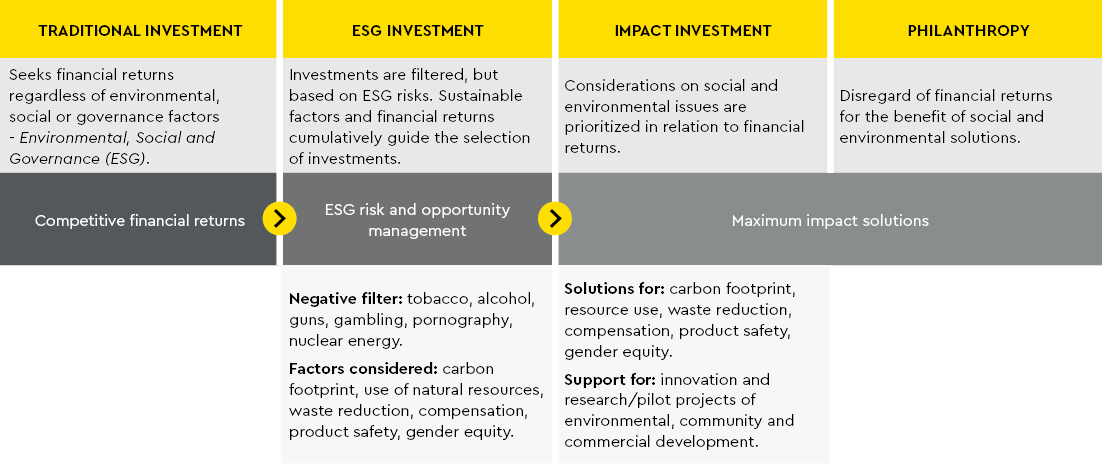
Source: Prepared on the basis of Evolution of an Impact Portfolio: From Implementation to Results, produced by Sonen Capital.
The following diagram simply summarizes different investment structures:
The following table summarises, in a non-exhaustive way, some aspects taken into account in the analysis of an ESG investment:
| ENVIRONMENTAL | Issues related to the preservation, recovery and functioning of the environment and natural resources: ▪ Generation or use of renewable energy sources ▪ Energy efficiency gains ▪ Basic sanitation and waste management |
| SOCIAL | Issues related to the rights and interests of individuals and communities: ▪ Attention to human rights ▪ Enforcement of labor rights and employee relations ▪ Promoting measures to encourage diversity and equal treatment ▪ Relations with local communities ▪ Activities in conflict zones ▪ Health promotion |
| CORPORATE GOVERNANCE | Issues related to the corporate governance of invested companies, other invested entities and their suppliers: ▪ Creation of councils and supervisory bodies ▪ Promoting diversity measures in management frameworks ▪ Disclosure of information ▪ Interactions with related parties ▪ Mechanisms for allocating competences and responsibilities for management ▪ Adoption of ethical standards ▪ Adoption of business strategies that take into account environmental and social criteria ▪ Promotion of best social and environmental and anti-corruption practices internally and externally (with customers and suppliers) |
Source: The emerging financial market verdes in Brazil, Deutsche Gesellschaft für Internationale Zusammenarbeit (GIZ).[4]
Financing entities such as development banks (National Bank for Social Development – BNDES, Banco do Nordeste – BNB, among others), multilateral agencies (World Bank, International Finance Corporation – IFC and Inter-American Development Bank – IDB), export credit agencies and commercial banks already include conditions related to ESG aspects in their investment and financing operations. In such cases, the adhering to ESG principles and the obligation to maintain and observe such principles throughout the duration of the funding are usually essential conditions for defining whether the project will receive funding from the bodies concerned. The form and periodicity of monitoring and monitoring of such adement vary according to the funding entity, but many of them have specific departments to do such monitoring.
Companies can also adhere to ESG principles on their own, regardless of the requirement of third parties or funders. In these cases, they seek certifications specific to their activities, their debt securities and/or projects to be financed.
Certifications can be based on various criteria, both environmental and social, and are tied to the issuers and their projects in which the resources will be used. The Green Bonds Principles and the Climate Bonds Initiative (CBI) are examples of criteria for issuing these certifications for green bonds. Green bonds (or green bonds) are debt securities used by issuers to raise funds for the purpose of implementing or refinancing projects or assets, new or existing, that have positive environmental or climatic attributes (generally defined as green projects) and recognized by a certifying entity.
Based on the Paris Agreement on greenhouse gas emission reduction measures to curb the planet's rising temperature, the CBI proposed common and broad definitions on what should be considered "green" in eight priority sectors in order to standardize and support the growth of a cohesive and consistent global market of green bonds. The sectors are: energy, transportation, water, buildings, land use and marine resources, industry, sewage and waste management, and information technology.[5]
Thus, the CBI created the Certification Scheme of the Climate Bonds Initiative, which establishes the Sector Criteria of the System of Standards and Certification of Climate Bonds, presenting proposals for conditions and eligibility limits that companies and their projects and debt securities must meet in order to be considered green.
Project developer companies can also finance them by issuing encouraged debentures. Law No. 12,431/11 consolidated a privileged tax regime in relation to assets and financial instruments for long-term financing with regard to projects in certain infrastructure and securities sectors that meet some specific requirements.
In relation to the debentures of incentorsins, Law No. 12,431/11 was regulated by Decree No. 8,874/16, which determined that investment projects aimed at the implementation, expansion, maintenance, recovery or modernization of infrastructure projects in the logistics and transportation, urban mobility, energy, telecommunications, broadcasting, basic sanitation and irrigation sectors, as well as projects that provide relevant environmental or social benefits, can be framed as priority projects by the competent ministries for the purpose of issuing such securities.
The encouraged debentures provide some holders with tax benefits for the financing of the project, which, depending on their nature, may or may not be considered green or social and, therefore, subject to environmental and social certifications (such as those of the CBI or Green Bonds Principles) and attract even more investors.
With the increasing support of investors and funders to ESG analyses, the option of obtaining environmental and social certifications should become even more recurrent in project financing structures. In addition, such certifications may be obtained for encouraged debentures in order to increase investor interest in assets that accumulate ESG characteristics and a differentiated financial return.
[1] Google Trends. https://trends.google.com.br/trends/explore?date=today%205-y&q=%2Fm%2F0by114h and https://trends.google.com.br/trends/explore?date=today%205-y&geo=BR&q=%2Fm%2F0by114h . Access on: 10 Mar. 2021.
[2] XP Expert. Impact Investment & ESG: the return of a better world. https://conteudos.xpi.com.br/alternative-week/live/investimento-de-impacto-esg-o-retorno-de-um-mundo-melhor/
[3] Sonen Capital. Evolution of an Impact Portfolio: From Implementation to Results. http://www.sonencapital.com/thought-leadership-posts/evolution-of-an-impact-portfolio/#:~:text=The%20report%2C%20titled%20Evolution%20of,social%20and%20environmental%20impact%20results.
[4] Chalk. The emerging green finance market in Brazil. http://www.labinovacaofinanceira.com/wp-content/uploads/2020/07/mercado_financasverdes_brasil.pdf
[5] Cbl. Climate Bonds Taxonomy. https://www.climatebonds.net/standard/taxonomy