
- Category: Tax
An old and even somewhat forgotten discussion has come to the fore again in recent years. It is the limitation on the taxable base for contributions intended for other entities and funds, commonly called third-party contributions, including Sesi, Senai, Sesc, Senac, Sebrae, Incra, Sescoop, Sest, Senat, and FNDE (education allowance).
The object of the discussion is the validity (or lack thereof) of article 4, sole paragraph, of Law No 6,950/81 - a provision that imposed a limitation on the taxable base for social security contributions and third-party contributions, stipulating that the contribution salary could not exceed the limit of 20 times the highest minimum wage in Brazil.
This is because article 3 of Decree-Law No. 2,318/86 prescribed that the "company's contribution to social security" would not be subject to "the limit of twenty times the minimum wage provided for by article 4 of Law No. 6,950/81."
Taxpayers argue that this decree revoked the application of the limit only for Social Security contributions (the employer's contribution of 20% on payroll) and not for third party contributions (intended for other entities and funds), mentioned in the sole paragraph of article 4 of Law No. 6,950/81.
Considering that article 3 of Decree-Law No. 2,318/86 prohibited application of the limitation only to the company's contribution to Social Security, the theory that the limitation continues to be applied to "quasi tax contributions" destined to other entities and funds is defended.
In our view, article 3 of Decree-Law No. 2,318/86 was not intended to revoke article 4. We explain: the rule did not simply repeal article 4 of Law No 6,950/1981, which could lead to the conclusion that the entire provision - including the single paragraph dealing with the limit on third-party contributions - was repealed.
Article 3 of Decree-Law No. 2,318/86 prescribed that the calculation of the contribution due to Social Security (defined in the head paragraph of article 4 of Law No. 6,950/81) "is not subject to the limit of twenty times the minimum wage." In our opinion, with the promulgation of this article, the limit corresponding to 20 times the highest minimum wage in force in Brazil is no longer applicable to contributions due to Social Security (employer contributions).
We also believe that Decree-Law No. 2,318/86 did not prohibit application of the limit of 20 minimum wages for third party contributions, since it did not provide for the revocation of such limit, as provided for in the sole paragraph of article 4 of Law No. 6,950/81.
In other words, the limitation provided for in the sole paragraph of article 4 of Law No. 6,950/81 remained unchanged: the taxable base for contributions due to other entities and (quasi tax) funds linked to compliance with the limit of 20 minimum wages was maintained.
According to the General Theory of Law, a law is valid, in force, and effective until it is repealed or modified by another, which, as it seems to us, did not occur in the present case. Repeal by a subsequent law may occur in the following manners: (i) express revocation (by express declaration) or (ii) tacit revocation (when the new law is not compatible with the content of the old law dealing with the same matter or when it entirely regulates the matter dealt with in the prior law).
However, none of these situations seems to have occurred in relation to the sole paragraph of article 4 of Law No. 6,950/81, since: (i) there was no provision for temporary validity for the sole paragraph of article 4 of Law No. 6,950/81; (ii) no law was published that expressly repealed the sole paragraph of article 4 of Law No. 6,950/81; (iii) there has been no publication of a law incompatible with the determination contained in the sole paragraph of article 4 of Law No. 6,950/81; and (iv) there was no publication of a law fully regulating the matter disciplined by the sole paragraph of article 4 of Law No. 6,950/81.
The Federal Government, for its part, has argued that the repeal of the limit for social security contributions was extended to the taxable base for social contributions for other entities and funds (third party contributions). According to the Federal Government, one could not be allowed to repeal only the head paragraph of article 4, keeping its sole paragraph isolated. For the Federal Government, the repeal of the head paragraph of article 4 would entail automatic repeal of its sole paragraph.
An analysis of the precedents on the matter shows that, within the Superior Court of Courts (STJ), the issue was reviewed in REsp No. 953.742 in 2008. The appeal was decided in favor of taxpayers by the 1st Panel of the STJ's 1st Section. After this judgment, it is also possible to find sole judge decisions handed down by STJ in the same direction favoring taxpayers in 2014, 2017, and 2019. In these decisions, the STJ seems to concur with the taxpayers' arguments, showing that it adheres to the understanding that Decree-Law No. 2,318/86 repealed only the limitation on social security contributions (employer's payroll contribution at the rate of 20%) and not on third-party contributions, mentioned in the sole paragraph of article 4 of Law No. 6,950/1981.
More recently, the First Panel of the STJ reaffirmed this understanding in the judgment of AgInt no REsp 1.570.980/SP, causing positive expectations among taxpayers, especially after the Federal Supreme Court (STF) decided, in the context of an appeal heard due to general repercussion, on the constitutionality of the contribution to INCRA, in accordance with Constitutional Amendment No. 33/01 - another issue related to the legitimacy of assessment of third-party contributions.
But even with the precedents handed down thus far by the STJ, which are mostly favorable to taxpayers, it is not yet possible to state that there is firm case law in their favor, either because of the small number of precedents or because there is no precedent derived from a judgment of a binding nature.
Sensitive to the need for unification of precedents, and also because of the considerable increase in cases involving the matter, the Superior Court of Appeals, on the eve of the judicial recess, bound Special Appeal No. 1,898,532[1] to the system for repetitive appeals (repetitive topic No. 1,079).
This means that the 1st Section of the STJ, the body that brings together the Justices of the 1st and 2nd panels and that deals with tax matters, will review the issue and, in a judgment that will be binding in nature, must definitively resolve the discussion.
In any event, in view of the not yet definitive scenario of the case law on the limitation imposed by article 4, sole paragraph, of Law No. 6,950/81 for determining the taxable base for third-party contributions and while Special Appeal No. 1.898.532 has not been ruled on, there is a high chance of questioning by the tax authorities if the taxpayer, on its own account and without the support of judicial authorization, calculates such contributions based on said limit and/or appropriates credits in connection with any past indebtedness.
The adoption of a more conservative stance - the filing of a lawsuit, for example - deserves to be evaluated, especially considering that the precedents handed down thus far by the STJ seem to be favorable to taxpayers.
In our opinion, this may be relevant to any decision by the bodies of the Judiciary to grant provisional judicial authorization to the taxpayer (via emergency relief or preliminary injunctive relief in an application for mandamus) to ascertain and collect the contributions of third parties based on the application of the limit of the taxable base to the value of 20 minimum wages.
The filing of a lawsuit would also allow interruption of the statute of limitations, such that, at the end of the lawsuit and in the event of success, the taxpayer could achieve recognition of the right to offset/refund of the undue payment made as of the fifth year prior to the filing date.
[1] Civil procedure. Special appeal. Code of civil procedure of 2015. Applicability. Proposal of binding effect as representative of the controversy. Tax. "Quasi tax contributions." Taxable base. Ascertainment. Application of the ceiling of twenty (20) minimum wages. Law No. 6,950/1981 and Decree-Law No. 2,318/1986.1. Delimitation of the question of law at issue: to define whether the limit of twenty (20) minimum wages is applicable to the taxable base of "quasi tax contributions collected on behalf of third parties," in accordance with article 4 of Law No. 6,950/1981, as its text was amended by articles 1 and 3 of Decree-Law No. 2,318/1986. 2. Special appeal submitted to the repetitive appeals system, in joint assignment with REsp n. 1.905.870/PR. (ProAfR no REsp 1898532/CE, opinion drafted by Justice Regina Helena Costa, first section, decided on December 15, 2020, DJe December 18, 2020).

- Category: Litigation
Law No. 11211/20, signed on December 24, introduced various changes in the Bankruptcy and Judicial Reorganization Law (Law No. 11,101/05 or the LRF). Among the main ones are those related to the role of the judicial trustee, whose main functions are to assist the court, caring for the good progress of the case, and to supervise the debtor's acts and compliance with the judicial reorganization plan.
The duties of the judicial trustee were expanded, notably due to the other innovations of the LRF, such as the possibility for creditors to present an alternative judicial reorganization plan, the express provision for the use of conciliation and mediation mechanisms, and the regulation of transnational bankruptcy.
The judicial trustee's duties may be divided among those (i) common to judicial reorganization and bankruptcy; (ii) exclusive to judicial reorganization; and (iii) exclusive to bankruptcy.
With regard to the common attributions, the LRF charged the judicial trustee with stimulating alternative methods of dispute resolution, such as conciliation and mediation. Although this provision is a novelty in the LRF, in practice, based on the Mediation Law, Resolution No. 125/2010 of the Judicial Review Board (CNJ) and an ordinance issued by state courts, mediation has long been applied in various cases of judicial reorganization, such as those of Oi and Saraiva, for which mediation was used to resolve various conflicts during the proceeding regarding the reorganization plan, debt claims, and bilateral disputes.
In addition, keeping in line with the digital era, it is now up to the judicial trustee, per provision of law, to maintain an electronic address on the Internet, through which updated information on the proceedings should be made available and requests for qualification and divergences of debt claims should be sent, which facilitates the monitoring of the judicial reorganization by creditors.
In the scope of the judicial reorganization, the judicial trustee also had the scope of its functions extended, mainly in relation to:
- inspecting the veracity and conformity of the information provided by the debtor to prepare the monthly activity report, the negotiations between debtors and creditors (ensuring that the parties not adopt dilatory or prejudicial arrangements) and the decisions of the general meetings passed by means of a consent form, electronic voting, or some other suitable mechanism (article 39, paragraph 5);
- submitting for a vote, in a general meeting of creditors rejecting the judicial reorganization plan proposed by the debtor, the granting of a 30-day period for the creditors to present their judicial reorganization plan (article 56, paragraph 4);
- submitting within 48 hours a report of the creditors' responses regarding the holding of a general meeting to resolve on the sale of assets, therein requesting the convening thereof.
The new powers of the judicial trustee in bankruptcy include:
- presenting, within 60 days of their investiture, a detailed plan for realization of the assets;
- selling all the assets of the bankrupt estate within a maximum period of 180 days, counted from the date of the filing of the notice of collection, under penalty of dismissal, except for reasoned impossibility, recognized by a judicial decision;
- in the event of insufficiency of the assets for the costs of the proceedings, promote sale of the assets collected within a maximum period of 30 days (for personal property) and 60 days (for real property), if the creditors do not request continuation of the bankruptcy; and
- collecting the amounts of deposits made in administrative or judicial proceedings in which the bankrupt is a party and which arise from attachments, freezes, seizures, auctions, judicial sales, and other cases of judicial constriction, with the exception of deposits of federal taxes.
One of the LRF's greatest innovations is the regulation of transnational bankruptcy proceedings, in which the performance of the judicial trustee is very relevant. It has authorization to appear in foreign judicial proceedings in the capacity of representative of the Brazilian judicial proceedings, in the event of bankruptcy, and obligation to cooperate and communicate with the foreign authority and with the foreign representatives.
The purpose of the changes in the judicial trustee's duties is to increase the participation of the court clerk’s office and allow it to act in a timely manner, which will end up increasing its responsibilities and its work. Although the novelties are beneficial to the system as a whole, because they increase legal certainty and speed up bankruptcy proceedings, they may discourage those interested in filling this position, especially because of the obligation to confirm the veracity of the debtor company's information.
In any event, it is expected that the actions of the judicial trustees will be under greater scrutiny, and it is up to the Judiciary, the creditors, the debtor, and the company as a whole to demand smoothness, speed, and commitment from the clerks of course in the performance of their duties.

- Category: Labor and employment
Algorithms are sequences of actions to be performed by software to solve a problem or achieve a certain result. They are used, for example, to automatically search for previously defined profiles in extensive databases in order to obtain specific data for a search, application, replacement of vacancy, and even diagnosis of diseases.
For the data to be obtained by the algorithm, it is essential to have a person responsible for defining the structure of the basis on which the data will be stored and a person responsible for supplying it, even based on virtual sensors, considering the parameters previously established. Human participation necessarily occurs at some of these moments, either to define the guidelines applicable to the algorithm or organize, develop, and govern the information.
There are various examples of the use of algorithms in labor relations, such as automatic review of job applicants' resumes or monitoring of employees' activities according to productivity targets set by the company for the purposes of bonuses or dismissal.
The question, however, is whether the use of algorithms alone is incompatible with Law No. 13,709/18, the General Data Protection Law (LGPD), which provides for the processing of personal data, including in digital media, by individuals or legal entities, in order to safeguard the privacy of data holders.
Before assessing any compliance situation, it is necessary to identify whether personal, sensitive, or anonymous data are involved, and whether these data are based on the LGPD for their processing.
Personal data may only be used in the following cases: fulfillment of a legal obligation, performance of studies by a research organization, performance of a contract or preliminary procedures related to the contract to which the data subject is a party, regular exercise of rights, legitimate interest, protection of credit, processing and shared use of data necessary for the execution of public policies, protection of life, protection of health, and by consent.
Sensitive data, on the other hand, cannot be used in the following cases: performance of a contract and protection of credit (if there is no consent from the data subject) and legitimate interest, but only in the other cases or to ensure prevention of fraud and security of the data subject in the processes of identification and authentication of registration in electronic systems.
If the data processed by the algorithm is anonymized and therefore cannot be identified, it will not be considered personal or sensitive and may be used. Considering that most algorithms process anonymized data, it is commonly understood that they do not have any prohibition on processing in the legislation, but this view is largely mistaken.
Anonymized data does not prevent certain processing of data from being considered discriminatory, which is prohibited by articles 3, subsection IV, and 5, subsection XLI, of the Federal Constitution and 6, subsection IX, of the LGPD. It must be kept in mind that algorithms, even if anonymous, are not impartial and may reflect prejudices rooted in the history of the data, as demonstrated by various recently reported cases that should be reviewed by companies.
The problem of algorithmic discrimination through the use of biased databases can still originate in data collection, including with human participation, and this situation has become increasingly common. For this reason, the Labor Prosecutor's Office has recently set up a group against algorithmic discrimination in order to investigate companies that use biased algorithms. It is called machine bias or algorithm bias.
The removal of biased algorithms is an issue that has been widely discussed by companies, which should review governance and human participation in the use of technology to legitimize it.
Facebook recently announced the launch of a board of experts from around the world with multidisciplinary and multicultural background, called Oversight Board Administration. This board is currently composed of 20 members and will be responsible for defining, for example, what type of content should or should not be removed from the social network, according to what is considered inappropriate, irrelevant, or excessive. It is an independent body that seeks to enhance the integration between the human being and artificial intelligence.
Another problem identified in the algorithms that process seemingly anonymized data refers to the decisions arising from their use. According to article 20 of the LGPD: “The data owner has the right to request review of decisions made solely on the basis of automated processing of personal data affecting his interests, including decisions to create his personal, professional, consumer, and credit profile or aspects of his personality.”
This means that if a certain algorithm has led to discriminatory treatment of the employee, both for recruitment and dismissal purposes, for example, the company must respect the principle of transparency, provided for in article 6, VI of the LGPD, and provide all necessary information on the processing of the data on which the decision was based, under penalty of being audited by the National Data Protection Authority (ANPD).
To confirm the legality of the algorithms, therefore, two questions must be taken into consideration and analyzed with great caution: classification of the data indicated (whether personal, sensitive, or anonymous) and whether they are legitimately presented in this manner.
Otherwise, the companies will be in breach of the LGPD and must review the use of the technology in accordance with the guidelines of the new regulation, under penalty of being subject to the administrative sanctions provided for by law (the application of which may occur as of August 1, 2021), as well as the payment of compensation for moral damages in the event of litigation in the labor sphere.

- Category: Restructuring and insolvency
Law No. 14,122, published on December 24 in the Official Gazette, updates the legislation on in-court reorganizations, out-of-court reorganizations, and bankruptcy of entrepreneurs and business companies. The text derives from Bill 4,458/20, which was approved by the Senate on November 25 and suffered some vetos by the President of Brazil.
To reflect the wording of the new law, we update below the table published on December 8 with the main points of change in the institutes of the current reorganization and bankruptcy legislation.
Analysis of the main changes |
|
|
Law No. 11,101/05 before Law No. 14,112/20 |
Law No. 11,101/05 after Law No. 14,112/20 |
|
Stay period · After the petition for judicial reorganization is granted, the stay period begins, an interval of 180 days for suspension of executions and acts of constriction against the debtor by creditors subject to the proceeding, which is intended to give breath to the negotiation of the judicial reorganization plan. · This period would be non-extendable under the LRF, but case law has admitted extension, occasionally even more than once, when the vote on the plan does not take place within 180 days for acts not attributable to the debtor. For reference, votes on plans for reorganizations in progress in the State of São Paulo have taken an average of 517 days, according to data from the 2nd Phase of the Bankruptcy Observatory of NEPI-PUC/SP and ABJ. · Bankruptcy-exempt creditors and the tax authorities are not affected by the stay period a priori. However, constrictions and foreclosures of essential capital goods are prohibited in such a period. According to the Superior Court of Appeals (STJ), the competent court to decide on the matter is that of the judicial reorganization. · There is no legal provision for a stay period in relation to mediation or out-of-court reorganization. |
Stay period · It expressly provides for the possibility of extending the stay of 180 days, for an equal period and a single time, provided that the failure to vote on the plan is not attributed to the debtor in possession. · The stay period may be extended a second time if creditors submit an alternative judicial reorganization plan, in the cases provided for in article 6, paragraph 4-A, and article 56, paragraph 4. (article 6, paragraph 4 and 4-A) · The stay period will continue to start from the granting of the processing of the case, but in the event of urgency, in limine relief may be granted for its effects to begin, in whole or in part, as of the filing of the case. · The rule regarding the possibility of execution and constriction by the tax authorities and bankruptcy-exempt creditors will continue. There will be an express legal definition of the jurisdiction of the court overseeing the reorganization to deal with the issue of essential capital goods in article 6, paragraphs 7 and 7-A. · There will be a legal provision for a stay period in the prior mediation and extrajudicial reorganization (for more details, see item on the subject, below). |
|
Prevention of the court · The rule of jurisdiction of the court by prevention did not cover requests for approval of out-of-court reorganization plans previously filed, although case law already recognized this possibility on the basis of an expansive interpretation of the rule. |
Prevention of the court · The assignment a petition for an out-of-court reorganization plan will also result in preventive jurisdiction of the court for any other bankruptcy, judicial reorganization, or out-of-court reorganization petition concerning the same debtor (article 2, paragraph 8). |
|
Arbitration agreement · The LRF is silent on this point, but case law already required companies in crisis to respect arbitration agreements. |
Arbitration agreement · The need to respect the arbitration agreement by the debtor in possession or bankrupt party, represented by the judicial trustee, will be established in positive law (article 6, paragraph 9). |
|
Distribution of profits or dividends · The LRF does not have provisions on the subject. |
Distribution of profits or dividends · Until the approval of the judicial reorganization plan, the debtor will be prohibited from distributing profits or dividends to partners and shareholders (article 6-A) |
|
Verification and registration of claims · Such provisions are listed in articles 7 to 20 of the LRF, and there are no express previsions regarding what happens with the registrations and objections in course, in the event of closure of the judicial reorganization. |
Verification and registration of claims · There will be an express rule as to the possibility of closing the judicial reorganization even if the General Table of Creditors has not been approved. With this, late registrations and objections will be reassigned to the judicial reorganization court as autonomous actions through the common procedure, and late registrations will have the competent credit reserve (article 10, paragraphs 7 to 9). · There will be specific treatment for registration of tax debts in the bankruptcy (article 7-A). · In the event of bankruptcy, there will be a three-year lapse period, counted from the decree of bankruptcy, for registrations and requests for a credit reserve (article 10, paragraph 10). · Apportionment in bankruptcy may occur even if the General Table of Creditors is not formed, provided that the class of creditors to be satisfied has already had all the judicial objections filed within the term provided for in article 8, except for the reserve of the disputed credits due to the delayed registration of credits distributed until then and not yet judged (article 16). |
|
Assignment of credits · Practice possible, but not regulated in the LRF. In bankruptcy, the assignment of labor debts denatures their characteristics, and the claim becomes unsecured. |
Assignment of credits · Promise of assignment or assignment must be immediately reported to the court overseeing the reorganization (article 39, paragraph 7). · In bankruptcy, any assignment of a credit will maintain the classification and characteristics of the credit (article 83, paragraph 5). |
|
Conciliation and mediation
· The LRF does not govern the practice of conciliation and mediation prior or incidental to a judicial reorganization proceeding. In practice, mediation has already been adopted in some judicial reorganizations, especially with a view to speeding up the procedures related to ancillary proceedings for verification of credits and to defining the means of reorganization and payment conditions to be arranged in the judicial reorganization plan. |
Conciliation and mediation
· Conciliation and mediation should be encouraged before and during judicial reorganization, at any level of appeal (article 20-A). · It will be possible to obtain urgent relief for the suspension of executions against the debtor for a period of up to 60 days prior to the filing of the judicial reorganization, for an attempt to reach a settlement with its creditors in a mediation or conciliation proceeding already instituted before the Judicial Center for Settlement of Conflicts and Citizenship. In the event of a subsequent request for judicial or extrajudicial reorganization, the time limit will be deducted from the stay period provided for in article 6 of the LRF (article 20-B, paragraphs 1 and 3). · Conciliation and mediation on the legal nature and classification of credits, as well as on voting criteria at the General Meeting of Creditors (GMC) will be prohibited (article 20-B, paragraph 2). · Settlements reached through conciliation or mediation must be approved by the competent court (article 20-C). · If judicial or extrajudicial reorganization is requested within 360 days as of the settlement signed in the conciliation or pre-trial mediation, the rights and guarantees of the creditors will be reconstituted on the terms originally contracted, with the exception of acts validly performed within the scope of the proceeding (article 20-C, sole paragraph). |
|
Role of the judicial trustee · Although it is currently common practice, there is no legal provision obliging judicial trustees to maintain a website with information on the proceedings in which they serve. · The judicial trustee is not obliged to certify the veracity of the information provided by the debtor, nor to supervise the negotiations held between debtors and creditors. · There is no provision for alternative methods of deliberations by creditors (e.g., by means of an consent form or electronic voting) and, therefore, there is no legal obligation for the judicial trustee to supervise such acts. · Obligation to sell the assets of the bankrupt estate has no time limit. The judicial trustee will request that the judge sell in advance perishable goods, which are deteriorable or subject to considerable devaluation or to risky or costly conservation. In addition, there is no express obligation for the judicial trustee to collect in bankruptcy the amounts of deposits in proceedings to which the bankrupt is a party, although it is currently understood that this is an implicit obligation. · There is no provision for cooperation mechanisms for transnational bankruptcy proceedings. |
Role of the judicial trustee · The judicial trustee will encourage mediation, conciliation, and other alternative methods of dispute resolution. · The judicial trustee will maintain an e-mail address with updated information on bankruptcy and judicial reorganization proceedings, with the main filings in the proceedings and monthly activity reports, and on the judicial reorganization plan, as well as for receipt of registrations and disagreements in the administrative sphere, unless a court decision to the contrary is entered. · The scope of the judicial trustee's duties under the judicial reorganization process will be broadened, notably (i) to inspect the veracity and conformity of the information provided by the debtor for purposes of preparing the monthly activity report; (ii) to inspect the negotiations between debtors and creditors, ensuring that the parties do not adopt dilatory or prejudicial arrangements; (iii) to inspect, by means of issuance of an opinion regarding their good standing, the decisions of the GMC by means of a consent form, electronic voting, or some other suitable mechanism (article 39, paragraph 5); (iv) to submit for a vote at the GMC that rejects the judicial reorganization plan proposed by the debtor the granting of a 30-day period for presentation of the judicial reorganization plan by the creditors (article 56, paragraph 4); (v) to submit within 48 hours a report of the creditors' responses regarding the holding of a General Meeting to resolve on the sale of assets, requesting its call. · The scope of the judicial trustee's duties within the scope of the bankruptcy proceedings will be broadened, namely: (i) the obligation to submit within 60 days of its appointment a detailed plan for realization of the assets; (ii) proceed with sale of all assets of the bankrupt estate within a maximum period of 180 days, as of the date of the filing of the notice of filing of the notice of collection, under penalty of dismissal, except for justified impossibility, recognized by a court decision; (iii) in the event of insufficiency of the assets for the expenses of the proceedings, procure sale of the attached assets within a maximum period of 30 days, for personal property, and 60 days, for real property, if the creditors do not request continuation of the bankruptcy; (iv) to collect the amounts of the deposits made in administrative or judicial proceedings in which the bankrupt appears as a party, arising from attachments, freezes, seizures, auctions, judicial sales, and other events of judicial constriction, with the exception of the deposits of federal taxes. · There will be provision for actions in the scope of transnational bankruptcy proceedings, notably (i) authorization to appear in foreign judicial proceedings in the capacity of representative of the Brazilian judicial proceedings, in the event of bankruptcy; and (ii) obligation of cooperation and communication with the foreign authority and with the foreign representatives. |
|
GMC · In person is the rule provided for in the LRF, but because of the covid-19 pandemic, virtual GMCs were admitted by the case law, including with the issuance of Recommendation No. 63 by the National Judicial Review Board (CNJ) in this regard. |
GMC · It may be virtual and may also be replaced, with the same effect, by a consent signed by creditors who meet the specific approval quorum or other mechanism deemed sufficiently secure by the judge (article 39, paragraph 4). · In addition to the duties provided for in the LRF, it may resolve on the approval of disposal of assets or rights of the debtor's non-current assets, not provided for in the judicial reorganization plan (article 35, item g). |
|
Abusive vote · There is no specific provision in the LRF, but there are decisions in which so-called abusive votes from significant creditors were disregarded whose contrary votes would prevent the achievement of the plan's quorum for approval. |
Abusive vote · Legal provision that the vote will be exercised by the creditor in the interest and in accordance with its judgment of advisability and declared null and void for abusiveness only when manifestly exercised to obtain an illicit advantage for itself or others (article 39, paragraph 6). |
|
Judicial reorganization of a rural producer · The LRF does not regulate the possibility for individual rural producers to request judicial reorganization. There is a divergence in the case law regarding whether the registration of rural producers is a declaratory or constitutive in nature and, therefore, whether the period of activity prior to registration must be taken into account in order to fulfill the requirement of at least two years of activity provided for in the head paragraph of article 48 of the LRF and whether or not the debts taken on prior to registration are subject to the judicial reorganization. |
Judicial reorganization of a rural producer · It will be defined that rural producers acting as individuals will be able to request judicial reorganization. · The special plan for rural producers may not involve debts of more than R$ 4.8 million (article 70-A). · Proof of the two-year period of activity established in the head paragraph of article 48 will be admitted through the Tax Accounting Book (ECF), or legal obligation to keep accounting records that may replace it (in the case of rural activity exercised by a legal entity), the Rural Producer Digital Cash Book (LCDPR), or legal obligation of accounting records that may replace it, the Income Tax Return, and balance sheet (in the case of rural activity exercised by an individual) (article 48, paragraphs 2 and 3). · Only credits arising exclusively from rural activities, even if not past due, will be subject to judicial reorganization (article 49, paragraph 6). · Appeals controlled and covered under articles 14 and 21 of Law No. 4,829/65 (article 49, paragraph 7) will not be subject to the effects of judicial reorganization. However, if they have not been renegotiated before the application for judicial reorganization, in the form of an act of the Executive, such credits will be subject to the effects of the plan (article 49, paragraph 8). · Credits relating to debts incurred in the last three years prior the request for judicial reorganization, as well as the respective guarantees, will not be subject to judicial reorganization (article 49, paragraph 9). |
|
Means of judicial reorganization
· The conversion of debt into capital (only the increase in share capital) is not expressly provided for, but is a means of reorganization used. · There is no provision for full sale of the debtor. |
Means of judicial reorganization · The conversion of debt into capital will now be included in the list of article 50 of the LRF and there will be no risk of succession or liability for debts to third parties. · The same rule of absence of liability and succession will be express for officers and directors who replace former officers and directors as a means of reorganization and for creditors who make contributions of funds (article 50, paragraph 3). · The creditors' alternative plan may also provide for the capitalization of credits, including foreign exchange of control, allowing the debtor's partner the right to withdraw (article 56, paragraph 7). · Full sale of the debtor: it will become a means of reorganization provided for in the list of article 50 of the LRF and can be used when the situation of the creditors who are not subject to the proceedings and who are not members is at least the same as it would be in a bankruptcy. In this scenario, the rule of absence of succession of the isolated productive unit (UPI) will be applied. |
|
Prior finding
· There is no legal provision for prior finding. · In practice, some judges order the holding of a prior finding before the granting of judicial reorganization, in line with Recommendation No. 57 of the National Judicial Review Board (CNJ). |
Prior finding · The prior finding will be provided for in the LRF, allowing the judge to carry it out when he deems it necessary (article 51-A). · The expert appointed by the judge will have no more than five days to submit a report issuing findings on the actual operating conditions of the debtor and the good order of the documentation submitted with the complaint (article 51-A, paragraph 2). · Dismissal of the processing of the judicial reorganization based on an analysis of the debtor's economic feasibility will be prohibited (article 51-A, paragraph 5). · If the preliminary finding detects strong evidence of fraudulent use of the judicial reorganization, the judge may reject the application, without prejudice to the issuance of an official letter to the Public Prosecutor's Office to take any criminal action that may be appropriate (article 51-A, paragraph 6). · If the prior finding shows that the debtor's principal place of business is not within the court's jurisdiction, the judge should order the case to be referred urgently to the competent court (article 51-A, paragraph 7). |
|
Alternative plan proposed by the creditors · There is no provision in this regard. Only the debtor may propose a plan for judicial reorganization, and any proposal for change made by creditors must have the debtor's express agreement. Rejection of the plan without meeting the requirements for a cram down entails conversion of the judicial reorganization into bankruptcy. |
Alternative plan proposed by the creditors · Creditors may submit an alternative plan if the debtor, after the extension of the stay period, is unable to put a plan to a vote or if, after the rejection of the plan at the GMC, the creditors vote for the granting of a 30-day period to do so, in which case the alternative plan must be voted on within 90 days of the GMC that decided on the submission of the plan. · The alternative plan should have a specific quorum of support from creditors representing, alternatively, more than 25% of the total credits subject to judicial reorganization or more than 35% of the credits of the creditors present at the GMC that decided to submit an alternative plan (article 56, paragraph 6, III); there may be no new obligations not provided for by law or in prior agreements with the debtor's partners; there will be a provision for exemption from personal guarantees provided by individuals with respect to credits held by creditors who supported/voted in favor of the alternative plan, which may not impose greater sacrifice on the debtor and its partners than that which would result from liquidation in bankruptcy (article 56, paragraphs 4 to 9). · The plan proposed by the creditors may provide for the capitalization of the credits, including the consequent change in the control of the debtor, allowing the exercise of the right of withdrawal by the debtor's partner (article 56, paragraph 7). · The alternative plan will only apply to judicial reorganizations filed after the entry into force of Law No. 14,112/20. |
|
Labor credits · They must be discharged within up to one year, and five minimum wages per employee of the strictly wage credits due in the three months preceding the claim must be paid within 30 days. |
Labor credits · The five minimum wages rule mentioned above will be maintained and the remainder may be paid within up to two years, provided that the plan, at the discretion of the judge: (i) provides sufficient guarantees; (ii) has been approved in class I; and (iii) guarantees payment of all labor credits (article 54, paragraphs 1 and 2). |
|
Sale of assets · UPI: there is no legal definition of what is an isolated productive unit (UPI). The no-succession rule exemplifies only tax and labor obligations and, following the example of IA 2237160-80.2019.8.26.0000 of the TJSP, most of the judgments hold that the sale must be made by some form of competition per article 142 of LRF to guarantee the absence of succession (there is, however, already a precedent of the STJ allowing another type of sale of a UPI within a judicial reorganization, provided it is authorized by a special quorum and indicating that the rule of absence of succession should prevail: REsp 1.689.187-RJ). · Assets: if there is no provision in the plan, the sale and encumbrance of assets require the judge's authorization, after hearing the creditors' committee (if any), and the judge must analyze the evident usefulness of the transaction. · Rule of succession: the general rules of succession of the acquirer in the sale of assets apply in reorganization proceedings not carried out in the form of a UPI. · Means of competition: auction, tender, and closed bid. · Price: Discussions regarding inadequate price are not uncommon. · Summons: summons of the Public Prosecutor's Office is mandatory. · Third party in good faith: no express provision in the LRF protecting their interests. |
Sale of assets · UPI: there will be legal definition (goods, rights and assets, tangible or intangible, such as corporate interest), the examples of absence of succession will continue to cite only the tax and labor ones, and the obligation to follow one of the competition modalities of article 142 of the LRF will continue (articles 60 and 60-A). · Assets: if there is no provision in the plan, sale and encumbrance of non-current assets (this is the novelty) will require the authorization of the judge, after hearing the creditors' committee, if any (the requirement of evident utility will cease to exist). Creditors with a joint claim in excess of 15% of the total amount of the liabilities, if they provide a bond and provided that they present justified reasons, may request a GMC to resolve on the matter, and the judicial trustee will explain the matter to the judge, convening a GMC, if the requirements are met. All this should be done quickly, in accordance with the legal deadlines and in the least costly manner, with the objecting creditors bearing the associated costs. · Rule of succession: all forms of divestiture made in accordance with the law shall be considered judicial sale for all purposes and effects. · Means of competition: article 142 of the LRF will provide for an electronic auction, a competitive process organized by a specialized agent of unblemished reputation and any other modality approved under the law. · Price: there can no longer be any discussion of a negligible or inadequate price. A third party contesting the sale must make or present a firm offer from a third party and a guarantee 10% of the value of the offer. Raising an undue objection on any point will be an act that undermines the dignity of justice. · Summons: a summons of the Public Prosecutor's Office and the tax authorities will be mandatory. · Third party in good faith: the sale of assets or guarantee granted by the debtor to a bona fide purchaser or lender, provided that it is carried out by express judicial authorization or provided for in an approved judicial or extrajudicial reorganization plan, may not be annulled or rendered ineffective after the consummation of the legal transaction with the receipt of the corresponding funds by the debtor. |
|
Partner or supporting creditor · Doctrinal and jurisprudential creation based on the spirit of article 67 of the LRF, which allows, based on the provisions in the plan and with justifications, that a certain creditor, named partner, or supporter, has privileged treatment in judicial reorganization in relation to other creditors of the same class. |
Partner or supporting creditor · Article 67, sole paragraph, will permit differentiated treatment of credits subject to judicial reorganization for suppliers of goods or services that continue to provide them normally after the application for judicial reorganization, provided that such goods or services are necessary for the maintenance of the activities and that the differentiated treatment is appropriate and reasonable as regards the future business relationship. |
|
DIP financing · The treatment provided for in article 67 of the LRF is insufficient and does not provide the necessary super priority. Thus, the vast majority of cases of financing that have existed in Brazil have always relied on guarantees, especially those of a fiduciary nature, and contractual arrangements for obtaining super-priority. · There is also no express provision in the LRF protecting third parties in good faith. · There is no provision in the LRF authorizing the creation of a subordinated guarantee on assets of the debtor without the consent of the holder of the original guarantee. · Experience shows that DIP financing cases ended up involving much litigation. |
DIP financing · Superpriority will be provided for by law (article 84). · Article 69-B will provide that a change in the level of appeal against the decision authorizing the engagement may not alter the bankruptcy-exempt nature or the guarantees given by the debtor to the lender in good faith, if disbursement has been made. · Article 69-C will authorize the establishment of a subordinated guarantee on one or more of the debtor's assets in favor of the lender of a debtor under judicial reorganization, waiving the consent of the holder of the original guarantee, with the proviso that the subordinated guarantee, in any event, will be limited to any excess resulting from the disposal of the asset subject to the original guarantee and that such provision will not apply to any type of fiduciary sale or fiduciary assignment. · Article 69-E will provide that financing may be provided by any person, including family members, partners, and members of the debtor’s group. · Article 69-D will provide that, in the event of conversation of the reorganization into bankruptcy, the financing agreement will be considered automatically terminated and the guarantees provided and preferences will be preserved up to the limit of the amounts actually delivered to the debtor before the date of the judgment that converted the judicial reorganization into bankruptcy. |
|
Procedural and substantive consolidation · Not regulated in the LRF. · Procedural consolidation is allowed on the basis of the rules for joint litigation in the Code of Civil Procedure (CPC), which apply where not incompatible with bankruptcy procedure, pursuant to article 189 of the LRF. · Substantive consolidation has divergent case law regarding the requirements, the competence of the decision on the subject, criteria, and quorums applicable to voting. |
Procedural and substantive consolidation · The LRF will have a provision stipulating the competent court, the requirements, the necessary documentation, and the form of voting in case of procedural consolidation (article 69-G). · The decision on the substantial consolidation may, exceptionally, be made by the judge and the requirements for its acceptance will be the finding of interconnection and confusion between assets or liabilities of debtors belonging to the same economic group, such that it is not possible to identify their ownership without excessive expenditure of time or resources, through the finding of at least two of the following events (i) existence of cross guarantees; (ii) relationship of control or dependency; (iii) identity of the corporate structure; and (iv) joint action in the market, which has generated criticism of the bill (article 69-J). · In case of substantive consolidation, there will be immediate extinguishment of fiduciary guarantees and credits held by one debtor against the other (article 69-K). · There will be a rule providing that secured guarantees will not be prejudiced in substantive consolidation, except with the approval of the holder (article 69-K). |
|
Possibility for the tax authorities to file for bankruptcy of the debtor · Although article 97, IV, of the LRF provide that any creditor may file for bankruptcy of the entrepreneur and of the business company, the currently settled understanding of the STJ is to the effect that the Public Treasury does not have standing to file for bankruptcy for companies and/or businessmen. · However, in an extended judgment held in August of 2020, the 1st Chamber of Business Law of the Court of Appeals of the State of São Paulo (TJSP), by majority vote, upheld the appeal so as to (i) annul the decision that had rejected the complaint and extinguished the proceeding without a resolution of the merits, on the grounds that the National Treasury had no procedural interest; and (ii) order the regular continuation of the petition for bankruptcy filed by the Federal Government, represented by the Attorney’s Office for the Federal Revenue Service, against a company engaged in the trade and distribution of food products. · The TJSP emphasized that, in the case at hand, the petition for bankruptcy was not based on article 94, subsection I of the LRF (whose more restrictive understanding should prevail) but on article 94, subsection II, since the Federal Revenue Service, although it filed for a tax foreclosure, has not located sufficient assets of the debtor to satisfy the debt. Having exhausted the means to satisfy its claim, it would not be possible to withdraw from the public body the possibility of filing for bankruptcy of the debtor. |
Possibility for the tax authorities to file for bankruptcy of the debtor · The tax authorities may petition for judicial reorganization of the debtor in bankruptcy if (i) there is nonperformance of the installment payments of the debts provided for in article 68 of the LRF or the transaction provided for in article 10-C of Law No. 10,522/2020; or (ii) when the debtor's assets are identified as being depleted, resulting in substantial liquidation of the company, to the detriment of creditors not subject to the judicial reorganization, as is the case of the Public Treasury. · Depletion will be considered substantial when assets, rights, or future cash flow projections are not reserved sufficient to maintain economic activity for the purpose of fulfilling its obligations. · It will be excepted expressly that, in the event that bankruptcy is decreed by the substantial depletion of the company, the disposals made will be preserved and considered effective, so as not to harm a bona fide third party purchaser. The proceeds of such disposals, on the other hand, should be blocked, with the consequent return to the debtor of the amounts already distributed to any creditors, which will now be available to the court. |
|
Closing of the judicial reorganization · There is two years of judicial supervision. In view of this, it is not possible to close it. When there is a grace period of more than two years, some judges extend the judicial supervision period. An attempt has already been made to close supervision early, but this was not allowed. |
Closing of the judicial reorganization · Supervision will be for a maximum of two years, and judicial reorganization may be terminated prior to that, regardless of the grace period and the closure of the registrations and consolidation of the general list of creditors (article 61). |
|
Fresh start · The LRF does not concern itself with this. Bankruptcy in Brazil is time-consuming and highly contentious. The requirements for closure of the bankruptcy and extinguishment of the bankrupt's obligations are lengthy. |
Fresh start · The changes seek to create a rapid bankruptcy process, with rapid sale of assets (and even the possibility of donating assets without interested parties) and reducing questions on this point, including placing responsibility and a burden on objectors (article 143). · The fresh start will be established in positive law as a principle to be sought in bankruptcy (article 75). · There will also be the possibility of termination of the bankrupt's obligations in shorter periods and under less onerous conditions (article 158), and the rules in force of article 5 of Law No. 14,112/20 must be observed. |
|
Extension of the effects of the bankruptcy · There is no legal provision, but case law admits and confuses extension of the effects of bankruptcy with piercing the corporate veil. |
Extension of the effects of the bankruptcy · Extension of the effects of bankruptcy will be expressly prohibited for limited liability companies. Piercing of the corporate veil must respect the precepts of the Code of Civil Procedure and the Civil Code (article 82-A). Such rules apply only to new bankruptcies. |
|
List of creditors in bankruptcy · The list of creditors is provided for in articles 83 and 84 of the LRF. |
List of creditors in bankruptcy · The order of classification will remain the same, but the table will be simplified, with the elimination of the class with privilege (article 83). · In relation to subordinated creditors, it will be clarified that partners without an employment relationship will hold this classification only in relation to credits taken on without observing strictly fair conditions and market practices (article 83, VIII, “b”). · Such rules apply only to new bankruptcies. |
|
Rapid closure of bankruptcy in the event of absence of assets · There is no express provision in the LRF. |
Rapid closure of bankruptcy in the event of absence of assets · If there are no assets to be collected, or even if they are not sufficient to pay the expenses of the proceeding, the judicial trustee will immediately report this fact to the judge, who, after hearing the representative of the Public Prosecutor's Office, will schedule, via call notice, a ten-day period for interested parties to request what is rightfully due. If the creditors choose to proceed, they will bear the costs of the judicial trustee. Otherwise, the bankruptcy will be terminated after the sale of existing assets within a maximum period of 30 days for personal property and 60 days for real estate. |
|
Sale of assets in bankruptcy · There is no maximum term for the judicial trustee to carry out sale of assets in bankruptcy. · Discussions regarding inadequate price are common. · There is no provision fordonation/return of unsold assets to the debtor. |
Sale of assets in bankruptcy · There will be a maximum period of 180 days for the judicial trustee to proceed with the sale of all the assets of the bankrupt estate. It will be counted from the date of the filing of the notice of collection, under penalty of dismissal, except for reasoned impossibility, recognized by a judicial decision. · The sale will not require consolidation of the general list of creditors. · The sale will not be subject to application of the inadequate and negligent price concept. A third party contesting the sale must make or present a firm offer from a third party and a guarantee 10% of the value of the offer. Raising an undue objection on a point will be an act that undermines the dignity of Justice. · Once the attempt at sale of the assets has been frustrated, and when there is no concrete proposal from the creditors to assume them, the assets may be considered as having no market value and sent for donation or returned to the debtor, if there is no interest in donation. · Pursuant to a resolution passed under article 42, creditors may obtain the assets sold in bankruptcy or acquire them through the formation of a company, fund, or other investment vehicle, with the participation, if necessary, of the debtor's current shareholders or third parties, or through the conversion of debt into capital. |
|
Extinguishment of the obligations of the debtor · Requirements for the extinguishment of the obligations of the debtor laid down in article 158 of the LRF: (i) payment of more than 50% of the unsecured credits; (ii) lapse of the period of five years from the closing of the bankruptcy; or (iii) in the event of conviction for a bankruptcy crime, a period of ten years from the closing of the bankruptcy. |
Extinguishment of the obligations of the debtor · Amendments were inserted to speed up the extinguishment of the debtor's obligations and to allow a fresh start, which will occur in the following events: (i) payment of more than 25% of the unsecured credits; (ii) expiration of three years, as of the decree of bankruptcy, except for the use of assets previously seized, which will be sent for liquidation to satisfy registered creditors or creditors with a request for reserve; (iii) closing of the bankruptcy pursuant to article 114-A (absence of assets of the debtor) or article 156. · The rule in force of article 5 of Law No. 14,112/20 must be observed. |
|
Extrajudicial reorganization · The debtor, provided that 3/5 of the class(es)/subclass(es) of creditors covered by the out-of-court reorganization plan have joined, may request in court approval of the plan, which will be mandatory for all creditors of that (those) class(es)/subclass(es) after approval. · The debtor is free to indicate the class(es)/subclass(es) involved, and may not cover labor creditors, bankruptcy-exempt creditors, and the tax authorities. · The LRF does not provide for a stay period for out-of-court reorganization, but in some cases and in relation to the creditors covered by out-of-court reorganization there are judgements that grant such a suspension pending ratification of the judicial reorganization plan approved by 3/5 of the creditors covered. · There is no protection of absence of succession of the purchaser of the debtor's UPIs in extrajudicial reorganization. |
Extrajudicial reorganization · The quorum for participating will no longer be 3/5 but 50%. The process may begin with the signature of 1/3 of the class(es)/subclass(es) involved, and the reorganization may obtain the 50% needed in the course of the proceeding within 90 days. If such additional adherence is not obtained, the debtor may apply for judicial reorganization. · The labor class may participate in the proceeding, provided that there is collective negotiation with the labor union of the respective professional category. · There will be legal provision for the possibility of a stay period to reach the class(es)/subclass(es) involved as of the request. · There will still be no provision for the absence of succession of the purchaser of a UPI in the obligations and debts of the debtor in possession. |
|
Transnational Bankruptcy · Issue not regulated by the LRF. · In the case of foreign companies that are part of the same economic group as Brazilian companies requesting reorganization in Brazil and whose center of main interest is Brazil, as in the case of offshore vehicles used to raise funds, there is case law allowing such companies to be applicants submitting the request for judicial reorganization. |
Transnational Bankruptcy · Transnational bankruptcy rules will be introduced in Brazil, along the lines of the Uncitral Model Law. · The principles for governing transnational bankruptcy, such as cooperation between judges and maximization of assets, will be established, and institutes (e.g. what is considered foreign proceedings, main proceedings, foreign non-main proceedings and others) will be conceptualized. · The following are the cases in which the provisions relating to transnational bankruptcy may be applied: (i) a foreign authority needing assistance in Brazil for foreign proceedings; (ii) assistance related to proceedings governed by the LRF filed in a foreign country; (iii) foreign proceedings and proceedings governed by the LRF relating to the same debtor underway simultaneously; and (iv) creditors or interested parties with an interest in requesting or participating in proceedings governed by the LRF. · The jurisdiction of the place of the debtor's main establishment in Brazil will be established for recognition of a foreign proceeding and for cooperation with foreign authorities. · There will be express authorization for the debtor and the judicial trustee to act in other countries, regardless of judicial decision, provided that the provision is admitted in the country where the foreign proceeding is being processed. · With respect to access to the Brazilian jurisdiction, the provisions will clarify that (i) the foreign representative will be entitled to submit filings directly with the Brazilian judge; and (ii) foreign creditors will have the same rights as granted to domestic creditors. · The documents to support the application for recognition of foreign proceedings and the effects of such recognition will be indicated. · Rules for the coordination of competing cases will be provided for. |
|
Application of the Code of Civil Procedure · The suppletory application of the Code of Civil Procedure is provided for in the LRF. However, as the new CPC establishes the counting of time limits in business days and restricts when interlocutory appeals may be filed, debates have arisen regarding application of the new rules to bankruptcy proceedings. |
Application of the Code of Civil Procedure · It will be expressly provided that all time limits provided for in the LRF will be counted in calendar days and that the applicable appeal against the decisions rendered in the course of the proceedings will be the interlocutory appeal, unless otherwise provided for in the LRF. · The LRF will also give priority to bankruptcy proceedings, except for habeas corpus and the priorities established in special laws. |
|
Matched transactions and derivatives · Without treatment in the LRF and in practice, early maturity and offsetting have been allowed. |
Matched transactions and derivatives · The possibility of early maturity and offsetting will be provided for by law, and any remaining claim will be subject to judicial reorganization, unless there is a fiduciary guarantee. |
|
Tax issues · When judicial reorganization is granted, the applicant must submit a clearance CND (article 57). However, since the law that provides for tax installments was slow to be enacted and, when it was, it received criticism, the case law has been softening this requirement. · The regulated tax issue is the absence of succession of the purchaser of an IPU in the judicial sale approved in the plan, provided that such purchaser is not (i) a partner of the bankrupt company or a company controlled by the debtor; (ii) a relative, in a straight or collateral line up to the fourth (4th) degree, by blood or by marriage, of the debtor or a partner of the bankrupt company; or (iii) identified as an agent of the debtor with the purpose of defrauding the succession. |
Tax issues · The requirement of article 57 will continue. · Possibility of installment payment of taxes due on capital gains from the judicial sale of a UPI: Corporate Income Tax (IRPJ) and Social Contribution on Net Income (CSLL) due on capital gains may be paid in installments. · Acts of constriction of assets in the scope of tax foreclosures: despite the discretionary power of the tax foreclosure court to order acts of constriction of assets, the reorganization court has the power to order the substitution of such acts that fall on capital assets essential for the maintenance of the business activity, to be exercised through judicial cooperation. · Payment of tax debts: once the judicial reorganization proceeding has been granted, federal tax debts may be settled on a consolidated basis within 120 months. Payments will be calculated in such a way that those due in the first years are lower than those due in subsequent years. As for debts managed by the Brazilian Federal Revenue Service, up to 30% of the consolidated debt may be settled using tax loss credits and the remainder may be paid in 84 installments. The value of the installments will also be lower in the first years of payment. · Other modalities of installment payment are also available, under the terms of Law No. 10,522/2002, as amended. · Settlement: once the processing of the judicial reorganization has been granted, the taxpayer may submit a proposed settlement to the National Treasury Attorney's Office. The conditions of the settlement must include payment within 120 months, reductions of up to 70% in the amount of the debt, among other things. · Ongoing judicial reorganizations may benefit from article 10-C of the Law No. 10,522/02, which deals with the possibility of tax settlements, provided that the requirements of article 5 of Law No. 14.112/20 have been observed. |

- Category: Tax
Leonardo Martins e Matheus Caldas Cruz
With the enactment of Complementary Law No. 189/2020, published on December 29, 2020, the State of Rio de Janeiro internalized ICMS Agreement No. 87/2020, entered into by the National Tax {Revenue} Policy Board (Confaz), to establish the Special Program for Installment Payment of Tax Debts of the State of Rio de Janeiro (PEP-ICMS) related to ICMS, IPVA, and ITD tax debts. The program establishes reduction of legal penalties and late payment chargers resulting from taxable events occurring up to August 31, 2020, whether or not they are registered as outstanding debt.
Complementary Law No. 189/2020 also internalizes ICMS Agreement No. 76/2020, which authorizes the State of Rio de Janeiro to grant amnesty for punitive fines for non-payment of installments of a debt refinancing program authorized by Confaz, which occurred between March 1, 2020, and July 30, 2020, in addition to reestablishing such installment payment programs and installment plans canceled due to default.
The enrollment to the PEP-ICMS will be conditioned on the prior approval of the request by the competent authority and will occur with the payment of the debt in cash or the first installment, depending on the installment option adopted by the taxpayer.
The maximum period for submitting an application for admission to the program will be 60 days, counting from the date of publication of the law. This period may be extended by an act of the Executive Branch only once and for a period not exceeding 60 days.
Among the conditions for enjoyment of the benefit, the law mandates that taxpayers waive any lawsuits and motions to stay tax enforcement, waiving the right on which they are founded, and any objections, defenses, and appeals filed in the administrative sphere involving the debt to be included in the program.
Absence of payment of more than two simultaneous installments (except the first one), existence of an installment or balance of an installment not paid for more than 90 days, default of the tax due for more than 60 days, or lack of proof of the withdrawal of any litigation involving the installment debt will cause cancelation of the program.
The benefits set out in ICMS Convention No. 87/2020 do not apply to taxpayers that have opted for the Special Unified Tax Collection Arrangement for Microenterprises and Small Companies (Simples Nacional), established by Complementary Law No. 123/06, nor to tax debts that have been subject to a judicial deposit in a lawsuit for which there is already a final decision in favor of the State of Rio de Janeiro.
The following table presents in detail the relationship between the number of installments and the proportion of the benefit granted:
Number of Installments* |
Benefit |
|
Single installment |
90% reduction in legal penalties and late payment surcharges. |
|
Up to 6 monthly and successive installments |
80% reduction in legal penalties and late payment surcharges. |
|
Up to 12 monthly and successive installments |
70% reduction in legal penalties and late payment surcharges. |
|
Up to 24 monthly and successive installments |
60% reduction in legal penalties and late payment surcharges. |
|
Up to 36 monthly and successive installments |
50% reduction in legal penalties and late payment surcharges. |
|
Up to 48 monthly and successive installments |
40% reduction in legal penalties and late payment surcharges. |
|
Up to 60 monthly and successive installments |
30% reduction in legal penalties and late payment surcharges. |
|
* The installments will be adjusted for inflation per the Selic Rate. ** The installments will have the minimum value equivalent to 450 Reference Tax Units of the State of Rio de Janeiro (Ufir RJ) |
|
Machado Meyer is available to advise on the subject.

- Category: Labor and employment
Rodrigo Seizo Takano, Caroline Marchi, Andrea Giamondo Massei, and Daniel Antonio Dias
When the lights went out on 2020, the plenary session of the Federal Supreme Court (STF) completed on the 18th the judgment of the lawsuits that debated the constitutionality of the application of the TR index in the updating of labor debts (ADCs 58 and 59 and ADIns 5,867 and 6,021).
Concurring with the opinion of Justice Gilmar Mendes, the court decided, by a majority, to rule out application of the TR in the updating of labor debts, defining that, as long as there is no specific legislative solution, the updating should be done as follows:
- Pre-judicial phase: IPCA-E
- Judicial phase, as of the service of process on the defendant: Selic
In the same judgment, the plenary session also softened the way in which adjustment for inflation is applied in existing court cases:
- The following shall not undergo any change: judicial payments already made, in due time and manner, and final decisions, which have defined the types of adjustment for inflation;
- A new rule should be applied retroactively: cases under discussion, that have not become final and unappealable, and decisions that have already become final that did not define the form of adjustment for inflation.
The content of the decision has not yet been made public, but there is already a great deal of debate among jurists as to whether the application of Selic will replace not only the TR, but also the application of interest on arrears of 1% per month, or whether it will be cumulated with the interest on arrears cited. However, from an analysis of the proposed opinion of Justice Gilmar Mendes, which will be confirmed when the ruling is published, the reporting judge makes clear in his reasoning that the Selic rate will replace the adjustment for inflation and default interest currently applicable:
"In addition, I believe that we should appeal to the Legislator to correct the issue in the future, equalizing interest and adjustment for inflation to market standards and, as for past effects, order application of the Selic rate, in substitution for the TR and legal interest, to calibrate, in an appropriate, reasonable, and proportionate manner, the consequence of this judgement.
(...)
On the other hand, ongoing cases that are stayed in the cognizance phase (regardless of whether they have been decided, including in the appeal phase) must be subject to retroactive application of the Selic rate (interest and adjustment for inflation), at risk of a future claim of unenforceability of judicial instrument based on an interpretation contrary to the STF's position (article 525, paragraphs 12 and 14, or article 535, paragraphs 5 and 7, of the Code of Civil Procedure).”
Once the understanding is confirmed, the new rule for adjustment for inflation will have positive implications for companies, since the annual interest rate on labor debts is 12% per year, while the Selic rate is currently below 4% per year. There will also be benefits for workers with the application of the IPCA-E in the pre-judicial phase, as the TR has been at 0% since 2018.
The decision stabilizes the numerous judicial debates on the issues in question, but will also have great impact on companies, which, after publication of the STF’s decision, will have to adapt their contingencies to the new rules.

- Category: Infrastructure and energy
Issuances of debentures had been showing strong growth since 2018, a process that was interrupted, albeit briefly, by the covid-19 pandemic. Just as an example, in 2019, as per a report byValor Econômico, the volume of issuances reached a record level of R$ 33.7 billion, totaling almost 100 issuances, with an average value of R$ 300 million per paper.
Incentivized debentures, used to finance infrastructure projects, with a focus on the energy and transportation sectors in particular, have shown historic growth. Since its creation in 2012, the total volume of issuances in 2019 exceeded BNDES' disbursements, totaling R$ 24.4 billion and taking the lead as the main instrument for financing infrastructure, according to data from Anbima and BNDES, highlighted in the figure below:
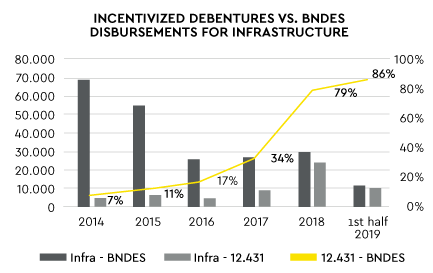
Source: Capital Markets Bulletin, Anbima, June 2019; BNDES, June 2019.
In 2020, the pandemic led to a reduction in the numbers to levels below those of 2018, but still much higher than in 2017. If, on the one hand, the total number exceeds that recorded in 2017, the number of issuances was lower, 35 this year against 49 papers issued in 2017, according to Anbima data.
The positive news is that the average value of 2020 issuances exceeds even the 2019 average, R$ 480 million, and the terms continue to extend, which means that the market believes in the security and liquidity of these papers.
Two factors indicate a considerable high expectation for 2021. First, a series of auctions has been postponed to next year and, as these projects are resumed, they should increase demand for infrastructure debentures. Then, a series of regulatory innovations took place in the telecommunications and sanitation sectors, which today account for less than 5% of the total volume of issuances, if added together.
The telecommunications sector recently saw the publication of Ordinance No. 502/2020, which modernized the regulation of processes for classifying incentivized debenture issuances by companies in the sector. The main innovations were expansion of eligible projects, issues related to project expenses, such as the possibility of reimbursement of expenses, future investments and reimbursement for grant expenses, and, especially, the possibility of financing imported goods. There are also high expectations with the arrival of 5G technology, which will require large investments. This new legal framework and the news in the sector should make incentivized debentures more attractive to finance projects in the sector.
The sanitation sector, in turn, has just received the new Regulatory Framework, which facilitates the concession of services to the private initiative. Dozens of bids are already planned for 2021. By 2030, the Ministry of Regional Development expects that between R$500 billion and R$700 billion will be invested in the sector, which today has the highest demand and expectation for investment in the infrastructure segment. At the same time, private companies account for about 3% of water and sewage service providers. As private players become more involved in the sector, demand for financing will automatically grow. Naturally, the incentivized debentures will now play an important role in financing sanitation projects.
Despite the pandemic, 2020 was a year of important legal milestones for the infrastructure sector. In May, the Chamber of Deputies proposed PL 2646, authored by Deputy Arnaldo Jardim, which, among other innovations, proposes the creation of a new class of infrastructure debentures, papers whose tax benefits would apply directly to the legal entity sponsoring the project. This would create higher yielding papers, more attractive to the market, especially for institutional investors such as large funds. In addition, the possibility of foreign exchange variation in the new infrastructure debentures could attract foreign investors.
The bill also creates greater incentives (50%) for sustainable projects, the so-called green bonds, in the sectors of renewable energy, energy efficiency, pollution prevention, and control, clean transport, sustainable water, and wastewater management, solid waste, climate change adaptation, and sustainable buildings.
Currently, bill 2646 has been sent to the Labor, Administration and Public Service; Finance and Taxation; and Constitution and Justice and Citizenship committees, and is subject to conclusive consideration, that is, it does not need to go to the floor of the Chamber of Deputies, and must only be approved in the committees.
The year 2020 was especially important for sustainable projects and green bonds
The federal government has updated Decree No. 8,874/16, which regulates Law No. 12,431/11, through the promulgation of Decree No. 10,378/20. Thus, the scope of the law was extended to the financing of infrastructure projects that present environmental and social benefits, through the possibility of classifying the issuance of incentivized debentures. The sectors of urban mobility, clean energy, and basic sanitation are covered. Apart from the issue of the nature of the projects, Decree No. 10,378/20 also allows the inclusion of smaller projects or projects that are not necessarily developed by concessionaires, permissionaires, or holders of public service authorization.
We see a significant increase in funding for sustainable projects through green bonds. Since January of 2020, according to data from the database of Sitawi, R$ 3.96 billion in green, transitional, or sustainable debentures were issued. All these papers were given a second opinion by specialized consultants.
According to the Sitawi database, the energy sector was responsible for R$ 1.6 billion, with special attention to Eneva's incentivized debentures, in two series, totaling R$ 950 million, with terms of 10 and 15 years. The transition debenture is a label aimed at carbon emitters who cannot receive a green label, but who seek to finance their gradual transition to a sustainable operation. It is also worth mentioning the incentivized green issuance by Neoenergia, which had a 25-year term and, like Eneva's issuance, had a second opinion from Sitawi.
Also according to information from Sitawi, the sanitation sector is surprising with R$ 1.98 billion in green issuances, driven mainly by the BRK Ambiental transaction, which represents the first issuance of infrastructure debentures to finance a winning project in Alagoas, the first bidding after the new Legal Framework for Sanitation.
Among the main benefits in issuing green bonds to sponsors are:
- diversification and expansion of the investor base, considering access to new investors such as sustainable funds, investors with specific mandates for the purchase of green securities or investors with long-term objectives, such as pension funds, insurance companies, and signatories to the Principles for Responsible Investment (PRI), which due to their characteristics, can maintain the paper in the portfolio even in times of crisis; and
- reputational gains.
For investors, the benefits are greater transparency in the use of resources and frequent classification into in long-term strategies. In addition, the specific allocation of funds and their monitoring can reduce the risks of green projects associated with the investment, according to Febraban's Guide for Issuance of Green Securities in Brazil.
Although the year 2020 presented great adversities for the market as a whole, the infrastructure sector is taking a breath of fresh air with incentivized debenture issuances, which are certainly consolidating their position as the sector's main financing instrument. These papers have grown well in a year in which discussions regarding ESG issues have been central to the debates. Infrastructure debentures will return with everything in the year 2021, with important advances in 2020. The scenario for debentures is extremely positive.

- Category: Tecnology
Diego Gualda and Laura Aliende da Matta
With the entry into force of the General Data Protection Law (LGPD) on September 18, its obligations became enforceable and the issue of liability came to the fore. While administrative sanctions can only be applied after August of 2021, civil liability is immediately applicable, which makes it essential to resume the debate on the conditions for holding data processing agents liable under the LGPD.
The rules on the liability of the controller and operator are of the utmost interest to the market, given the potential for significant financial impact. Consideration should also be given to the novelty of the law for operators of the law, especially in the Judiciary, who will certainly approach the LGPD on the basis of already established models, including from the point of view of civil liability.
In this context, it is possible that many consider the civil liability rules of the LGPD without greater care with the possibilities of interpretation left opened by the text of the law. What we propose in this article is precisely to draw attention to this examination. In particular, we argue regarding the departure from an interpretation that considers strict liability as the general rule on the processing of personal data.
Strict or subjective liability
There is a debate about the nature of civil liability under articles 42 to 45 of the LGPD. Some argue that the legislator's original vision was to prepare a system of strict liability, which would be evident in the justifications and motivations of the LGPD bill itself. Others consider the activity of data processing to be risky.
On the one hand, it is a fact that the standard mode of liability in Brazilian civil law is subjective liability. Article 927 of the Civil Code itself establishes that the obligation to repair the damage caused to another is due to the ascertainment of a tort, according to the provisions of articles 186 and 187 of the code. Furthermore, the sole paragraph of article 927 establishes the exceptional form of strict liability:
“Sole paragraph. There will be an obligation to repair the damage, independent of fault, in the cases specified in the law, or when the activity as normally conducted by the perpetrator of the damage implies, by its nature, risk to the rights of another.”
In general, Brazilian case law has maintained the interpretation that strict liability will only occur in exceptional cases, either by express legal determination or on the occasion of activities that represent a risk inherent to the rights of third parties.
In fact, the LGPD does not present an express determination on liability independent of fault. In addition, the provision states that the conduct of the processing agent must be in violation of personal data protection legislation, that is, in the face of failure to comply with the duties brought about by the law, which provides for fault in the broad sense as the basis for liability. The reproachability of the conduct of the processing agent is linked to the breach of the duty to comply with the provisions of the LGPD.
Without prejudice, it would then be appropriate to assess whether the data processing was a risky activity in itself. This may be an undetermined issue because of the wide variability of personal data processing activities, which may refer to elementary conduct with low potential for harm, such as exchanging business cards in commercial activities, to profiling on the basis of sensitive personal data, which has a higher degree of risk for the data subject.
Thus far, in general, the case law has relegated the classification of risky activity to activities that strictly present serious potential offense to the rights of third parties.
In any case, considering the LGPD's focus on the conduct of processing agents - so much so that liability and accountability are principles for the processing of personal data - the conclusion in favor of a strict liability model is contradictory to the very spirit of the law, which instead seeks to encourage processing agents to adopt good practices.
Again, it seems to us that the focus on the conduct of the processing agent, either by referring to the necessary act of violation of legislation to establish liability, or by recognizing accountability as a fundamental principle of data processing activity, leads to the subjective nature of civil liability in the LGPD as the general rule of its system. The text of the law says:
"Article 42. The controller or operator who, due to the exercise of personal data processing activity, causes to another person property damage, non-economic, individual or collective, in violation of personal data protection legislation, is obliged to repair it.
- Paragraph 1, subsection I - the operator is jointly and severally liable for damages caused by the processing when it fails to comply with the obligations of the data protection legislation or when it has not followed the lawful instructions of the controller, in which case the operator is equated to the controller, except in the cases of exclusion provided for in article 43 of this Law.”
Even more indicative of subjective liability is the scenario for exclusion from liability set out in subsection II of article 43:
"Article 43. Processing agents shall not be held liable when they prove:
I - that they have not carried out the processing of personal data attributed to them;
II - that, although they have carried out the processing of personal data attributed to them, there has been no violation of the data protection legislation; or
III - that the damage is the sole fault of the data subject or a third party."
While sections I and III normally refer to exclusions in cases of strict liability, since they would affect the causal link with the conduct of the processing agent, section II turns to the element of conduct, whether or not it violates the legislation. Under the provision, even if conduct related to data processing may cause damage to a data subject, if such conduct is not unlawful, if it is not contrary to the duties of the law, then the controller should not be held liable.
This concept reinforces and preserves the principle of liability of the agent, the encouragement of observance of good practices in the processing of personal data. In fact, it encourages processing agents to make an effort to conduct and implement good adaptation processes, to make decisions on the processing of personal data in a conscientious manner, to carry out accurate assessments of the risk of processing in relation to the data subject, since a demonstration of LGPD-compliant conduct, in addition to mitigating liability, may well exclude full liability, depending on the circumstances of the specific case.
It is worth emphasizing again that the strict liability of the processing agents would make them liable for damages caused to holders, regardless of any conduct contrary to the legislation. In other words, they could be held liable for occurrences of damage to the holders that do not result from any legal or regulatory provision regarding the parameters necessary for data processing. In this scenario, the question would be: if the conduct of the agent does not call for the application of liability, what is the reason for the adoption of good practices or investment in expensive adaptation measures?
It seems to us that the most appropriate interpretation of the liability established in the LGPD is that it would be based on fault (even if one could argue for civil liability with presumed fault). This interpretation also manifests itself as pointing to the best interest of the data subject himself, because the incentive for good practices - resulting from the focus on the wrongful conduct of the agent - results in greater protection for the data subject.
Thus, companies will be able to demonstrate in court the measures effectively taken to maintain compliance with the legislation and data protection regulations to guard against liability. If the processing agent proves adoption of the conduct expected under the LGPD, it cannot be held liable.
Future regulations of the ANPD (National Data Protection Authority) may work as an optimal parameter for reasonable efforts to be made by companies for each type of processing activity, by purpose and/or by sector of operation. Thus, not only will protection of the data of the data subjects be guaranteed, but so also will criteria for the conduct to be adopted by the processing agents, in line with the principle of accountability.

- Category: Tax
The writ of mandamus is a procedural instrument provided for in the Federal Constitution to protect citizens against abuse of power or illegality committed by a member of the Public Administration. With this constitutional lawsuit, the aim is to re-establish the legal situation and protect the right of the covered person arbitrarily restricted by an authority.
Faced with so many peculiarities in the handling of the writ of mandamus, there is an important point about whether it is possible to withdraw it at any time, especially after the trial denying the order has been issued and regardless of the agreement of the administrative authority.
Law 12,016/09, which establishes the framework of the writ of mandamus, does not address the issue, such that the provisions of the Code of Civil Procedure (CPC) are applicable to the matter.
First of all, it is worth making a distinction between withdrawal and waiver. Withdrawal produces eminently procedural effects, whereas waiver, precisely because it is closely related to the substantive right itself under discussion in the case, receives separate treatment.
If the party in a procedural relationship chooses to withdraw the claim, the effect of this unilateral act is extinguishment of the suit without a resolution of the merits, as provided for in article 485, subsection VIII, of the CPC.[1] This is because, regardless of the reason that led the party to withdraw from the proceeding, such conduct takes on a procedural form, causing only the case itself to cease. That is, there is repercussion only in the procedural field. The substantive right remains intact. In other words, the existing discussion will not be able to affect the underlying substantive right for any purpose. Thus, it is permitted for a private party to file a new lawsuit - writ of mandamus or any other type compatible with the claim made - provided that it is within the deadline for the exercise thereof.
On the other hand, with waiver, the effects arising from such an expression of will affect the underlying substantive right and the party which has granted it recognizes the right of the counterparty, including with retroactive effect. So much so that a trial ratifying the waiver expressed by the party resolves the merits of the case and is equivalent to acceptance of the opposing party's claim. This is the provision of article 487, subsection III, letter 'c' of the CPC.[2]
Faced with the effects that these unilateral statements propagate, the CPC does not contain any provision to condition a trial that resolves the merits (in the event of waiver) with the agreement of the opposing party. On the other hand, paragraph 5 of article 485 of the CPC provides that the withdrawal of the lawsuit may be filed up to the trial. This led to the understanding that, after this decision was issued, its ratification would be conditional on the agreement of the opposing party.
However, in the case of an application for mandamus, unlike in actions involving only private parties, the authority's agreement to the request for withdrawal is dispensable. This is because, while in private relations (fully governed by the CPC) the defendant also has an interest in judicial relief from the moment it joins the case, in disputes against the Public Administration, via the route of mandamus, there is nothing to be said of the State's interest in obtaining a decision that recognizes the legality of the contested act.
In fact, the acts performed by the Public Administration are considered, even if by presumption, in line with the legal system until another one (administrative act or judicial decision) comes about that says otherwise. Therefore, from the Public Administration's perspective, before or after the trial in a writ of mandamus, there is not even a procedural interest that requires ratification of the withdrawal with the agreement of the authority.
Due to the characteristic of self-execution of administrative acts, it is not necessary for the Judiciary to act with the objective of recognizing the existence of a right against the private party. The Administration is allowed to adopt measures for direct execution of its own act. As an example, tax foreclosures.
The matter was examined by the Federal Supreme Court (STF), under the general repercussion system, in the trial of Extraordinary Appeal 669.367-RJ, in which the Court decided that the provision of the Code of Civil Procedure of 1973 (article 267, paragraph 4 - reproduced in article 485, paragraph 5, of CPC/2015) which required the agreement of the adverse party for ratification of the withdrawal after the trial was rendered is not applicable to writs of mandamus.
According to Justice Rosa Weber, who issued the prevailing opinion, even if the trial has granted the mandamus claimed, "by withdrawing from favorable judicial relief in a writ, the applicant is subject to the prevalence of the administrative act that, before, it sought to rule out, as though the writ had never been filed; the self-execution of the administrative act resurfaces in its entirety.”
Necessarily, with the withdrawal in a writ of mandamus manifested after the trial has been rendered - whether it was favorable for or against the private party - the effect is to restore the enforceability of the administrative act challenged in the proceedings. Even in situations where the trial is unfavorable to the private party, the withdrawal from the writ of mandamus will only entail preservation of the act of authority as issued, there being no grounds for objection by the Public Administration.
In the case of a writ of mandamus, it is not in the interest of the Public Administration to obtain a judicial enforcement instrument (res judicata) to protect itself from the taxpayer. The administrative act fought is already endowed with self-execution. With the withdrawal of the claim, its legality is confirmed.
The elements outlined contribute to conclude for the correctness of the position reached by the STF, followed by the Brazilian courts, and on the need to interpret the rules that establish the procedure in line with the particularities of the substantive law discussed in the specific lawsuit.
The withdrawal from the writ of mandamus, regardless of the stage of the proceeding, re-establishes the self-execution of the administrative act contested. Therefore, the requirement that the authority agree to the private party's claim is unnecessary, since the end sought by the Public Administration itself will already be achieved.
[1] Article 485. The judge shall not decide the merits when he: (...)VIII - ratifies withdrawal of the action;
[2] Article 487. There shall be a resolution on the merits when the judge: (...) III - ratifies: (...) c) the waiver of the claim made in the action or in the counterclaim.

- Category: Litigation
When the new Code of Civil Procedure (CPC) entered into force, one of the provisions that generated great stir in legal scholarship was article 139, IV, which gave the judges the power to “determine all inductive, coercive, mandatory, or subrogatory measures necessary to ensure compliance with a judicial order, including in actions that have as their purpose a monetary payment.” The futurology exercises on what claims would be submitted to the judges and to what extent these provisions could give rise to a wave of judicial activism were fruitful.
In fact, it is a provision that gives room for the creativity of the parties and judges, since its objective is to select and apply the measures that, in the specific case, have the greatest chance of compelling the debtor to comply with a certain judicial order or obligation. At first, a series of very original claims could be identified: suspension of social network accounts and blocking of instant messaging applications, blocking of credit cards, prohibition of access to condominium leisure areas by defaulters, sealing of commercial establishments, or part of commercial activity, among others.
This diversity of claims challenged the courts to develop some criteria for applying atypical measures to balance the creditor's enforcement claim and the rights - particularly fundamental rights - of the debtor. In addition, it was necessary to carry out an examination of the measures required that would be effective in motivating the fulfillment of the obligation and which would be emulative and motivated by vengefulness or merely punitive intent. These criteria have been outlined around the concepts of reasonableness, proportionality, and the use of atypical measures as the ultima ratio.
More than two thirds of decisions on atypical measures involve suspension or seizure of CNH and passport
The application of these criteria over the four years of the CPC has finally defined a certain typicity to the atypical measures most demanded and therefore most often granted. Thus, although the legal provision gives the judge broad powers to define the best atypical measure to be applied in the specific case, most of the claims for application of article 139, IV, of the CPC and, consequently, of the decisions that grant the application of the atypical enforcement measures, revolve around the suspension or seizure of the National Driver's License (CNH) and passports. At the São Paulo Court of Appeals (TJSP), for example, 362 out of 544 judgments on atypical measures issued between 2016 and 2019 dealt with claims of this nature - over 66%, therefore.[1]
In view of this, the delimitation of the criteria for granting and maintaining atypical enforcement measures, and the current stage of this discussion with the higher courts - as will be seen below - is already occurring in a much more controlled environment, with a much smaller variety of claims and decisions. The same was observed in the TJSP during the new coronavirus pandemic.
The case law of the STJ and the parameters for granting atypical measures
The case law of the Superior Court of Appeals (STJ) regarding atypical measures, following the trend observed with the TJSP (and other state courts), has also been forming around claims for suspension or apprehension of CNH and passports. Therefore, it is not uncommon for the parameters for granting or revoking atypical enforcement measures to be found in a habeas corpus suit, on the grounds that they constrain the fundamental rights of debtors to come and go.
The following is an analysis of some recent judgments by the STJ aimed at identifying which parameters have prevailed for the application of atypical measures.
- Resp 1.788.950/MT (decided on April 23, 2019)
Execution of an extrajudicial enforcement order brought by the appellant against Mr. Fernando Bardi. At the trial level, an interlocutory decision was issued rejecting the claim for suspension of the CNH and seizure of the passport of the judgment debtor. The appellant filed an interlocutory appeal, which was denied relief. Thereafter, the appellant filed a special appeal for annulment alleging, among other things, violation of article. 139, IV, of the CPC, since it would be "appropriate and necessary to adopt an atypical enforcement measure, as it is essential for satisfaction of the obligation in the execution proceeding, considering that numerous attempts have already been made to locate assets liable to constriction, all of them unsuccessful."
Appellate Decision. In the opinion, it was stated that application of article 139, IV, of the CPC requires:
- The prior summons of the judgment debtor to pay the debt or to present assets intended to settle it, followed, as a corollary, by the typical acts of expropriation;
- The prior exhaustion of the typical means of satisfaction of the debt executed;
- The existence of minimal indications that the judgment debtor possesses assets capable of satisfying the debt; and
- The decision to authorize the use of indirect enforcement measures must also be duly reasoned, according to the specific circumstances of the case (case-by-case analysis).
In the specific case, the STJ held that, despite having exhausted the traditional means of satisfaction of the debt, there were no signs that the debtor was hiding its assets, but rather that it did not possess assets to pay off the debt, which is why it dismissed the special appeal, as highlighted by the reporting judge Nancy Andrighi in her opinion:
"In short, it is possible for the judge to adopt atypical enforcement means provided that, if there is evidence that the debtor possesses assets capable of fulfilling the obligation imposed on it, such measures are adopted in a secondary manner, by means of a decision that contains adequate grounds for the specificities of the concrete scenario, with due regard for the substantantive adversarial process and the requirement of proportionality."
More recently, the same grounds were adopted in the following appeals: REsp 1.782.418/RJ (DJe April 26, 2019), 1.828.969/MT (DJe September 5, 2019); REsp 1.854.289/PB (DJe February 26, 2020), and REsp 1864190 (Dje June 19, 2020).
2. HC 558.313/SP (decided on June 23, 2020)
Collection action in view of execution of judgment. In this case, the partners of the judgment debtor company (whose corporate veil was pierced) filed a writ of habeas corpus in order to vacate the order restricting the departure of the patients from the national territory, without a prior guarantee of execution.
Appellate Decision. In the opinion, it was stated that application of article 139, IV, of the CPC requires:
- Meet the requirements of necessity, adequacy, and proportionality of the measure;
- There are indications that the debtor has expropriated assets or has been hiding its assets to frustrate the execution; and
- The typical execution measures are found to be ineffective.
In the specific case, it was found that (i) the international trips taken by the patients are not be compatible with the allegation of lack of funds to pay the amounts due, (ii) the typical measures proved ineffective, and, (iii) although the judgment debtors claimed that the atypical enforcement measure was disproportionate, they did not present any alternative, less burdensome, and more effective executive means, as incumbent on them, for which reason the habeas corpus was not heard and the constriction was maintained.
3. HC 453870/PR (decided on June 25, 2019)
Tax execution filed by the municipality of Foz do Iguaçu (PR). In this case, the debtor filed a habeas corpus suit to vacate the order that seized his passport and suspended his CNH.
Appellate Decision. At the time of the judgmnet, it was stated that, in tax collection proceedings, atypical personal coercive measures, such as suspension of passport and driver’s licence, are not fitting, as application thereof in this context would result in excess. To this end, the STJ held that the State has super priority in its capacity as creditor, and tax debt is highly resistent to the risk of default by its own “legal and procedural conformation”.
In view of this, the STJ granted habeas corpus for the exclusion of the atypical measures contained in the judgment under appeal, since they were excessive, stating that, in the record, there was already indication of attachment of 30% of the salary the defendant receives at Sanepar (the Paraná Sanitation Company).
Atypical enforcement measures during the pandemic
The new coronavirus pandemic has placed greater emphasis on the need for a careful and a thorough examination of the necessity, adequacy, and proportionality of the atypical enforcement measures requested. The decrease in income and the financial difficulties caused by the health crisis have increased both the creditors' need to receive and the debtors' solvency problems, making the judge's actions even more critical, as they are responsible for balancing the interests expressed by the parties in the case.
Because of the short time that has elapsed since the restrictive measures adopted by the public authorities to contain the advance of the pandemic began, few judgments on the application of atypical enforcement measures in the context of the pandemic have reached the courts.
In the scope of execution for a certain amount, the TJSP, despite finding that, in theory, the atypical measure claimed as a way to ensure the success of the enforcement claim, opted for the non-applicability of article 139, IV, of the CPC, in view of the exceptional situation caused by the pandemic. According to the judgment, this guidance would persist until, in principle, the return to economic normalcy:
"EXECUTION FOR CERTAIN AMOUNT. FINANCING AGREEMENT, GUARANTEED BY MORTGAGE. ATYPICAL COERCIVE MEASURES UNDER ARTICLE 139, IV, OF THE CPC. SUSPENSION OF CREDIT CARD. REASONABILITY. PROPORTIONALITY. 1. Atypical coercive measures may be used to compel the debtor to perform his duty (CPC, article 139, IV). 2. However, they should not be merely a means of constricting the debtor, as a mere punishment, without bringing about for the creditor the possibility of satisfaction of the debt. The measures must be useful to that satisfaction, as well as proportionate and reasonable. 3. The blocking of credit cards seems to us, as a rule, an appropriate measure that contributes to the achievement of the scope of the execution process, aiming at removing debtors from their inertia. 4. Considering, however, the situation of deep economic and financial crisis imposed by the Covid-19 pandemic, without prospects for improvement in the scenario of global recession in the short term, we have to maintain the decision under appeal, at least until the resumption of economic normality, when the issue may be reviewed. Appeal denied relief, with an observation.” (TJSP; Interlocutory Appeal 2092438-16.2020.8.26.0000; reporting judge: Melo Colombi; Adjudicatory Body: 14th Chamber of Private Law; Central Civil Courts - 4th Civil Court; Date of Judgment: June 17, 2020; date of registration: June 17, 2020)
Excerpt from the opinion of the reporting judge:
"The blocking of cards of [...] would work as a stimulus for the discharge of their debts, without so much recalcitrance, being useful, therefore, for the scope of the execution process. It so happens that the current scenario in which we find ourselves does not recommend the adoption of this measure. [...]
The moment, therefore, does not favor the blocking of funds and means of acquisition of basic survival inputs of people (individuals or companies) who were already experiencing financial difficulties even before the arrival of the epidemic in our country."
The discussion regarding the applicability of atypical measures during the new coronavirus pandemic was given greater prominence in the area of alimony suits. In this case, there was discussion of the possibility of imposing house arrest on the alimony debtor in this context (cf. CNJ Resolution No. 62) and adopting, first, other atypical enforcement measures (credit card blocking, CNH etc.) before civil imprisonment. The application of a prison sentence in the current health crisis scenario would potentially expose the debtor to a substantially higher risk of contamination, which is why other legal restrictions have been adopted to encourage the payment of the alimony debt.
On the other hand, and considering the indispensable adequacy link between the atypical measure applied and the incentive given to the debtor to pay the debt, it is certain that, at the present time, restrictions such as suspension or seizure of a passport will not have the same effectiveness as in other times, considering the current limitations on international travel.
Thus, with the pandemic, the complex task of the courts to strike a balance between legitimately inducing compliance with a court order or obligation litigated and overly restricting the rights of debtors has become even more arduous and with potentially more serious consequences for the parties.
Parameters consolidating
The application of atypical enforcement measures, under the terms of article 139, IV of the CPC, brings with it the challenge of pondering and weighing up the interests of creditors and debtors, going beyond the sphere of assets and entering into the sphere of fundamental rights. With the submission of the subject to the scrutiny of the STJ, a list of parameters has been formed that should guide judges and courts in the application of the concept.
Currently, in order to maintain the constriction of CNH and passport due to default or debt, it is necessary to observe the following issues:
- Exhaustion of the typical means of satisfying the obligation (atypical measures as ultima ratio);
- Indications that the debtor is voluntarily concealing assets capable of discharging the debt;
- The appropriateness and proportionality of the measure, analyzed in the specific case; and
- Balanced relationship between the litigant parties.
Thus, although case law has tried to establish predictability in the application of these measures, there is still a high degree of subjectivity bequeathed to judges and courts to assess the advisability and effectiveness of atypical constrictions requested by creditors in each specific case.
The pandemic, which has significantly altered the financial condition of some creditors and debtors as well as the national and international travel dynamics of all individuals, has also interfered with the parameters for the application of the most common atypical measures and their effectiveness in effecting satisfaction of debtors’ obligations.
[1] Empirical research conducted in March of 2019, with the collection and analysis of all judgments with the term "atypical measures" available for consultation on the website of the Court of Appeals of São Paulo and relating to cases judged since March of 2016.

- Category: Corporate
On November 13, the Board of the Brazilian Securities and Exchange Commission (CVM) decided CVM Administrative Proceeding SEI No. 19957.005563/2020-75, which arose from an appeal filed against the understanding of the Bureau of Corporate Relations (SEP), manifested in Report No. 083/2020, to the effect that the founding shareholders of Linx S.A. are prevented from voting on certain matters on the agenda of the extraordinary general meeting (EGM) of the company called to resolve on the merger of all its shares into STNE Participações S.A.
Per the SEP’s understanding, the impediment on voting results from the receipt of a private benefit by the founding shareholders, pursuant to article 115, paragraph 1,[1] of the Brazilian Corporations Law (Law No. 6404/76), since the latter, due to the merger of shares, would enter into non-competition and consulting agreements with the acquiring company (ancillary contracts), and would be remunerated for the obligations assumed.
The founding shareholders argued that the benefit derived from the ancillary contracts was not linked to Linx's status as a shareholder, nor was it even a direct result of the decision at the meeting, which is why the compensation received could not qualify as a private benefit for the purpose of disqualification from voting under the Brazilian Corporations Law (LSA).
SEP, on the other hand, argued that "it would not be appropriate to believe the case of a private benefit provided for in article 115, paragraph 1, of Law No. 6,404/76 as restricted to benefits received in the condition of shareholders, either because there is nothing in the law that restricts this interpretation, or because article 109 itself already provides that the shares of each class will confer equal rights to their holders." From this point of view, a meeting resolution that intended to confer special rights to certain shareholders, in this condition as shareholder, would not be admissible according to article 109.
Also for SEP, "in spite of the non-competition commitments and the fact that the proposal to hire the [founding shareholder] is not, in itself, the subject matter of a resolution at a meeting, such agreements are an essential condition for the transaction, they originate precisely from STNE's proposal to take over Linx], and there is, therefore, an undeniable direct and intrinsic relationship between the benefit that will be received and the transaction to be resolved on at an EGM. This is not a circumstantial and uncertain situation which may potentially generate an environment that benefits the shareholder in some way. On the contrary, these are contracts signed in the context of a restructuring and whose effects only require approval of the transaction at a meeting.”
Within the scope of the proceeding, the Board of the CVM, by majority of votes, granted the appeal[2] filed by the founding shareholders, to admit their vote at Linx's EGM, which resolve on the transaction based on the following grounds (presented in summary form):
- The ancillary contracts are not the subject of a resolution at the EGM, nor do they have Linx as a counterparty or intervening party, nor do they generate obligations or encumbrances for the company;
- The benefits do not derive from the status of partner of the founding shareholders and are not even related to the position of those shareholders in Linx's capital stock. In this sense, they do not constitute a breach of equality in the treatment of shareholders, a necessary condition to establish the legal scenario for an impediment to voting;
- The ancillary contracts are not "born" out of the decision of the Linx shareholders meeting regarding the matters on the agenda of the EGM in question, but out of the ability and expertise of the founding shareholders to compete with Linx after the transaction has been completed or to provide the services contracted, as the case may be;
- There is clearly a correlation between the meeting resolution and ancillary contracts, due to the connection for generating effects, but even so, it is not characterized as a direct benefit to which the shareholders will give cause through the meeting decision; and
- The interpretation that the concept of a private benefit would encompass indirect benefits, whether derived from contracts of any nature or from other sources (and not those received as shareholders), would create too great an intersection between the concepts of private benefit and conflicting interest.
In a dissenting vote, and corroborating the understanding expressed by SEP, board member Henrique Machado found an impediment to vote due to the private benefit or, alternatively, due to a conflict of interest, based on the following grounds:
- The principle of equal treatment of all shareholders continued to be protected by article 109, paragraph 1, of the LSA, and thus the appropriate interpretation of the scenario for a private benefit under article 115, paragraph 1, is that which presupposes equal treatment among shareholders and provides abstention from voting regardless of whether the advantage to be gained is linked to the condition of shareholder, provided that it is not extended to the other partners;
- Although the ancillary contracts are not resolved on by the EGM, the fact remains that they were negotiated together and are included in the conditions and characteristics of the transaction;
- In the field of governance, there is a typical situation of adverse selection prior to the formation of the contract (ex ante) that should give rise to the adoption of mechanisms to prevent the risk of expropriation and encourage the alignment of interests between management and minority shareholders, such as recusal from voting; and
- Even if one could rule out the possibility of a private benefit, the potential conflict between Linx's interests and those of its founding shareholders resulting from ancillary contracts, whose imperative expression "may not vote" in article 115, paragraph 1, of the LSA prevents the participation of the founding shareholders.
In his statement of vote, board member Alexandre Costa Rangel diverged from board members Marcelo Barbosa and Flávia Perlingeiro exclusively in relation to the recognition of the impediment to voting by shareholders in cases of conflict of interest, under the following terms: "I do not envisage legal support to prevent in advance the exercise of the right to vote of a shareholder in a conflict of interest, based on article 115, paragraph 1, in fine, of Law 6,404/76. In my opinion, the legal framework provided for by the Brazilian Corporations Law does not authorize formal prohibition a priori of the vote of a shareholder in the event of a conflict of interest, in accordance with the aforementioned provision."
As a result, the lawsuit reversed SEP's understanding, and the CVM's Board stated that, for the facts under analysis (those suggested in the SEP Report and others heard up to the judgment date), Linx's founding shareholders would not be prevented from voting at the EGM called to approve the transaction.
[1] Article 115. Shareholders must exercise the right to vote in the interest of the company; votes exercised in order to cause damage to the company or other shareholders, or to obtain, for oneself or for others, an advantage to which one is not entitled and which results, or may result, in prejudice to the company or to other shareholders are considered abusive.
Paragraph 1. Shareholders may not vote on resolutions of the general meeting on the valuation report of assets with which to contribute for the formation of the capital stock and approval of their accounts as officer, or on any others that may benefit them in a particular way, or in which they have an interest conflicting with that of the company.
[2] With votes in favor by Marcelo Barbosa, chairman, and the directors Flávia Perlingeiro and Alexandre Costa Rangel.

- Category: Restructuring and insolvency
Bill 4,458/20, approved by the Senate on November 25 of this year, amends laws - 11,101/05, 10,522/02, and 8,929/94, to update the legislation on judicial reorganizations, extrajudicial reorganizations, and bankruptcy of entrepreneurs and business companies. The bill stems from Bill 6,229/05, which was passed in the House of Representatives on August 26.
The signature of the President of Brazil is now expected to take place by December 24 of this year. If the current wording of the bill is maintained, the main points of change in the institutes of the current reorganization and bankruptcy legislation will be those indicated in the table below.
The main changes relate to:
- legal certainty and super priority in relation to the granting of loans during judicial reorganization;
- legal certainty and modification of some of the asset sale rules;
- cross-border bankruptcy and cooperation between domestic and foreign courts in such cases;
- fresh start;
- general rules for extrajudicial reorganization, with the possibility of including labor credits and reducing the quorum required for approval of the plan;
- installment payment of debts with the Federal Government and other tax matters; and
- judicial reorganization of rural producers.
In the event of doubt, Machado Meyer's debt Restructuring and Bankruptcy and Tax teams are at your disposal.
Partners of the Restructuring team responsible for this newsletter: Renata Oliveira and Renato Maggio.
Partner on the Tax team responsible for this newsletter: Bruna Marrara.
| Analysis of the main changes | |
| Law No. 11,101/05 before the approval of the Bill | Law No. 11,101/05 after the approval of the Bill |
|
Stay period
|
Stay period
|
Prevention of the court
|
Prevention of the court
|
Arbitration agreement
|
Arbitration agreement
|
Distribution of profits or dividends
|
Distribution of profits or dividends
|
|
Verification and registration of credits
|
Verification and registration of credits
|
|
Assignment of credits
|
Assignment of credits
|
|
Conciliation and mediation
|
Conciliation and mediation
|
|
Role of the judicial trustee
|
Role of the judicial trustee
|
|
GMC
|
GMC
|
|
Abusive vote
|
Abusive vote
|
|
Judicial reorganization of a rural producer
|
Judicial reorganization of a rural producer
|
|
Means of judicial reorganization
|
Means of judicial reorganization
|
|
Prior finding
|
Prior finding
|
|
Alternative plan proposed by the creditors
|
Alternative plan proposed by the creditors
|
|
Labor credits
|
Labor credits
|
|
Sale of assets
|
Sale of assets
|
|
Partner or supporting creditor
|
Partner or supporting creditor
|
|
DIP financing
|
DIP financing
|
|
Procedural and substantive consolidation
|
Procedural and substantive consolidation
|
|
Possibility for the tax authorities to file for bankruptcy of the debtor
|
Possibility for the tax authorities to file for bankruptcy of the debtor
|
|
Closing of the judicial reorganization
|
Closing of the judicial reorganization
|
|
Fresh start
|
Fresh start
|
|
Extension of the effects of the bankruptcy
|
Extension of the effects of the bankruptcy
|
|
List of creditors in bankruptcy
|
List of creditors in bankruptcy
|
|
Rapid closure of bankruptcy in the event of absence of assets
|
Rapid closure of bankruptcy in the event of absence of assets
|
|
Sale of assets in bankruptcy
|
Sale of assets in bankruptcy
|
|
Extinguishment of the obligations of the debtor
|
Extinguishment of the obligations of the debtor
|
|
Extrajudicial reorganization
|
Extrajudicial reorganization
|
|
Transnational Bankruptcy
|
Transnational Bankruptcy
|
|
Application of the Code of Civil Procedure
|
Application of the Code of Civil Procedure
|
|
Matched transactions and derivatives
|
Matched transactions and derivatives
|
|
Tax issues
|
Tax issues
|

- Category: Tax
The Brazilian Federal Revenue Service (RFB) has expressed its position, through Solution of Consultation No. 206/03 and No. 232/07 and SRF Interpretative Declaratory Act No. 25/03, to the effect that it suffices to have the final and unappealable decision in an action recognize the right to restitution of amounts to call for the levying of IRPJ and CSLL for legal entities submitted to the accrual method.
Specifically in SRF Interpretative Declaratory Act No. 25/03, the RFB presents two scenarios for tax assessment purposes when the court decision does not define the amount to be refunded: the date of sending of the judicial payment order or, if a motion to stay execution is filed, the date of the final and unappealable judgment.
In this scenario, with the growing number of final and unappealable cases that recognize the right to repetition, many taxpayers have opted to go to court to litigate the time when the IRPJ and CSLL are levied, if whether:
- at the time of the final and unappealable decision that declared only the right to set off, the calculation/settlement of which will occur administratively;
- at the time of registration of the administrative claim; or
- in the transmission of setoff declarations (DCOMPs).
The federal circuit courts have been providing different solutions for the issue and have, in general, analyzed the issue according to the concepts of asset increase and economic and legal availability, and the (i) liquidity of the credit recognized by the final and unappealable decision, for the purposes of levying IRPJ and CSLL.
Recently, the Federal Court of Appeals for the 3rd Circuit[1] expressed its position in favor of the taxpayer's theory and set aside the levying of IRPJ and CSLL, inasmuch as the final decision had only assured the right to offset, without identifying the amount actually due. The court established that IRPJ and CSLL are due only when the tax authorities approve the offset.
Along the same lines, there is the recent decision by the Federal Court of Appeals for the 5th Circuit,[2] which found that IRPJ and CSLL will be levied if, on the date of the final and unappealable judgment, the decision defines the amount to be returned. If only the right to offset is recognized, taxes are not required at the time of the final and unappealable judgment.
The Federal Court of Appeals for the 2nd Circuit,[3] in turn, has precedents to the contrary, since it concluded that "once the taxpayer's right to a setoff credit is recognized by a final and unappealable decision, the legal availability of the revenue (asset increase) will already be accrued, and the triggering event for the IRPJ and CSLL is established.
Along the same lines argued by taxpayers, the Superior Court of Appeals (STJ) reviewed an analogous claim and recognized that mere expectation of right and indebtedness resulting from the final and unappealable decision does not represent an asset increase to be taxed by IRPJ and CSLL, as established in article 43 of the National Tax Code.
Considering the divergent decisions rendered by the federal circuit courts regarding the interpretation of federal legislation, it will be incumbent on the STJ to give the final word on the matter, in order to provide legal certainty to taxpayers as to when they will offer the tax credits to the tax authorities.
[1]TRF 3rd Circuit, Ap 5004691-74.2019.4.03.6114, opinion drafted by Federal Appellate Judge Antonio Carlos Cedenho, decided on July 24, 2020; AI 5010177-15.2020.4.03.0000, opinion drafted by Federal Appellate Judge Marli Marques Ferreira, decided on July 20, 2020.
[2]Ap 08107154820194058400, Federal Appellate Judge Rogério de Meneses Fialho Moreira, 3rd PANEL, decided on July 2, 2020.
[3]TRF 2nd Circuit, 3rd Specialized Panel, Appeal 5004097-22.2019.4.02.5101, opinion drafted by Federal Appellate Judge THEOPHILO ANTONIO MIGUEL FILHO, decided on December 3, 2019; TRF 2nd Circuit, 3rd Specialized Panel, Appeal 5035622-22.2019.4.02.5101, opinion drafted by Federal Appellate Judge MARCUS ABRAHAM, decided on August 10, 2020.

- Category: Real estate
The Brazilian Code of Civil Procedure (Federal Law No. 13,105/15) lists in its articles 879 and 880 the events for forced sale of assets of the judgment debtor in the course of lawsuits. These are the award, sale by private initiative, and, further, the electronic or in-person judicial auction. In accordance with the procedural regulations in force, in cases where there is no interest on the part of the judgment creditor in the award of the asset, sale by private initiative is now admitted, in preference to an auction.
This instrument is a novelty introduced by the Code of Civil Procedure to speed up the resolution of disputes and rises judgment creditor’s autonomy, since it can convert the pledged asset into cash, seeking buyers to satisfy his claim. However, the procedures of the sale by private initiative still raises doubts (including practical), due to the existence of legislative gaps, especially in relation to real estate matters. This is due to the fact that the Code of Civil Procedure is silent on important issues for real estate transactions. For instance, the valuation of the property or the nature of the acquisition (original or derived), which may entail the assumption of an encumbrance by the acquirer, among other points highlighted below.
According to the legal rules, the judgment creditor may request award of the asset pledged in the ongoing lawsuit itself. This means that the creditor will replace the obligation to pay in cash with its own pledged asset, appropriating it as a way to satisfy the claim. However, if the judgment creditor has no interest in the award it may request the sale of the property to a third party, which may be done directly or through a real estate broker or an auctioneer accredited by the judicial body (which should not be confused with a purely judicial auction, dealt with starting from article 881 of the Code of Civil Procedure). If there is no interest in sale by private initiative, the sale shall be done through the model of an in-person or electronic auction. Thus, the traditional auction continues to be an option, but applicable secondarily if there is no interest on the part of the judgment creditor in the award of the asset or in a sale by private initiative.
Article 880 of the Code of Civil Procedure establishes that the procedure for disposal by private initiative shall be governed by the judge of the case. This means that the procedure and the practical application of the sale of the asset may vary according to each judge, who shall order: (i) a term for disposal; (ii) the form to give publicity to the sale; (iii) the minimum price; (iv) the terms of payment (v) request for guarantees; and (iv) the brokerage commission, if applicable. The judge will also sign, together with the purchaser and the judgment debtor (if it is present), the letter of sale and the reinstatement of possession order, which will represent the transfer titles of the property, to be recorded with the relevant Real Estate Registry Office, together with the proof of payment of the Real Estate Transfer Tax (ITBI).
Although divestiture by private initiative has preference over judicial auction, the rules governing this process are limited to the provisions of article 880, while auctions, a traditional form of divestiture in lawsuits, has much more robust regulations. There is no clear provision regarding the possibility of secondary application of the provisions dealing with auctions (ee.g., whether the person prevented from participating in a judicial auction, listed in article 890 of the Code of Civil Procedure, cannot carry out the acquisition on their own initiative either) in divestitures on their own initiative, which gives rise to doubts, in addition to making the aforementioned sale almost entirely governed by the judge.
By way of illustration, some of the main shortcomings of private initiative disposal are highlighted:
- Need/requirement for the judge to make the divestiture offer public (e.g. via public notice) to confirm the existence of interested third parties;
- Express possibility for the judgment debtor, debtor or interested third party to request disposal, regardless judgment creditor's agreement; and
- Objective criteria for the judge to establish a minimum sale value (e.g. requirement for appraisal or use of the municipal value plan, in the case of urban real estate).
In general, despite of the existence of various scholarly currents, the Judiciary standing has been bold in this sense, i.e. waiving the public notice as a requirement to the sale (which, in fact, would make the process lengthy and bring it closer to a traditional auction). In addition, requests for disposal by the judgment debtor or third parties, provided that it is with the consent of the judgment creditor, have been allowed. Undoubtedly, the most controversial point, however, is the valuation of the asset attached, for which case law has not yet been settled.
In addition to the points highlighted, from a real estate perspective, one of the main issues concerns the nature of a sale by private initiative. This is because, although it is a judicial sale, it is requested (most of the time) by the plaintiff in the action, and the terms and conditions are settled for by the judge, who directs the entire sale procedure. Given that, one debates whether or not existing propter rem encumbrances and/or debts would be enforceable against the purchaser/bidder of the asset, even if the procedure takes place entirely in a judicial sphere.
In relation to this issue, on February 14 of this year, when the Superior Court of Appeals (STJ) ruled on Special Appeal 929.244-SP (which deals with the enforceability of Real Estate and Urban Territorial Tax (IPTU) debts against the purchaser), it held that such a disposal is comparable to a public auction, given that it is "a joint sale of the asset seized, under judicial supervision, although with simpler procedures.” Thus, according to this decision, the sale by private initiative means an original acquisition of a real estate (i.e. a new property, not related to any issue or debt related to the prior owner), which is why the acquirer receives the property free of encumbrances and debts.
Another point that deserves to be highlighted is the possibility of applying the sale by private initiative in labor actions. In these lawsuits, the Code of Civil Procedure is applied in a secondary manner, but Decree-law No. 5,452/43, the Consolidated Labor Laws (CLT), in article 888, also regulates the matter, only in a different manner. The article stipulates that private disposal is only possible if there are no bidders at the auction.
In this sense, the prevalence of the principle of the specialty of labor law over subsequent supplementary legislation is discussed. The Judiciary has taken the position to allow application of the Code of Civil Procedure, that is, private sale before the auction, focusing on procedural economy and speed in the process, although there is also a current (minority) position that argues for application of the CLT.
Overall, the sale by private initiative aims to give dynamism to legal proceedings, to make the sale of pledged assets more efficient and less bureaucratic. However, the coercive disposal of assets may soon come up against legislative loopholes and divergent views on the application of the suitable legislation. There is a risk of this procedure to be challenged in its validity and, consequently, give rise to undesirable legal uncertainty, especially for the purchaser of property sold under such conditions.

- Category: Environmental
In October, the Federal Supreme Court (STF) concluded the judgment of Direct Action of Unconstitutionality (ADI) No. 4,619, filed by the National Confederation of Industries (CNI) against São Paulo State Law No. 14,274/2020, which governs the labeling of transgenic products.
CNI requested a declaration of unconstitutionality of the state law on two main arguments: (i) usurpation of residual and complementary jurisdiction, therefore the state is not allowed to deal with the issue in a general manner, but only on a regional basis; and (ii) invasion of exclusive jurisdiction of the Federal Government to legislate on interstate commerce.
STF dismissed the suit, pursuant to the opinion drafted by Justice Rosa Weber, and upheld the validity of the state rule. In general terms, the main discussion brought about by the suit was the question of legislative jurisdiction of the Federal Government and the states.
According to Justice Rosa Weber's opinion, the great difficulty in understanding the limits of each state to legislate lies in the lack of a definition of basic concepts such as general rules and special rules. Article 24 of the Federal Constitution provides for concurrent jurisdiction to legislate between the Federal Government, the states, and the Federal District, granting the Federal Government the prerogative to legislate on general rules and the states and the Federal District on special rules. Although there is no clear definition of these concepts, in a simplistic manner it is possible to conclude that the Federal Constitution sought to limit the purview of each state, with the states and the Federal District being responsible for complementing the federal rule.
In the specific case, the analysis revolves around identifying whether the state rule has replaced or supplemented the federal rule, considering that the matter subject to the state law at issue, the right to information and the duty to label food and food ingredients intended for animal or human consumption and produced from genetically modified organisms (GMOs), already finds a provision in federal norms, namely, the Biosafety Law and its regulatory decree (Law No. 11,105/05 and Decree No. 5,591/05), as well as Decree No. 4,680/03, which regulates the right to information (provided for in Law No. 8,078/90 - Consumer Protection Code) on food and food ingredients intended for human or animal consumption that contain or are produced from GMOs.
Among the federal rules mentioned, Decree No. 4,680/03 establishes the limits and criteria for the duty of information on the labels of products that contain or are derived from GMOs. While the federal decree establishes the duty of information on transgenic nature of products produced from GMOs when there is presence above 1% limit of the product, the state rule provides for the duty of information in the marketing of products intended for human or animal consumption, or, further, those used in agriculture, when the presence of GMOs is found in a proportion equal to or above the 1% limit.
According to Justice Rosa Weber's opinion, considering that products derived from transgenics or of transgenic origin offer potential risks to consumers’ health , they, as final recipients, must have their rights to choose ensured, through the right to information.
According to STF’s decision, it is incumbent on the states to establish requirements for labelling of genetically modified food, which does not mean legislating in a manner contrary to the federal rule.
As a parallel, Justice Rosa Weber made reference to Regulation No. 1.829/03 of the European Parliament and Council, which disciplines that labelling of genetically modified food and animal feed requires the presence of more than 0.9% in the products.
In addition, the Justice sets out the arguments by which she understands that the case under analysis is distinct from the precedent formed in judgment of ADI No. 3,645, handed down in 2006 and mentioned by CNI as an analogous case. STF granted ADI No. 3,645 for the purpose of declaring the unconstitutionality of a law of the state of Paraná that required consumers to be informed of the presence, in any percentage, of genetically modified ingredients in a product to be purchased.
The legal basis used by STF at the time was violation of article 24 of the Federal Constitution, as the state normative act, by establishing the obligation to label products intended for human and animal consumption containing GMOs, in any percentage, inaugurated parallel regulations explicitly opposed to the federal legislation in force (Federal Decree No. 4,680/03).
On the other hand, in this case, the legislation of São Paulo provides for the obligation to provide information on the label of products that contain GMOs in a percentage that is more protective for the right of consumers and human health - not in a generic manner and contrary to the federal rules -, unlike the Paraná law. In the conclusion of her opinion, Justice Rosa Weber contends that there is no usurpation of the Federal Government's jurisdiction to legislate on commercial law and interstate commerce since when legislating on consumer protection, São Paulo’s legislation deals with matters of concurrent jurisdiction.
The conclusion is that STF's understanding in the case of labelling of products containing GMOs appears to be in line with recent court rulings in the analysis of conflicts of legislative jurisdiction in environmental matters. As an example, on December 10, 2019, Justice Celso de Mello issued a sole judge decision rejecting a petition for in limine injunctive relief submitted by the Liberal Party in the record of ADI No. 6.218/RS, which deals with the suspension of the effects of Law No. 15.223/18 of the state of Rio Grande do Sul on prohibition of trawling in the coastal area of the state.
As in GMOs’ case , Justice Celso de Mello found that the state of Rio Grande do Sul has legislated on a matter of concurrent jurisdiction, establishing measures to protect the marine environment, such that there is nothing to be said of usurpation of legislative jurisdiction in matters exclusive to the Federal Government relating to maritime law and the rules of navigation.
These precedents are important in guiding the states when it comes to issuing laws on environmental matters, the subject of so many discussions.

- Category: Competition
The approval of the Superintendence-General (SG) of Cade (Administrative Council for Economic Defence) is an important step for the parties to a merger filing to be able to close the deal, but it is not necessarily the last. This is because the Competition Law provides that, for 15 days after the publication of the SG's clearance decision in the Official Gazette, it may be challenged by means of appeals from interested third parties duly qualified in the proceeding or by a request from Cade’s Administrative Tribunal itself. For this reason, the parties must necessarily wait for this period to elapse before declaring the closing of the transaction, so as not to engage in a violation known as gun jumping.
Challenges by the tribunal were rare in the Brazilian experience. During approximately five years of the Competition Law, which instituted the pre-merger control regime, only three transactions had been called up for review by the tribunal. As of 2018, however, there has been a significant increase in the number of challenged cases: with 12 precedents in this direction today - three in 2020 alone -, the possibility of requests for review by Cade’s Administrative Tribunal can no longer be considered remote, especially in merger cases that are complex from a competition standpoint.
The vast majority of the challenged transactions to date involve merger filings reviewed under the non-fast track procedure, but transactions under the fast-track procedure may also be subject to being called up by the tribunal, which must take place at the request of one of Cade’s Commissioners in a reasoned dispatch, subject to ratification by CADE’s panel.
The order requesting the review of a merger case does not mean a ruling on the merits of the case, but only the existence of reasoned doubt as to whether the transaction can be approved. According to Cade’s case law, the tribunal’s justifications for challenging a merger case include: (i) a more careful review of the relevant markets affected, including markets rarely analyzed by Cade; (ii) discussions regarding the dismissal of transactions that may potentially affect competition; (iii) high market shares; (iv) inaccuracies in the data presented to the SG; and (v) facts supervening the SG's clearance.
When calling up a merger filing, the tribunal must decide whether to uphold the SG's decision for unconditional clearance, approve it with restrictions, or even block it. So far, the tribunal has upheld the SG's unconditional clearance decision in all cases called up for review, except for one that is still under analysis by Cade.
Companies should be aware that a merger filing may be reviewed by both bodies at Cade, which will entail a longer review period until the clearance decision, even going beyond the 30 days deadline for fast-track cases, and may postpone the date initially foreseen for closing the deal.