Publications

- Category: Life sciences and healthcare
On November 29, the Brazilian House of Representatives approved the proposed text of Bill of Law No. 7,082/17 (PL 7,082/17), which aims to create a legal framework for clinical research with human beings in Brazil, in addition to establishing ethical guidelines and control of good practices through research ethics committees (CEPs).
The Bill of Law will now be analyzed by the Federal Senate's Committee on the Constitution and Justice and Citizenship (CCJC) and then go to the plenary.
As a general rule, clinical research is a study that aims to discover or confirm disease risk factors, new therapeutic indications, adverse reactions, and/or effects on a particular therapy (including gene or cellular), technique, drug, and/or medical device.
The purpose of this type of research is to evaluate aspects involving quality, efficacy and safety of the product in human volunteers. The main steps involve:
- Preclinical stage: manipulation of cells and/or animals to verify the feasibility of a substance or product becoming a new therapy, to know the mechanisms of action and to evaluate the potential for toxicity.
- Clinical stage: carried out in human beings with the aim of progressively testing the safety and efficacy of the new therapy, divided into:
- Phase 1 (group of 20 to 100 participants) – evaluate the safety of therapy on a preliminary basis.
- Phase 2 (group of 100 to 300 participants with a certain disease and/or condition) – Analyzes the efficacy and possible adverse effects of the molecule, substance, or product.
- Phase 3 (group of 800 or more patients with a certain disease and/or condition) – Evaluates the therapeutic advantage, establishes indications, contraindications, dosages and routes of administration, among others.
In practice, the results of these surveys must be submitted to the health agencies of each country (in the case of Brazil, the National Health Surveillance Agency – Anvisa), for regularization and commercialization of the product, as applicable.
In addition, this evidence can also be analyzed in the context of health technology assessment (HTA) for incorporation into the Unified Health System (SUS) or in the list of procedures for mandatory coverage by health plans established by the Brazilian National Supplementary Health Agency (ANS). This analysis considers aspects of cost-effectiveness, necessity, and financial/budgetary impact.
There is also the possibility of a phase 4 research, after commercialization, when the therapy is already used by hundreds or thousands of patients. The purpose is to collect and process real-world data (RWD), develop real-world evidence (RWE), monitor pharmacovigilance actions, and search for new indications.
In practical terms, Brazil already has a structured clinical research system that includes the Brazilian Health Council (CNS), the Brazilian Research Ethics Commission (CONEP), and research ethics committees (CEPs) established in hospitals, research centers, and academic institutions.
Bill of Law No. 7.082/17, however, intends to bring legal certainty, in addition to legal ballast, to the regulation and inspection of public and private institutions that carry out research with human beings in Brazil.
It is also expected that this new legal framework will bring predictability and more attractiveness to the performance of international studies, boosting technical and scientific development.
Check out the main points of the Bill of Law below.
Definitions and operational aspects
According to the text approved by the Brazilian House of Representatives, research with human beings includes the management of their data, information, or biological material, directly or indirectly, and can be divided into three categories:
- Scientific, technological or innovation research – Study that interacts with human beings (individually or collectively), directly, without the objective of registering the product under research.
- Clinical research – A set of scientific procedures developed systematically with the aim of:
- evaluate the action, safety and efficacy of medicines, products, techniques, procedures, medical devices or health care for preventive, diagnostic, or therapeutic purposes;
- to verify the distribution of risk factors, diseases, or conditions in the population;
- assess the effects of health factors or states.
- Clinical Trial – Its purpose is to discover or confirm the clinical, pharmacological, or any other pharmacodynamic effects of the investigational drug, to identify any reaction to the drug or to study its absorption, distribution, metabolism, and excretion, to analyze and verify the action, safety and efficacy of the investigational drug.
In these cases, it will be necessary to submit a research protocol to a prior ethical analysis, to be carried out in a single instance by the Research Ethics Committee (CEP), putting an end to the double review carried out by CONEP, which today still occurs in specific cases.
As in other countries, the study will continue to be previously evaluated by the IRBs, considering ethical principles, such as protection of dignity; based on a risk-benefit relationship (individual and/or collective) favorable to the research subject; voluntary participation; preventing foreseeable damage; and respect for dignity, safety, and well-being.
Bill of Law No. 7,082/17 also provides that a body for the registration, inspection, and training of CEPs will be created by the Executive Branch within a period of up to two years.
Another regulatory gap that will be filled concerns the establishment of a maximum period of 30 days for deliberation by the CEPs, except when it comes to research of strategic interest to the SUS, which will have priority and will have special evaluation procedures. For sanitary analyses by Anvisa for sanitary registration of the product under investigation, the maximum period may vary between 90 and 120 days.
Post-study supply
According to the proposed text approved by the Brazilian House of Representatives, before the start of the clinical trial, the research sponsor and respective researcher must submit a post-study access plan to the CEP.
This plan should contain details on whether it is necessary to provide the investigated product free of charge at the end of the clinical trial. The obligation will be incumbent on the sponsor as long as it is considered the best therapy or treatment for the research participant's clinical condition.
Contrary to what is currently provided for in the CNS regulation, this supply may be interrupted in the following situations:
- the research participant's own decision;
- cure of the disease or health problem that is the subject of the clinical trial;
- introduction of a satisfactory therapeutic alternative;
- when the continued use of the investigational drug does not bring benefit to the research participant;
- when there is an adverse reaction that makes it impossible to continue the investigational drug, even in the face of possible benefits;
- impossibility of obtaining or manufacturing the investigational drug for technical or safety reasons, provided that the sponsor provides an equivalent or superior therapeutic alternative existing on the market;
- after five years of the commercial availability of the experimental drug in Brazil; or
- when the experimental drug is available in the SUS.
Indemnity
Bill of Law No. 7,082/17 innovates by establishing that, in the case of research sponsored by governments, national or international government agencies, or non-profit institutions, the collaborating Brazilian institution may assume and exempt the responsibilities of one or more sponsors who participate in the research from the obligation to indemnify and provide health care for any damages caused.
Open points
Other operational points that should be contemplated in a regulation to be issued by the regulatory body include:
- availability of information about the research on a publicly accessible website;
- definition of standard operating procedures and best practices;
- rules for biobanks and biorepositories;
- mandatory clauses for clinical research contracts;
- definition of special groups;
- procedures for suspension or termination of zip codes;
- monitoring rules for research;
- definition of information and procedures for ethical analysis by the IRBs;
- creation of a national registry of volunteers in bioequivalence studies;
- requirements for the design and implementation of a post-study supply program or continuation of the experimental treatment;
- specificities of research in the humanities and social sciences;
- functioning of independent ethics committees (IECs).

- Category: Telecommunications
This article presents guidelines for businesses wanting to enter the mobile phone industry in Brazil. It explains how to get permission to operate and the different business models available.
Service authorization
Authorization to provide telecommunications services is mandatory for any company that aims to constitute a mobile phone operator in Brazil. The National Telecommunications Agency (Anatel), Brazil’s sector’s regulatory body, must grant the service authorization.
Currently, service authorizations issued by Anatel have a generalist nature, being valid for different telecommunications services and for an indefinite period. However, the interested company shall notify the Agency of the services it plans to explore. Specifically for mobile services, the notification shall indicate the Personal Mobile Service (“Serviço Móvel Pessoal” or SMP).
The interested company must submit an authorization requirement form, accompanied by company and tax documents and declarations of technical qualification and sound financial conditions. Moreover, the company must declare that no regulatory hindrances prevent them from obtaining the authorization.
The applicant must be a legal person constituted according to Brazilian law, with its headquarters and administration in Brazil. The company must also comply with other regulatory and legal requirements.
It will also be necessary to pay a regulatory fee of BRL 400.00 to Anatel regarding the expedition of the grant instrument.
Access to radio frequencies
Companies interested in becoming SMP carriers in Brazil must also obtain access to the radiofrequency spectrum. In that regard, they need Anatel to grant them authorization to the right to use radio frequencies.
Applicants can secure radiofrequency bands by submitting an application or engaging in a public call or bidding process. The method to obtain the frequency will depend on evaluating existing technical limitations, manifestations of other interested parties and the possibility of band use sharing. Moreover, Anatel may organize a bidding process to encourage competition in the telecom market.
The granted right to use can either be primary or secondary. In both cases, protection against prejudicial interference is guaranteed. However, in secondary use, there is no protection against interferences caused by primary or subsidiary use resulting from industrial exploration contracts (“Contratos de Exploração Industrial”).
The regulatory authority can authorize secondary use in areas where the primary use holder has not yet effectively used their radio frequencies. This authorization depends on prior notification and, possibly, negotiations with the primary use holder. The secondary user must discontinue the use once the primary use of the band starts.
The interested company must also pay a public price for Anatel to grant them the right to use radio frequencies. The public price will be calculated based on the chosen band’s capacity and coverage, population and geographic area of the authorization, grant period and the service provided.
MVNO models
As an alternative to the traditional mobile carrier model, it is also possible for interested companies to constitute a mobile virtual network operator (MVNO) in Brazil.
There are two different MVNO models in Brazil: authorized and accredited. In the former, the MVNO provides their services through network sharing with the MNO (traditional operator).
An authorized MVNO is also considered an SMP provider. In that sense, the authorized MVNO must comply with the same legal conditions of a traditional operator to obtain service authorization. Moreover, the interested company must also submit to Anatel their network sharing agreement signed with the MNO.
Furthermore, the authorized MVNO can set up an enabler business strategy. In this model, the authorized MVNO operates as an MNO to accredited MVNOs, providing support and solutions to help them structure their own businesses.
On the other hand, accredited MVNOs are just representatives of their respective MNOs. They incur lower regulatory, tax and infrastructure investment costs than traditional mobile carriers and authorized MVNOs.
Companies interested in becoming accredited MVNOs must submit their signed contract with an MNO to Anatel. The Agency then validates the contract.

- Category: Labor and employment
The legality of outsourcing companies' core activities is already pacified, including in the Brazilian Supreme Court - STF, allowing the engagement of legal entities to provide services related to the essential and non-essential activities of companies.
The doubts now concern the legality of hiring legal entities to provide services, essential or not, even if the requirements of the employment relationship are present.
In a recent decision STF, Minister mDias Toffoli, in Complaint 65868 (RCL 65868), revoked a decision of the Labor Court of Appeals of the 15th Region (TRT-15) that pronounced the employment relationship between a officer engaged through a legal entity incorporated by him and the contracting company.
Although the issue has already been the subject of discussion in Brazilian courts, especially in recent months, the decision has fostered arguments in favor of the validity of this type of engagement.
In the recent judgments of the Allegation of Non-Compliance with a Fundamental Precept (ADPF 324), the Declaratory Action of Constitutionality (ADC 48), the Direct Action of Unconstitutionality (ADI 3961) and the Extraordinary Appeal 958252 (Theme 725), the STF recognized the lawfulness of other forms of organization of the workforce in addition to the employment relationship.
Based on these decisions, the STF has issued several decisions recognizing the legality of engaging individual independent contractors through legal entities incorporated by them.[1] Such decisions determine, in general terms, that different employment relations can be established, including the provision of services by a legal entity for the outsourcing of companies' core activities , provided that the contract is real and reflects, in practice, the absence of the requirements of the employment relationship, especially subordination.
Forexample, RCL 56285, the MinisterRoberto Barroso decided under the following terms, on December 6, 2022:
(...) 4. Contracts for the outsourcing of labor, partnerships, and the provision of services by a legal entity (pejotização) are lawful, even if for the execution of the company's core activity, provided that the contract is real; that is, that there is no employment relationship with the company taking the service, with subordination, hours to be fulfilled, and other obligations typical of the labor contract, hypothesis in which the hiring would be rigged. 5. In this case, the claimant is not a low-income worker, and is therefore able to make an informed choice about his hiring. There is no concrete evidence in the contested decision that there was coercion in the contract concluded. 6. The appeal is dismissed. (g.n.)
The decision of theinsinister Dias Toffoli in RCL 65868 also refers to the above decision to revoke the decision of the TRT-15. In this case, however, the TRT-15, responsible for the analysis of facts and evidence, verified that, in the specific case, the officer provided services under subordination and, based on this, upheld the original judgment that recognized the employment relationship.
The TRT-15 decision, therefore, was not based on the intrinsic illegality of engaging individual independent contractor through legal entities incorporated by him/her. It was based on the analysis of the facts that, according to the understanding of the judges, evidenced the subordinate work:
Now, considering that both (the defendant's witness and the plaintiff) were subordinate to the president, the only difference lies in the greater or lesser flexibility of working hours, which confirms that the non-hiring of the plaintiff as an effective employee resulted solely from the defendants' choice to defraud labor rights. In view of all the above, there is no other conclusion to be reached than that the hiring of the plaintiff through a company constituted exclusively for this purpose (a phenomenon known as "pejotization") was perpetrated with the evident intention of defrauding rights provided for in the labor legislation. Therefore, it is necessary to recognize the nullity of the work performed (article 9 of the CLT) and the consequent pronouncement of the employment relationship during the entire period of service provision, including because all the legal requirements necessary for the pronouncement of the employment relationship are present. (g.n.)
Thus, although the STF has issued several decisions recognizing the validity of other forms of hiring other than the employment relationship, this validation is not absolute. The lawfulness of suc hemployment is conditional on the absence of the requirements of the employment relationship.
Thus, it is clear that the topic still needs to be further debated to bring greater legal certainty to forms of engagement that do not only involve the employment relationship.
In the current scenario, there is still not enough legal certainty to affirm that the STF considers any form of contracting the provision of services through a legal entity to be lawful.
We understand that the best interpretation of the decisions issued by the STF to date is that forms of employment other than the employment relationship are valid, provided that the elements of the employment relationship are not present in the specific case.
We will continue to follow the theme.
[1] Rcl: 58583, Rcl: 56453, Rcl: 60436, Rcl: 57057, Rcl: 59735.

- Category: Labor and employment
The Ministry of Labor and Employment (MTE) has just released to the public the Salary Transparency Reports of all companies with more than 100 employees on a specific portal.
As we had already anticipated in our articles, the methodology used by the MTE to prepare the Salary Transparency Report does not comply with the legal requirements for salary equalization and is based on a non-objective comparative basis.
The use of Major Groups of Occupations as a grouping parameter for comparing the remuneration of women and men also generates distortions and tends to lead to erroneous conclusions on the subject.
The issue became even more critical due to the publicity given to the reports by the MTE – which was not expected and is not in line with the regulation of the subject, which gave companies the responsibility for publication of their respective reports.
In view of this scenario, companies should evaluate the appropriate administrative and/or judicial measures due to the publicity given by the MTE to the report.
Machado Meyer Advogados will continue to monitor the evolution of the matter and its potential developments.
Update on 03/15/2024, at 7:52 PM:
The MTE has just released an update on its website stating that companies should only consider as valid the Salary Transparency Reports that will be made available starting from March 21 on the Emprega Brasil portal.
The MTE emphasized that "only the report, which will be released from March 21, should be considered official" and that "information disseminated before this date should be disregarded."
In light of this, companies should continue working on their own reports and consider how to proceed, according to the options below, based on their own reality:
- publish the report of the Ministry of Labor and Employment, exactly as provided by the labor authority (recommended only if there is no wage discrepancy);
- publish the report of the Ministry of Labor and Employment and, jointly, publish the company's own report, in which possible inconsistencies in the report of the labor authority are clarified; or
- file a lawsuit seeking not to publish the report of the Ministry of Labor and Employment, but at the same time work on the company's own report, considering that the precedents are not yet well established and different decisions may be rendered – in addition to the obligation to publish the Salary Transparency Report remaining in force.
For companies that choose to file lawsuits, we recommend that it be done as soon as possible, as the deadline for publication of the Salary Transparency Report is maintained for March 31.
We continue to follow the topic and will inform you of any news.
- Category: Life sciences and healthcare
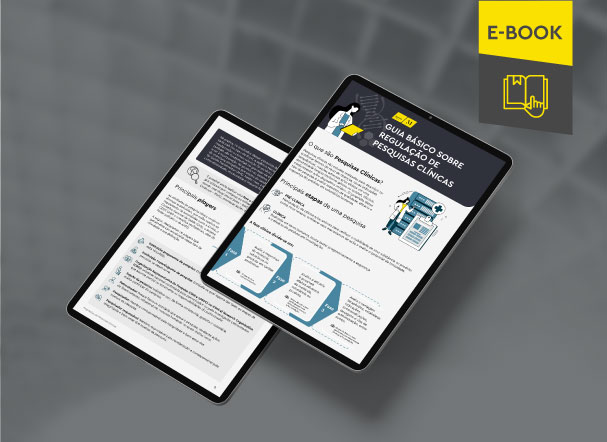
Clinical research is conducted to discover or confirm risk factors for diseases, new therapeutic indications, adverse reactions, and/or effects of a specific therapy (including gene or cell therapy), technique, medication, and/or medical device. The purpose of this type of research is to evaluate aspects of quality, efficacy, and safety of the product in human volunteers.
Our ebook "Basic Guide on Clinical Research Regulation" details each step of introducing new therapies, medications, and medical devices to the market, from pre-clinical phases to human trials, addressing the regulation involved.
The ebook explains the vital role of the key participants in the process – including researchers, institutions, and volunteers – in conducting these research studies. Additionally, it provides a clear overview of Bill 7,082/17, which aims to establish a legal framework for clinical research in the country, ensuring legal certainty and process simplification.
The publication highlights all relevant aspects of the topic:
- Research stages
- Regulation and approval
- Key participants
- Bill 7,082/17

- Category: Life sciences and healthcare
The Ministry of Health published, on May 4th, 2024, Ordinance GM/MS 3.232/24, which alters Consolidation Ordinance GM/MS 5/17 and launches a new digital health program within the Brazilian Publica Health System (“SUS Digital Program”). The initiative seeks to promote digital transformation in the SUS in areas such as:
- comprehensive health care;
- health surveillance;
- training and continuing education of health workers and professionals;
- management of the SUS (at all levels and spheres); and
- planning, monitoring, evaluation, research, development and innovation in health.
The SUS Digital Program will be implemented by the Federal Government, states, the Federal District and municipalities, with the possibility of participation of higher education institutions, technological institutes and research institutions.
Concepts and definitions
The new ordinance brings important concepts and definitions for understanding the objectives, development stages and actions/projects of the SUS Digital Program. Among them, the following stand out:
- Sensitive personal health data: any data relating to a data subject's health or health care provided to him or her that reveals information about your physical or mental health in the present, past, or future. It is important to note that this is a complementary definition to the concept of sensitive personal data, relating to health or sex life, genetic or biometric data, brought by Law 13.709/18 (General Data Protection Law – LGPD);
- Digital health ecosystem: system with technical objects, techniques and technologies organized on a physical basis (connectivity, equipment and auxiliary devices), structures (networks, systems and databases), instruments (electronic medical records, self-applied records and protocols), operational processes (programs, applications and routines) and applications of digital techniques, for problem solving or interventions in health situations;
- National Digital Health Maturity Index (INMSD): representation of the results of metrics used for the diagnosis, monitoring and evaluation of digital maturity, including the most important indicators to demonstrate the sustainability of digital health actions and services;
- Digital health: a set of knowledge, techniques, practices, attitudes, ways of thinking and values related to the use of digital technologies in health and the growth of the digital space.
Objectives
Among the objectives of the SUS Digital Program, we highlight:
- foster the appropriate, ethical, and critical use of new digital technologies in the SUS;
- support the proposition of collaborative and free digital solutions that improve the provision of services, the management of care by health professionals and the quality of health care;
- encourage training and continuing education in digital health;
- promote sensitization, awareness and engagement for the use of digital technologies and adequate data processing by SUS actors, fostering the culture of digital health and the protection of personal data;
- promote the interoperability of health data;
- reduce inequality in access to digital health solutions and services in the different regions of the country.
Development Steps
The SUS Digital Program will be divided into three stages of development:
- Step 1: preparation of the Action Plans for the Transformation of Digital Health (PA Saúde Digital) by the states, the Federal District and municipalities that adhere to the SUS Digital Program, according to the following phases (Ordinance GM/MS 3.233/24):
- diagnosis of the territory situation, considering the health macro-region to which the plan refers and establishment of the degree of digital maturity based on the application of the INMSD – according to guidelines to be released by the Secretariat of Information and Digital Health by April 3rd of this year; and
- analysis of the territory situation diagnosis and the recommendations resulting from the application of the INMSD.
The execution of the three phases related to the preparation of the Digital Health PA must meet the following deadlines – under penalty of suspension of the financial incentives (transfers) provided for in Ordinance GM/MS 3.233/24:
- by April 3 of this year – states, the Federal District and municipalities must submit a request to join the SUS Digital Program;
- within 90 days from the Ordinance publication date – diagnosis of the territory situation must be sent; and
- within 120 days from the date of submission of the territory situation diagnosis – PA Digital Health by macro-region must be sent.
- Step 2: Implementation of the respective Digital Health Transformation Action Plans, elaborated in the form of Step 1.
- Stage 3: evaluation of the actions implemented as a result of the program, with reference to the INMSD.
The Ministry of Health will publish other ordinances with guidelines on stages 2 and 3 of the SUS Digital Program and its actions.
Actions and projects
According to Ordinance GM/MS 3,232/24, the digital transformation actions and projects resulting from the SUS Digital Program must be based on one or more of the following axes of action:
- Axis 1: digital health culture, training and continuing education in health, which covers initiatives such as:
- training and continuing education in digital health;
- strengthening the digital health ecosystem by promoting open innovation; the structuring of a collaborative network for the sharing of experiences, knowledge, culture and practices among actors; and co-creation with citizens and organised civil society;
- strengthening the use of studies and evidence for the incorporation of digital technologies in health;
- fostering a culture of protection of personal and sensitive health data; and
- improvement of health records.
Axis 2: technological solutions and digital health services within the scope of the SUS, which covers initiatives such as:
- support for the computerization of the SUS and the adoption of electronic medical records that meet the interoperability standards of the RNDS;
- supporting the improvement of infrastructure for digital and connectivity systems;
- strengthening security mechanisms for access to health systems, data, and information;
- encouraging the structuring and use of technological solutions and digital health services within health establishments and services;
- strengthening digital health for health care for neglected, vulnerable, and geographically isolated populations and indigenous peoples; and
- expansion of the offer of telemedicine and telehealth within the scope of the SUS in the national territory.
- Axis 3: Interoperability, analysis and dissemination of health data and information, which covers initiatives such as:
- promoting the interoperability of health data with the RNDS;
- management and governance in the sharing of health data;
- elaboration of technical studies, guidelines and protocols, analysis and dissemination of data to support digital health strategies and innovation in health;
- standardization of national information models, as well as health vocabularies and terminologies;
- promotion of the dissemination of health data and information, maintaining confidentiality, privacy, data protection and security of personal health information; and
- preservation of the authenticity, integrity, traceability and quality of health information.
The following guidelines must be observed for the execution of digital transformation actions and projects:
- universality and equity in access to digital health products and services, at all levels of health care;
- recognition of the National Health Data Network (RNDS) as the digital platform for interoperability, innovation, information and health services for all of Brazil;
- active transparency in the availability of data and information that enable the monitoring and participation of society in the social control of digital health services and policies, with cooperation between federated entities;
- use of information and communication technologies to support the decentralization of health activities, observing regional and local specificities;
- recognition of access to quality internet as essential to promote digital inclusion and reduce inequalities in access to information and communication technologies necessary for the realization of digital health;
- guarantee of the safe use of information, in compliance with the rules on data protection provided for in the legislation;
- prioritizing digital health in the training and continuing education in health of SUS health professionals and workers; and
- association of the program's digital health actions with the SUS health care model, to guide its conduction.
Our Life Sciences & Healthcare practice can provide more information on the topic.