Publications

- Category: Capital markets
CVM Resolution 175/22 represents a new regulatory framework for investment funds, modernizing the rules on the constitution, operation and disclosure of fund information and the provision of services to funds. The rule replaces and repeals 35 normative instructions and three resolutions issued by the Brazilian Securities and Exchange Commission (CVM).
In this ebook, we detail the changes brought about by the new regulations, which came into force on October 2, and their tax aspects.
- Category: Tax
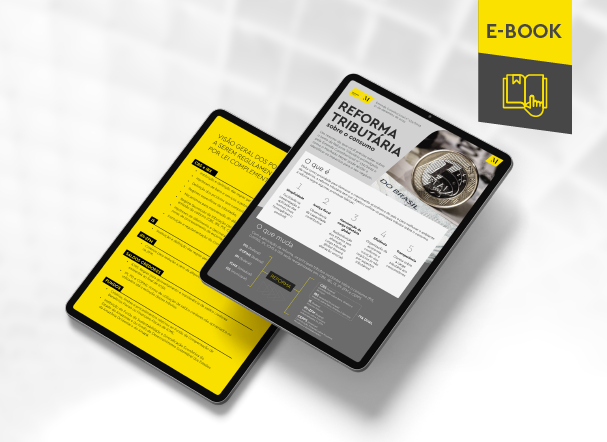
Elected as a national priority, the tax reform will unify the main taxes on consumption in order to improve Brazil's business environment and boost its economic growth.
To help you understand the changes and the impact of these transformations on the business landscape, we have put together a complete guide to the Tax Reform on Consumption, summarizing the challenges and opportunities for companies as they adapt to the new tax environment.
The guide explains the evolution in the way taxes are collected and administered in Brazil and the new tax categories, which simplify the tax system and seek to promote greater efficiency. Understand what Dual VAT is, the situations in which the Differentiated Taxation System will be applied, and which other tax systems will be maintained.
Check out the Portuguese and Spanish versions of the content at the following links:

- Category: Labor and employment
The year 2023 was marked by a clash between the decisions handed down by the Labor Courts and the Federal Supreme Court (STF), especially with regard to accepting the validity of other types of employment relationships, in addition to the employment relationship provided for in the Consolidated Labor Laws (CLT).
Despite the decisions handed down by the STF in actions for concentrated control of constitutionality (ADPF 324, ADC 48, ADIs 3.961, and 5.625) and the theory established in general repercussion in the judgment of RE 958252 (Topic 725), the Labor Courts continue to recognize the unlawfulness of other forms of hiring.
This understanding was sometimes based on doctrinal ideals used as grounds for legal relationships regulated by different instruments to be considered fraudulent and end up having an employment relationship recognized as established in the CLT.
As a result, there was a flurry of constitutional complaints that culminated in hundreds of STF decisions annulling decisions handed down by the Labor Courts due to non-compliance with Supreme Court precedents. These STF decisions are sometimes accompanied by severe criticism of the way in which the Labor Courts administer justice.
The Labor Courts, in turn, feels increasingly under attack in the face of threats to strip it of its jurisdiction and the constant overturning by the Supreme Court of understandings that had previously been established in the Labor Courts.
The clashes between the STF and the Labor Courts show that we are still a long way from achieving the legislator's goals of reducing repetitive litigation, guaranteeing equal protection for the litigants, and increasing the legal certainty of judicial activity. It is not new that the Brazilian legal system has been structured to achieve these goals, as was the case with the reforms to the old Code of Civil Procedure, Constitutional Amendment 45, the promulgation of the Code of Civil Procedure in 2015, and the Labor Reform in 2017, among other initiatives.
With the enactment of Constitutional Amendment 45 (EC 45/03), the constitution introduced the concept of binding precedents into our legal system. Taken in its full context, this initiative is an approximation of the idea of the duty to observe judicial precedent present in common law. The aim is precisely to impose a normative mechanism that helps to standardize case law and provide greater legal certainty for the litigants.
In the same vein, the 2015 Code of Civil Procedure requires judges to comply not only with binding precedents, but also with all decisions handed down by the STF in actions for concentrated control of constitutionality, in rulings on incidental proceedings for assumption of jurisdiction, or resolution of repetitive demands and in the judgment of repetitive extraordinary and special appeals, and with the precedents handed down by the STF and STJ. The same applies to the guidelines of the courts en banc or special bodies of the courts to which they are attached.
Despite the legislator's efforts to impose mechanisms for the social pacification of judicial activity, 20 years after EC 45/03 and almost a decade after the "New" CPC entered into force, little progress has been made in reducing repetitive litigation. There are still many conflicting decisions on the same subject, which creates undeniable legal uncertainty for labor litigants.
Much has been said about the political differences between the two judicial bodies as the cause of these conflicting positions. However, it seems to us that the difficulty in providing greater legal certainty in decisions is, in fact, intrinsically related to the undue use of discretion in judicial activity, which must be rejected in any instance.
Within the scope of the Labor Courts, despite the fact that the Constitution confers jurisdiction on these courts to prosecute and judge any and all disputes over labor relations, in general, what was observed was an almost automatic classification of the legal relationship between the parties under the CLT.
This practice was often carried out in a discretionary manner, as a way of protecting one of the parties from what was seen as making labor precarious, completely ignoring the circumstances that permeated other forms of hiring. This led the discussion to the STF so that the issue could be settled.
Currently, even in the face of the STF's binding decisions, some Labor Courts continue to act in a discretionary manner by not even weighing the STF's precedents when faced with discussions regarding invalidating legal relationships without an employment relationship.
By legal and constitutional force, the decisions handed down by the STF in actions of concentrated control of constitutionality - such as those handed down in ADPF 324, ADC 48, ADIs 3.961 and 5.625, as well as in the judgment of RE 958252, which led to the theory general repercussion set out in the enunciation of Topic 725 - consist of formal sources of labor law.
These decisions cannot, as some labor judges have been doing, be ignored in judicial rulings. The STF's intention to curb decisions that, based on discretionary acts, ignore the existence of binding decisions is therefore legitimate.
On the other hand, the existence of binding decisions as mentioned above cannot have the power to rule out the functional jurisdiction of the Labor Courts, provided for in the Constitution, to hear and decide conflicts related to labor relations. Labor judges have the prerogative to proceed with a hermeneutic interpretation of labor law, in all its sources, which includes binding decisions, with the autonomy to cease applying them, as long as the techniques for overcoming precedents are duly used, with an emphasis on distinguishing and overruling.
In this sense, it seems to us that the solution to impasses of this kind will only come about when the courts overcome totalitarian ideologies and definitively abolish the adoption of discretionary criteria in the administration of justice, using techniques for the formation and interpretation of precedents. This is necessary in order to ensure greater legal certainty and swift and efficient access to justice for all litigants.
These are certainly the wishes for 2024 of all legal practitioners, especially those who practice in the Labor Courts.

- Category: Labor and employment
The joint judgment of the motions for clarification filed due to omissions, contradictions, and obscurities in the preliminary injunction granted in Direct Action for Unconstitutionality 7.222 (ADI 7.222) was completed on December 18th.
The ADI was filed by the National Confederation of Health, Hospitals, and Establishments and Services (CNSaúde) against Law 14.434/22, which established the national salary floor for nurses, nursing technicians, nursing assistants, and midwives (national nursing floor).
In an en banc judgment of the Federal Supreme Court (STF), the dissent opened by Justice Dias Toffoli prevailed. There were six votes in favor of the understanding that:
- the implementation of the national nursing floor must be carried out through collective bargaining for employed professionals in general;
- the national nursing floor refers to the overall remuneration of the civil servant or the employed professional; and
- the proportionality of the national nursing floor is in relation to the working day of eight hours a day or 44 hours a week.
Collective bargaining is essential in order to apply the floor
Among the points addressed in the motions for clarification filed in ADI 7.222 was obscurity as to what would consist of "sufficiently substantive and apt collective bargaining" to serve as an indispensable condition for application of the national nursing floor described in the decision granting a preliminary injunction upheld by the STF in July of 2023.
In partially granting amending effect to the motion for clarification filed by CNSaúde, Justice Dias Toffoli presented a vote in which he defined application of the national nursing floor through regionalized collective bargaining and observing the base date. If collective bargaining is unsuccessful, the parties have the prerogative to initiate collective dissent. Justice Dias Toffoli established a new wording for item (iii) of the decision granting a preliminary injunction upheld by the STF:
"(iii) in relation to employed professionals in general (article 15-A of Law No. 7,498/1986), implementation of the salary floor must take place on a regionalized basis through collective bargaining carried out in the different territorial bases and on the respective base dates, with what is negotiated prevailing over what is legislated, in view of the concern regarding possible layoffs and the essential nature of the health service. If collective bargaining is unsuccessful, collective dissent, by mutual agreement, is fitting (article 114, paragraph 2, of the Federal Constitution of 1988), or, independently of this, in the event of a momentary stoppage of services carried out by any of the parties (article 114, paragraph 3, of the Federal Constitution of 1988). The resolution of the conflict by the Labor Courts will be guided by the primacy of maintenance of jobs and the quality of patient care, respecting the economic realization of each region."
The dissenting vote presented by Justice Dias Toffoli - and concurred with by Justices Alexandre de Moraes, Cristiano Zanin, Gilmar Mendes, Luiz Fux, and Nunes Marques - made collective bargaining an essential procedure for application of the national nursing floor, favoring what is negotiated over what is legislated.
As we had already argued when the STF's decision granting a preliminary injunction was published, in July of 2023, the logic behind the preliminary injunction was to make collective bargaining a condition for implementation of the national nursing floor, in order to avoid negative externalities.
In the case of the national nursing floor, as highlighted in the vote of Justice Gilmar Mendes, the negative externalities would be "reduction of jobs through the practice of mass layoffs" and "damage to the continuity of provision of health services."
Overall remuneration
As Justice Dias Toffoli's dissenting vote prevailed, item (iv) was set as part of the decision granting a preliminary injunction upheld by the STF in July of 2023, to define that the national nursing floor refers to the "minimum amount to be paid according to full working day."
Accordingly, the national nursing floor will correspond to the "overall remuneration" of the civil servant or employed professional, encompassing "all the amounts received" and not just the base salary or wage.
Proportionality of the floor to the working day
Although the reporting judge, Justice Luís Roberto Barroso, presented a vote that reduced the working hours parameter for the payment of the national nursing floor to 40 hours a week, the dissenting vote presented by Justice Dias Toffoli prevailed.
Thus, item (iv) set for addition to the decision granting a preliminary injunction upheld by the STF in July of 2023 mentioned the working hours of eight hours a day or 44 hours a week as a parameter for payment of the floor. Working hours can be reduced proportionally through collective bargaining.
The STF has yet to decide on the merits of ADI 7.222 filed by CNSaúde. The judgment refers only to the motions for clarification filed against the decision granting a preliminary injunction upheld by the STF en banc.
The decision, therefore, only clarifies omissions, contradictions, and obscurities related to the preliminary injunction granted by the STF, resulting from CNSaúde's request to suspend the effects of Law 14,434/22.
The appellate decision has yet to be drafted by Justice Dias Toffoli.

- Category: Labor and employment
Published on December 22, Law 14,766/23 added another paragraph to article 193 of the Consolidated Labor Laws (CLT). This article deals with activities considered hazardous and provides for the granting of a 30% hazard premium to workers exposed to them.
The new provision mainly benefits employers in the road transport sector, as it rules out the payment of hazard pay to vehicle drivers under certain conditions.
The new provision states:
"Paragraph 5. The provisions of subsection I of the head paragraph of this article do not apply to the quantities of flammables contained in the original factory fuel tanks and supplementary fuel tanks, for the own consumption of cargo vehicles and public passenger transport vehicles, machinery and equipment, certified by the competent body, and in cargo refrigeration equipment."
With the inclusion of paragraph 5 in article 193 of the CLT, therefore, the hazardous nature of the activities and operations carried out by drivers of vehicles exposed to flammable fuels is expressly ruled out, provided that the requirements mentioned in the text are met.
The change in the CLT is relevant due to the divergent interpretations given by regional courts regarding the mandatory payment of the hazard premium to workers exposed to this situation. In addition, the Superior Labor Court (TST) has already established that the premium must be paid, even if the legislation in force states otherwise.
Decisions favoring payment of hazard pay are based on the text of Regulatory Standard 16 (NR-16) created by the Ministry of Labor to regulate hazardous activities and operations established in articles 193 to 196 of the CLT.
This is because item 16.6 of NR-16 states that "transport operations of flammable liquids or liquefied gases, in any container and in bulk, are considered to be hazardous, with the exception of transport in small quantities, up to a limit of two hundred (200) liters for flammable liquids and one hundred and thirty-five (135) kilos for flammable liquefied gases."
However, when ordering employers to pay hazard pay, judges end up disregarding items 16.6.1 and 16.6.1.1, included in NR-16 in December of 2019.
These items exclude from the standard established by item 16.6 the quantities of flammables contained in vehicles' own consumption tanks, as well as those contained in original factory fuel tanks and supplementary tanks certified by the competent body.
It is therefore believed that the inclusion of paragraph 5 in article 193 of the CLT will guide the courts in their judgments and bring an end to discussions on the subject.
It is important, however, to keep a close eye on future decisions, as it is uncertain whether the change will affect current employment contracts or only those entered into after the law's publication.

- Category: Labor and employment
Among other qualities, the legal community is very skilled at creating memes on social media. And there's no time of year better suited to generating memes than the so-called judicial recess. "It's already judicial recess in Australia," says a meme that has now become a tradition.
This article aims to clear up some myths related to the judicial recess and vacations, as well as revealing two or three well-kept secrets about labor law practice in the higher courts.
- OVERCOMING A MYTH AND REVEALING SOME SECRETS
To begin with, the most important thing: the myth that all deadlines are suspended during the judicial recess and vacations is false.
We are not referring to statutory limitations or lapse periods, nor to the exception made by article 215 of the Code of Civil Procedure (CPC) on the time limits that apply during judicial vacations. Nor is it the case of the rule in article 129, II, of Law 8,213/91, which provides for the processing of disputes and injunctive measures relating to accidents at work, including during judicial vacations. Or, again, the time limit for an action for vacatur - which, as is well known, is extended to the first subsequent business day "when it expires during judicial vacations, recesses (...)" (article 975, paragraph 1, CPC).
We are dealing here with labor procedural deadlines that are not suspended during judicial recess and vacations. These deadlines exist and overcome the myth that all labor procedural deadlines are suspended during judicial recesses and vacations. The fall of this myth is also the revelation of a first secret: the existence of a universe that does not stop working during judicial recesses and vacations, the Disciplinary Board of the Labor Judiciary (CGJT).[1]
A subject little studied by the legal profession and to a certain extent unknown even to lawyers, the jurisdiction and duties of the Disciplinary Board of the Labor Judiciary form a magnificent universe that is fully expanding even during the judicial recess and vacations.[2] The CGJT's own case law establishes that its activities are uninterrupted:
- “APPEAL PURSUANT TO INTERNAL RULES OF COURT. PARTIAL CORRECTION. UNTIMELINESS. COURT RECESS. UNINTERRUPTED ACTIVITY OF THE DISCIPLINARY BOARD. 1. An interlocutory appeal does not merit relief when the reasons given fail to undermine the grounds set out in the decision rejecting the complaint. 2. The activities of the Disciplinary Board of the Labor Judiciary are uninterrupted, and the judicial recess does not constitute a cause for suspension of the time limit in the rules referred to in article 17 of the RICGJT. Precedents. 3. Interlocutory appeal denied relief." (TST, Special Body, CorPar - 1000013-93.2019.5.00.0000, opinion drafted by Justice Lelio Bentes Correa, DJ, October 15, 2019, emphasis added)
The precedent shows that the deadline laid down in article 17 of the Internal Rules of the Disciplinary Board of the Labor Judiciary (RICGJT) is not influenced by the judicial recess.[3] This reveals a second secret - perhaps the most important one: the five-day deadline for filing for a partial correction influences the deadline for filing an appeal in the main action.
The subject is broad and beyond the limits of this short article. The idea, however, is simple: if the party wants to preserve the useful outcome of the main proceedings, it should bring forward the filing of the appeal in the main action and make it coincide with the deadline for filing the partial correction. It's something that even relates to article 218, paragraph 4, of the CPC and with the rule that says that an appeal filed before the start of the deadline is timely.[4]
An important precaution can be added to equalize the judicial recess and group judicial vacations.
For labor lawyers who do not practice before the Superior Labor Court, the judicial recess is established by article 775-A of the CLT: the procedural deadlines are suspended between December 20th and January 20th, inclusive.[5]
But Brazilian cassazionisti or barristers practicing before the Superior Labor Court need to consider in their strategies the canonical judicial recess, so to speak, and the group judicial vacations, "in the periods from January 2 to 31 and from July 2 to 31" (article 66, paragraph 1, of Complementary Law 35/79).
Another trap is hidden here and a third secret for lawyers is revealed: even during the group vacation period , the work of the Disciplinary Board of the Labor Judiciary is uninterrupted. CGJT case law states as follows:
- “APPEAL PURSUANT TO INTERNAL RULES OF COURT IN A PARTIAL CORRECTION. UNTIMELINESS OF THE CORRECTION MEASURE. JUDICIAL RECESS AND GROUP VACATIONS. UNINTERRUPTED ACTIVITY OF THE DISCIPLINARY BOARD. 1. The activity of the Disciplinary Board of the Labor Judiciary is uninterrupted. In the event of any absences or temporary impediments, the Disciplinary Board of the Labor Judiciary will be replaced by the Deputy Chief Judge, or, in the absence of the Deputy Chief Judge, by the Chief Judge, and then by the Justices, in descending order of seniority, in accordance with articles 15, subsection III, of the Internal Rules of the Superior Labor Court and 2, paragraph 2, of the Internal Rules of the Disciplinary Board of the Labor Judiciary. For this reason, neither the judicial recess nor the group vacations of the Justices of the TST constitute a cause for suspending the five-day deadline for the interested party to request partial correction from the Disciplinary Board of the Labor Judiciary. Particularly in this case, where the party invokes a suspension of deadlines within the jurisdiction of the Regional Court. 2. The Appellant did not put forward any argument that would undermine the grounds of the order under appeal, which is why the request for modification of the decision does not prosper. (TST, AgR-CorPar 1002-24.2016.5.00.0000, reporting judge Justice João Batista Brito Pereira, Special Body, DEJT, June 14, 2016, emphasis added)
- DISTINCTION BETWEEN THE DEADLINES FOR FILING FOR PARTIAL CORRECTION AND FOR FILING AN INTERLOCUTORY APPEAL PER INTERNAL RULES OF COURT
The difference is fundamental between the deadline for submitting the partial correction and the deadline for filing an interlocutory appeal with the Special Body of the Superior Labor Court - an appeal that may be lodged, depending on the alternative chosen by the Justice member of the Disciplinary Board of the Labor Judiciary (a position currently held by Justice Dora Maria da Costa) when submitting the application for partial correction.
One of the alternatives involves immediate rejection of the partial correction, "if it is inadmissible, inept, untimely, or unaccompanied by an essential document" - which reinforces the need to pay attention to timeliness, even during judicial recesses and vacations.[6]
A question little debated in labor law scholarship: if the request for correction is rejected or granted during the recess and vacation periods, is the deadline for filing the interlocutory appeal, provided for in article 35 of the RICGJT,[7] influenced by the suspension of deadlines or is it not suspended?
It seems like a simple question, but it led to a tie,[8] a request for review, twists and turns,[9] and a great deal of reflection in the paradigmatic precedent RC 1552056-38.2005.5.00.0000, in which the theory was established that the time limit for the interlocutory appeal is suspended during judicial recesses and vacations. Since then, this understanding has been reiterated, maintaining the distinction between the deadlines for filing for a partial correction and for filing an interlocutory appeal:
- “(...) V - Here it is worth noting the impertinence of the appellate decision in AG-RC-1552056-38.2005.5.00.0000 (DJ of September 1, 2006), invoked by the appellant to support its version that the case law that does not suspend deadlines in this Disciplinary Board during the judicial recess is not settled. VI - It was argued there that the urgency capable of justifying absence of suspension of the deadline during the judicial recess was indiscernible in the case of an interlocutory appeal, that is, an "appeal filed against a decision of the Disciplinary Board," a situation different from that outlined in the decision under appeal, in which the untimeliness of the partial correction was recorded. VII - The subject-matter inadequacy of the provisions of articles 173, head paragraph, 179 of the CPC and 183 of the RITST should also be emphasized, since the rules of the CPC and the Internal Rules of this Court refer to procedural deadlines, that is, deadlines that must be observed in the triangular procedural relationship in which its protagonists are involved, among which the deadlines referring to the judge stand out, with everything indicating that they refer substantially to the exercise of judicial activity, unrelated to the duty of the Disciplinary Board, known to be of an administrative nature, according to article 709 of the CLT and article 6, subsection II, of the RICGJT/2011. VIII - Hence no violation of subsections XXXV, LIV, and LV of article 5 of the Constitution can be seen, either because the decision under appeal refers to the repeated actions of the Disciplinary Board, or because the untimeliness of the partial correction does not reach a constitutional level. IX - Interlocutory appeal denied relief." (TST-AG-CorPar-301-68.2013.5.00.0000, Special Body, reporting Justice Barros Levenhagen, DEJT, April 5, 2013, emphasis added)
- CONCLUSION
There are many lessons in the case law of the Disciplinary Board of the Labor Judiciary that, if looked at carefully, become secrets revealed to the lawyer obliged to act during judicial recesses and vacations.
Only those who have had to draft and file a partial correction on Christmas Eve know that obtaining a favorable decision from the Disciplinary Board of the Labor Judiciary on Christmas Day gives new meaning to hope in justice and makes concrete the theoretical idea that to win without challenges is to triumph without glory.[10] For the lawyer who prefers to wait until the end of the judicial recess and vacation to file a partial correction, there will always be the story already told by the precedent TST-AG-CorPar-301-68.2013.5.00.0000:
- "INTERLOCUTORY APPEAL IN PARTIAL CORRECTION - IN LIMINE DISMISSAL OF THE COMPLAINT AS UNTIMELY - NON-SUSPENSION OF THE DEADLINE FOR FILING THE CORRECTIVE MEASURE DURING THE JUDICIAL RECESS - READING OF ARTICLES 15, SUBSECTION III, OF THE RITST AND 2, PARAGRAPH 2, OF THE RICGJT/2011 - INSUBSISTENCE OF THE ARGUMENTS ON APPEAL. I - It should be noted, as it was in the decision under appeal, that article 15, subsection III, of the RITST provides that, in the event of absences or temporary impediments, the Disciplinary Board of the Labor Judiciary will be replaced by the Deputy Chief Judge, or, in the absence of the Deputy Chief Judge, by the Chief Judge, and then by the Justices, in descending order of seniority". II - Article 2, paragraph 2, of the RICGJT/2011, in turn, states that "in the event of absences, impediments, and vacations, the Justice serving as Disciplinary Reviewer will be replaced, in the exercise of his functions, by the Deputy Chief Justice or, in his absence, by the Chief Justice of the Court and, if this is not possible, by the Justices in descending order of seniority". III - It is clear from the aforementioned rules of procedure that the exercise of the duties conferred on the Disciplinary Board of the Labor Judiciary does not suffer from dissolution of continuity, such that the judicial recess and collective vacations cannot be characterized as causes that suspend expiration of the period for the interested party to file for partial correction (precedents of the Disciplinary Board of the Labor Judiciary). IV - Based on these considerations and taking into account the rule of article 17, head paragraph, of the RICGJT/2011, which sets the deadline for filing for partial correction at five days, the measure sought is untimely, since the applicant was unequivocally aware of the decision to be corrected on December 19, 2012, and did not realize that the deadline had fallen on December 24, 2012, and only filed the complaint on January 11, 2013. (...)." (TST-AG-CorPar-301-68.2013.5.00.0000, Special Body, reporting judge Justice Barros Levenhagen, DEJT, April 5, 2013, emphasis added)
Of course, for many lawyers, all the "secrets" revealed by this article are nothing more than Pulcinella's secret.[11] Anyone who is familiar with the case law of the Superior Labor Court knows that, "according to long-standing and settled case law, the recess does not constitute a cause for suspending the flow of time limits for the applications for correction." This case law was already well-established in 2009, when the following judgment was published:
- "On the other hand, the Application for Correction is manifestly untimely. Under the terms of article 15 of the Internal Rules of the Disciplinary Board of the Labor Judiciary, the deadline for filing an application for correction is five days, counting from publication of the act or order in the official gazette, or from the party's unequivocal knowledge of the facts relating to the objection. In this case, the act now contested was published in the Electronic Journal of the Labor Courts on Thursday, December 18, 2008 (page 481). Thus, the legal five-year period for filing an application for correction began on Friday, December 19, 2008, and ended on Tuesday, December 23, 2008. The Application for Correction under examination, however, was only filed on Thursday, February 5, 2009 (page 2). Untimely, therefore. It is important to emphasize that, according to long-standing and settled case law, the recess does not constitute a cause of suspension of the flow of the deadline for applications for correction, either because there is no legal permission, or because the Disciplinary Board of the Labor Judiciary runs uninterruptedly. (...)." (TST, RC-2044806-52-2009.5.00.0000, Disciplinary Board of the Labor Judiciary, Justice João Oreste Dalazen, decided on February 12, 2009, emphasis added)
But the competence and duties of the Disciplinary Board of the Labor Judiciary involve highly complex and challenging issues. Just think, for example, of the impact and potential that article 22 of the RICGJT can acquire in a system of mandatory and qualified precedents.[12] Not to mention the gigantic scenario that emerges from reading the sole paragraph of article 13 of the RICGJT.[13] To return to the memes: those in the know will know.[14]
Finally, when you see a legal meme about the judicial recess and vacations, remember that neither St. Ivo nor St. Claus will be able to help if your lawyer forgets that the activities of the Disciplinary Board of the Labor Judiciary are uninterrupted.
[1]The purpose of this article is to deal with the dynamics of the Disciplinary Board of the Labor Judiciary during judicial recesses and vacations. At some point in the future, another article will have to be written to deal with the equally relevant and admirable performance of the chief judge’s chambers of the Superior Labor Court during judicial recesses and vacations. As the TST operates on call during this period and there is no service in the offices and chambers of the Justices, it is incumbent on the Chief Judge, independently of the reporting judge, to "decide, during the judicial recess, collective vacations, and holidays, on petitions for injunctions in applications for mandamus, provisional injunctions of an urgent nature, and other measures claiming urgency" (article 41 of the Internal Rules of the TST).
[2] In general, when thinking about the jurisdiction and duties of the CGJT, it is not usually considered beyond the head paragraph of article 13 of the RICGJT, according to which "Partial Correction is appropriate to correct errors, abuses, and acts contrary to good procedural order and which imply an infringement of legal procedural formulas, when there is no appeal or other specific procedural means for the case."
[3] RICGJT, article 17: The deadline for filing a Partial Correction is five (5) days, counting from the publication of the act or order in the official gazette, or from the party's unequivocal knowledge of the facts relating to the objection.
[4]CPC, article 218, paragraph 4: Any act carried out before the initial deadline will be considered timely.
[5] However, there is already a case of this rule being relaxed: lawyers who work at the Campinas Labor Court in São Paulo, for example, managed to sensitize the administration of the Court of the 15th Region and won a few more days of judicial recess. As a result, procedural deadlines in that court will also be suspended from January 21 to 29, 2024, with deadlines resuming on January 30, inclusive (GP-CR Ordinance 15/23).
[6]The alternative of an immediate dismissal of partial correction is indicated in article 20, I, of the RICGJT. The second alternative is provided for in article 20, II, of the RICGJT: preliminary granting of suspension of the act objected to by the application for partial correction. The third alternative is provided for in article 20, III, of the RICGJT: to dismiss the partial correction outright, provided that the request is manifestly unfounded. And a fourth alternative has been noted in practice: the scheduling of a conciliation hearing.
[7]RICGJT, article 35: Decisions handed down by the Disciplinary Board may be appealed to the Special Body of the Superior Labor Court, in accordance with article 69, item I, letter "g", of the RITST.
[8] In the judgment session of November 10, 2005, two justices voted that the time limit for an interlocutory appeal was uninterrupted and two justices considered that the time limit for an interlocutory appeal was suspended during the judicial recess. A request for review of the record suspended the judgment, with the following scenario being recorded: "Decision: unanimously to adjourn the judgment of the case due to the request for review of the record granted to Justice João Oreste Dalazen, after the votes of the Hon. Justices Rider Nogueira de Brito and Ronaldo Lopes Leal to dismiss the appeal as untimely. The Hon. Justices Vantuil Abdala and José Luciano de Castilho Pereira voted to hear the appeal, dismissing it as untimely."
[9] It took a few months for the winning theory to be set, which established that the time limit for the interlocutory appeal is suspended during judicial recesses and vacations. The threshold issue of in limine rejection of the interlocutory appeal was rightly noted: "Decision: I - by a majority, to reject the threshold issue of non-admission of the interlocutory appeal, over the dissent of the Hon. Justices Ronaldo Lopes Leal, Antônio Barros Levenhagen, José Simpliciano Fernandes, and Emmanoel Pereira; II - unanimously, to dismiss the interlocutory appeal. Note: I - Justice Rider Nogueira de Brito, reporting judge, changed his vote in the session of November 10, 2005" (TST, en banc, published in the Gazette of the Judiciary on September 1, 2006).
[10] Among many precedents, see the emblematic decision handed down by Justice Dora Maria da Costa in CorPar 1001189-68.2023.5.00.0000, decided on December 22, 2023.
[11] Segreto di Pulcinella is an Italian idiomatic expression used to indicate a secret that is not actually secret because it has become public, despite the attempts to keep it secret by those who think they are the only people to know the "secret". In short, Pulcinella's secret is an obvious one known to all.
[12]RICGJT, article 22: The Disciplinary Board, if it deems it necessary, may order a copy of the final decision to be sent to other Judges and Courts for uniform observance.
[13]RICGJT, article 13, sole paragraph: In an extreme or exceptional situation, the Disciplinary Board may adopt the necessary measures to prevent damage that would be difficult to repair, thus ensuring a useful outcome to the proceeding, until the matter is examined by the competent judicial body.
[14]To go beyond the meme, we recommend reading the application of ADI 4.168 (reporting judge Justice Nunes Marques), filed by Anamatra to protect the freedom of labor judges against the actions of the Disciplinary Board of the Labor Judiciary.