Publications
- Category: Digital Law
In the fifth and final article in the series "Gaming, betting and eSports Law: what do you need to know?" we look at how companies can act ethically, responsibly and in compliance with applicable regulations.
The aim is to provide information that will help companies strengthen their legal security and properly manage the risks involved, so that they can make the most of the opportunities and reap better results from their practices.
Privacy and protection of personal data. Activities involving gaming and eSports practices, although they vary in terms of profile and governance structure, use personal data to carry them out. In other words, data that makes it possible to extract information about the individuals involved in these activities, especially players, bettors and employees.
It is essential that companies have solid governance of personal data in order to mitigate risks and be fully compliant with personal data protection legislation, in particular the General Personal Data Protection Law (LGPD) and its regulation by the National Data Protection Authority (ANPD). Solid governance will also be profoundly strategic if companies are to be able to use data in a legally compliant manner and be well-prepared to receive investments, positioning themselves consistently in the due diligences to which they are subjected.
- Companies also need to be ready to account for their activities. To do so, they must
- - have privacy as a key element of their vision and mission;
- - structure a team responsible for privacy issues and, above all, appoint a Data Protection Officer;
- - draw up and keep up-to-date data inventories, especially records of operations involving personal data, identifying and mapping all the legal bases and producing the relevant documents;
- - establish routines that consolidate the ideal of privacy by design so that privacy and the protection of personal data are integrated into all the organization's activities;
- - carrying out all relevant and necessary assessments, such as:
- o balancing tests for activities that draw on legitimate interest;
- o data protection impact reports for high-risk data processing and other situations;
- o artificial intelligence assessments;
- o supplier assessments;
- o assessments of information security controls and routines; and
- o relevant due diligence
- - drawing up and updating privacy policies and notices;
- - draw up and maintain a plan for responding to requests from personal data subjects.
- - implement training and awareness-raising measures for professionals;
- - properly prepare the company's contracts, with a clear configuration of the role of the processing agent and other relevant clauses;
- - adopt all technical or administrative measures to prevent any unlawful or inappropriate processing of personal data and privacy incidents, including drawing up a privacy incident response and remediation plan that includes simulated exercises to check risks and procedures in practice.
Nudges techniques and dark patterns. In order to maintain compliance with applicable legislation, especially on privacy and protection involving specific audiences such as children, adolescents and the elderly, it is highly recommended to avoid adopting nudges techniques and dark patterns.
Preventive technical and legal assessments are great initiatives to mitigate risks and avoid wasting investments. They can prevent the release of games that don't comply with best practices, or that require disrupting the production flow in order to make corrections or adjustments.
- Nudges techniques are resources used in the course of the game that guide or lead the user to follow the path that the developer wants. However, if the technique or this "path" harms the player's rights, these practices should be avoided.
- Dark patterns are nudges techniques that are more ostentatious or exert greater pressure on the user to choose what is best for the developer. Examples of what should be avoided in the initial evaluation and development of the practice, product or service - whatever its modality or platform of use - include the following features:
- play to skip, in which players are "invited" to pay a fee to make progress during the game;
- play to unlock, in which players are "invited" to pay an amount to unlock certain stages of the game or specific content; and
- dayly rewards, in which players receive prizes or in-game items on a daily basis, prompting them to play the game regularly.
Children and adolescents. Considered one of the main target audiences for these practices, there are concerns and risks directly related to the protection of children and adolescents. It is important to ensure that the development of practices aimed at this audience are in line with legislation, especially the Statute of the Child and Adolescent (ECA), the Consumer Protection Code (CDC) and the LGPD.
The mitigation of legal risks and the credibility of games are directly related to the ability of companies to include legal protection parameters in the game development process. Legal assessments and alignments are fundamental.
Among the main measures to be considered are:
- adopting mechanisms to identify players under the age of 18 with a high degree of accuracy and implementing tools and communications that discourage false declarations of age.
- prioritizing practices and initiatives that are not harmful to the health and well-being of children. For example, it is advisable to adopt measures to discourage playing games for long periods of time. These measures include:
- introducing frequent checkpoints;
- avoiding the use of loot boxes which make it a condition of eligibility to remain in the game for a long period of time;
- adopting age-related protocols to encourage players to take breaks; and
- not associating game results or success during the game with long periods of permanence.
- pay attention to misleading (not in line with reality) and abusive (taking advantage of the fragility or ignorance of children) advertising practices aimed at marketing games, services or related items.
- prioritize as a standard the non-adoption of profiling[1] of players for marketing or advertising purposes, especially those related to monitoring user behavior.
- implement measures to monitor or control games, advertising and player migrations to third-party activities that may not be at the same level of suitability and compliance.
- avoid the use of nudges techniques and dark patterns in the players' journey, mainly due to the greater vulnerability of this audience.
- adopt appropriate means to identify inappropriate or illegal behavior in interaction spaces (video, chat, etc.), including extreme situations in which adults participate in the game to commit crimes related to exposure and/or child pornography.
Artificial intelligence. Practices use artificial intelligence tools in a large part of their processes and operations. It is important for companies to seek the legal certainty necessary for the use of artificial intelligence, by adopting best practices for the use of this technology, in order to minimize risks, maximize opportunities and guarantee adequate levels of ethics, transparency, reliability and information security.
Among the initiatives, we recommend:
- develop and apply frameworks and solutions for ethical governance and legal compliance, with the identification of applicable ethical parameters, legislation and national and foreign precedents, highlighting, for example, the recent approval of the AI Act by the European Union;
- drawing up applicable transparency policies and documents;
- preparing the necessary assessments, such as those relating to the protection of personal data and the use of artificial intelligence;
- evaluate and contract suppliers;
- monitor and audit artificial intelligence systems; and
- training and raising awareness among the teams responsible, including policies on the conscious use of these systems to protect personal data and the company's intellectual property.
Information security. Information security is also a highly sensitive issue. Companies need to be prepared to mitigate the risks of digital fraud, cyber attacks and crises, as well as being ready to respond appropriately to all these situations.
It is essential that companies focus on:
- preparation, developing appropriate plans and structures to manage cyber risk and respond to incidents quickly and effectively. To this end, it is advisable to draw up and review response plans, policies, contracts, campaigns, codes of conduct and corporate governance structures to reduce exposure to risk and guarantee the preservation of electronic evidence, based on best market practices, ISO ABNT 27.000 and 31.000 standards, COBIT, ITIL, NIST practices, comparative law and current legislation.
- response, remaining prepared to contain the negative impacts of the event, ensure business continuity and protect the brand's reputation. To this end, it is recommended that companies be ready to investigate incidents, preserve the necessary evidence, manage crises by interacting with authorities and regulators, senior management and other stakeholders such as employees, suppliers and customers.
- remediation, remaining prepared to mitigate the impact of legal actions resulting from the incident - including liability - class actions, administrative proceedings, among others. It is also recommended that companies be prepared to review incidents in a process of evaluating gaps and lessons learned that helps strengthen the organization's information security.
[1] Profiling is any form of automated processing of personal data that evaluates personal aspects relating to an individual. The aim is to analyze or predict aspects relating to the data subject's performance, economic situation, health, personal preferences or interests, reliability or behavior, location or movements.
- Category: Digital Law
In this fourth article in the series "Gaming, betting and eSports Law: what do you need to know?", we deal with the concepts of gambling, the elements that differentiate the practices and the laws that regulate them.
Gambling. This broad category includes all practices, whether or not permitted by law and Brazilian case law, in which, in addition to the purpose of entertainment, the following elements are identified cumulatively:
- Payment of a consideration made by the person either directly (such as payment for the bet itself) or indirectly (as in the case of participation in a prize draw conditional on payment for some product or service, collection of personal data, etc.).
- The person has the chance of winning a financial or non-financial prize. It could be, for example, a product or an indirect benefit - such as discounts, loyalty program points, specific NFTs, accessories for characters in games, experiences, etc.
- The prize is won by participating in a game that depends solely on luck (chance) or luck combined with the participant's skill (skill). Games of pure skill would not be included.
There is a lot of disagreement about this third element. So far, there is no broad definition in Brazil. The expression "games of chance" adopted in the well-known article 50, paragraph 3, "a", of the Criminal Contraventions Law, which prohibits their exploitation, stands out. The provision defines a game of chance as "a game in which winning or losing depends exclusively or mainly on luck".
Subparagraphs b and c of paragraph 3 also mention other practices considered games of chance by the Brazilian legislator. Both deal with betting, whether on horse races not organized with state authorization or on any sports practice. There is a debate as to whether or not skill prevails in sports betting, as we will show below.
Some legislations (such as those of certain US states) and some of the literature on the subject work with a narrower concept of gambling, which only includes practices in which the results depend exclusively or predominantly on luck. If the player's skill is predominant, the practice is not considered gambling according to this concept.
How do you know if luck or skill is predominant?
One of the techniques used is the so-called "dominant factor or predominance test", which consists of identifying which of the elements is more present. The idea is to break down and understand all the elements and determine, on a scale, which ones prevail over the others, in a weighting exercise.
Other regulations are broader and consider the three elements above without distinguishing whether it is luck or skill that prevails.
This second group includes, for example, the broad concept introduced by the UK's Gambling Act of 2005, which encompasses the practices of gaming, betting and participating in lotteries (Section 3). Gambling would thus be the genus of these three species:
- Gaming: seen as "playing a game of chance for a prize" - Section 6 (1). At first reading, this could suggest games based solely on luck or predominantly on luck. For the Gambling Act, however, "game of chance" includes: games that involve luck and skill; games that involve luck even if skill prevails; and games in which elements of luck are introduced - Section 6 (2) (a). The practice of sports does not characterize a "game of chance" - Section 6 (2) (b).
- Betting: placing or accepting a bet on the results of races, competitions or any event; the probability of anything happening or not happening; or whether something is true or not - Section 9 (1).
- Lottery: any situation or arrangement that characterizes any of the situations defined in the Gambling Act Subsections (2) and (3).
The same occurs in French legislation in its Code de la sécurité intérieure (Article L 320-1), which, although it uses the expression games of chance, adopts the broad meaning. As such, it considers all practices that depend totally or partially on luck to be included in this category.
France used to separate games of chance, which were prohibited, from games of skill, which were permitted. As of 2019, they are all prohibited, with specific and regulated permissions for only a few practices.
Legality or illegality of gambling practices in Brazil
Currently, due to article 50 of the Criminal Contraventions Law, the assessment of the legality or illegality of a given practice in Brazil is linked to the legal concept of gambling and depends on the joint analysis of the two points below:
- Presence of the three elements: consideration, prize and luck (isolated or predominant). If any of them is not present, regardless of the item below, the practice will be considered lawful.
- Even if all three elements are present, it is necessary to check whether there is authorization in legislation or case law for the practice to be carried out, even if it is based on the three elements above.
By way of exception, some practices are permitted in Brazil, such as lotteries operated directly or indirectly by the state. If there is no legal permission and all three elements are present, the practice is prohibited under Article 50. If skill prevails (as in the case of sports poker), the practice is permitted.
Casino games. This subcategory of gambling includes all typical casino practices in which the results depend exclusively or predominantly on luck. Some examples:
- slot machines;
- roulettes;
- dice-based games;
- blackjack;
- baccarat;
- sweepstakes;
- jogo do bicho; and
- bingo with no social purpose
These practices are prohibited in Brazil under article 50 of the Criminal Contraventions Act, whether they take place in person or online. However, if the skill component prevails in any practice carried out in a face-to-face or online casino (as we will see later in the case of poker), the practice will not be considered gambling and may be permitted.
There are a number of bills underway that discuss the legalization of these practices. The main one is Bill 442/91, which proposes to allow most casino games and gambling practices in general. The bill was approved in 2022 in the Chamber of Deputies and is currently before the Federal Senate.
Lotteries. Another subcategory of gambling is lotteries. They bring together the elements of gambling, since there is a consideration (payment of money) by the player, who competes for predefined prizes. The prizes are conditional on luck. Lotteries are permitted in Brazil and operated at federal and state level.
At the federal level, according to Decree-Law 204/67 and federal laws 6.717/79 and 759/69, lotteries are organized and operated exclusively by Caixa Econômica Federal.
State exploitation was permitted by the Supreme Court in 2020 (Action for Failure to Comply with Fundamental Precept 492). Each state is responsible for defining how it operates the lottery.
Sports betting. Sports betting has been a growing and successful activity all over the world. In Brazil, it is estimated that the activity will generate R$12 billion by 2023.
Here, the modality is already commonplace and practiced on platforms hosted outside the country. Its regulation and permission began with Federal Law 13.756/18, which, in its article 29, defined sports betting as fixed-odds betting.
The regulation was renewed by Provisional Measure 1.182/23 and the Normative Ordinance of the Ministry of Finance 1.330/23 - to learn more about the norm, read a specific article published on the portal.
Executive Bill 3.626/23 is also currently being processed. The bill, which aims to regulate the issue, has already been approved by the Chamber of Deputies in the first vote and recently by the Federal Senate. The text returned to the House.
Sports betting or fixed-odds betting (or sports betting, online or otherwise) is defined in the legal system as betting systems related to real sporting events, in which, at the time the bet is placed, the bettor knows how much he could win if the prediction of the bet is confirmed.
By going into a little more detail about the concept, it is possible to extract the following elements:
- there is a betting contract signed with a promise of a consideration for the user if the prediction is confirmed;
- the bet must be linked to a real sporting event, which includes any sporting event - such as soccer, chess, eSports - but excludes fantasy or non-real situations (fantasy sports, for example);
- the activity must be carried out by a physical or digital system (set of organized elements), usually supported by the well-known betting platforms that operate the business (bookmakers); and
- when the bet is placed (either before the sporting event or during it), the bettor already knows how much he will receive if the prediction of his bet (future results of the sporting event) is confirmed (bet result equals the actual final result).
Poker. Poker in Brazil, mainly online, has grown exponentially, especially after the pandemic, with the popularization of home office.
There is no specific regulation on the practice of poker in the country and the legal debates on the subject refer, in particular, to the discussion of whether the practice is considered gambling or game of chance (based on luck) or not (based on skill).
How can gaming, betting and eSports practices be conducted in an ethical, responsible and legally compliant manner? This is the subject of the fifth and final article in this series.
- Category: Digital Law
In this second article in the series "Gaming, betting and eSports Law: what do you need to know?" we look at the legal aspects of games and electronic games.
Games. This category includes practices and electronic games whose main element is to entertain users, regardless of the type of game: sports, action, adventure, strategy, role playing games (RPG), racing, simulators etc.
The number of users, the profile of the players (children, teenagers, adults, the elderly) and even the platforms ou gadgets used (consoles, computers, smartphones, tablets, among others) are not relevant elements to categorize the practice as games or electronic games.
Documents from the European Parliament, for example, propose classifying games as:
- video games: broader category involving games played on mobile and other devices - such as computers and consoles.
- mobile games: category of games played on mobile devices - such as smartphones and tablets.
- online games: this category includes all games in which elements are played online. It allows, for example, interaction between players in multiplayer games.
If the game involves, in addition to entertainment, the elements that characterize the practice of gambling (identified later in our series of articles), it will fall into this category for the purposes of regulation, compliance and risks.
Legal Framework for Games (Bill 2.796/21). The Chamber of Deputies approved this bill in October 2022. The text proposes to regulate the manufacture, import, marketing and development of electronic games in the country. The bill is currently being considered by the Federal Senate.
The creation of the Legal Framework for Games is important for legal certainty in the sector. It provides important definitions, proposes initiatives to foster development, reinforces the role of the state as an incentive for the segment and does justice by bringing the tax treatment of electronic games into line with that of computer products.
It also recognizes the growth of eSports (see below) and encourages the creation of technical courses and innovation. It also proposes establishing legal limits for the practices, as long as they are not strictly characterized as games of chance.
Fantasy games. This is a sub-category of games. Fictitious teams or groups are assembled virtually, using real people or companies as a reference. The results of real games directly influence the results and winnings of electronic games.
In addition to the entertainment element, the results and winnings or prizes of electronic games - which can be exclusively financial - reflect what happens in reality. In some cases, elements of gambling or games of chance are present. When this occurs, these practices are characterized.
The best known are the so-called fantasy sports, in which players field fictitious teams made up of professional athletes from the real world. In these games, statistics accumulated from the performances of real athletes, teams and results are used.
One of the best-known examples of this category in Brazil is Cartola FC, operated by the company Globo Comunicação e Participações S.A. The game Rei do Pitaco is another example. There are many games of this type abroad, including NBA Fantasy and NFL Fantasy in the United States and Fantasy Premier League in England.
eSports. This is the so-called electronic sports, in which players compete professionally in games. They are real sporting competitions. Players act as professional athletes, compete against each other - individually or in groups - and are watched by a large audience - in person or remotely - on platforms or even on sports channels.
The main professionals involved include:
- pro players (those who perform the competitive function and play directly - the faces of the teams);
- coaches (responsible for training pro players and teams);
- designers (responsible for creating and managing the teams' visual identities);
- data analysts (responsible for analyzing data and producing statistics for the teams);
- social media professionals (responsible for the teams' social media); and
- managers (responsible for the administrative and operational coordination of the teams).
This is a strong and booming market, in which Brazil occupies a prominent position. The relationships associated with the practice have highly relevant commercial impacts and require more and more legal measures to guarantee the legal certainty necessary for its development.
In terms of legal regulation, there is no definition of "eSport" in the country or specific regulation for the practices.
The Pelé Law (Federal Law 9.615/98) defines, in its Article 1, that "Brazilian sport encompasses formal and non-formal practices" and defines formal sporting practice as that "regulated by national and international standards and by the rules of sporting practice for each discipline, accepted by the respective national sports administration bodies" (Article 1, §1).
Non-formal sports practice, on the other hand, is defined as "characterized by the playful freedom of its practitioners" (Art. 1, §2).
The law therefore delegates the definition to the specific regulations of the entities responsible or, on the other hand, accepts generic practices based on people's daily lives.
This year, the General Sports Law (Law 14.597/23) was passed, which did not deal with the issue and defined sport as "any form of predominantly physical activity which, in an informal or organized way, aims to practice recreational activities, health promotion, high performance sport or entertainment." (Art. 1, §1).
At the same time, Bill 70/22, which proposes regulating e-sports, is being processed in the Chamber of Deputies. According to the substitute approved this year, the practice would be included in the General Sports Law and eSport or electronic sport defined as "the activity that requires eminently intellectual exercise and dexterity, in which people or teams compete in virtual games, with predefined rules, through the internet or a set of networked computers".
In the next article in the series, we'll deal with two other fundamental issues: so-called loot boxes and play-to-earn practices.
- Category: Tax
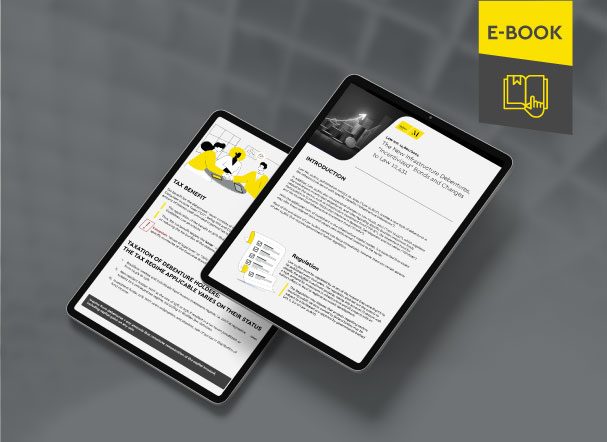
Our eBook provides detailed insights into the new legislation on the subject.
Published on January 10, 2024, Law No. 14.801/24 introduces a new type of debenture in the infrastructure sector, with specific tax benefits and significant modifications to Law No. 12.431/11. With the expectation of lower interest rates and the attraction of new investors, the legislation promises to transform the infrastructure capital market.
Our eBook details the legislative changes, highlighting the creation of infrastructure debentures and changes in the rules relating to specific Brazilian investment funds, such as FIP-IE, FIP-PD&I, and FI-Infra.
- Understand who can issue infrastructure debentures, the tax benefits for issuers and debenture holders, as well as the associated responsibilities and prohibitions.
- Explore the changes in taxation, the conditions for investments in environmental or social projects, and the alterations in the investment fund regime.
- Category: Digital Law
With this publication we inaugurate a series of five articles that will cover the main legal concepts and aspects related to gaming, betting, and eSports. In general, the legal practice related to these subjects encompasses all issues associated with regulation and business related to electronic games or games, betting of any kind, typical casino games and electronically practiced sports.
The series is divided into five articles that will be published on our website:
- What is the legal practice of gaming, betting, and eSports?
- Games, fantasy games and eSports: main aspects
- What are loot boxes and play-to-earn practices?
- An overview of gambling, gaming and betting practices
- Gaming, gambling and eSports: the road to legal certainty
All these practices are growing rapidly. Generations Z and Alpha (today's and tomorrow's consumers) have migrated from more static social media content to video and interactive content. The new generations are looking for spaces to get entertainment and content and, at the same time, socialize in a real way. Games have players, not just users, and function as spaces for interaction and, often, escape from the patterns artificially established by social media.
Concepts about these practices are not uniform and are sparse. They may vary from country to country or according to the literature consulted. The most important thing is to identify each practice individually and its own elements in order to then understand the specific regulation applicable (in material and territorial terms) and the risks that need to be addressed.
Depending on the elements, the classifications can intersect: a game can be recognized as or contain a gambling practice, and vice versa. In fact, there is growing convergence between gaming and gambling practices. The inclusion of gambling elements in electronic games is increasing. The so-called loot boxes, discussed in another article in this series, are perhaps the greatest example of this interaction.
The legality or illegality of each practice is not automatically related to its category or denomination. It depends on individual analysis. For example, gambling may or may not be legally permitted. A specific game may contain unauthorized gambling elements, making the practice prohibited by law or deserving of adjustments.
These practices and the development of the metaverse are connected precisely by the socialization provided and sought in games. These practices will dictate a large part of the rules and risks, especially considering that the new generations are already directly responsible for business and regulatory guidelines.
The metaverse is much more than just virtual reality. It is the interconnection between our physical (analog) and digital lives. It represents an uninterrupted flow between what we are and what we see in the analog world, to a completely digital environment. An interoperable digital environment created jointly by the initiatives of various organizations.
Businesses, products and content have been directed towards this new environment. As a result, strategy, compliance and risk mitigation activities need to be directly related to this new reality.
In the next article in the series, we'll look at the legal aspects of games and electronic games.

- Category: Life sciences and healthcare
The growing number of scientific studies on the therapeutic properties of Cannabis Sativa and psychedelic substances points to the need for relevant updates in Brazilian regulation. Our Life Sciences and Health experts bring the most current overview of the topic, as well as perspectives for the near future.