Publications

- Category: Labor and employment
This exclusive publication offers a detailed look at the most important labor judgments of 2023, highlighting legal trends for 2024. In a month-by-month analysis, we provide a comprehensive overview of the most relevant cases that have marked the year and are likely to influence the decisions of companies, unions, executives, and workers.
In addition to the judgments, we highlight important news from each month, all the topics covered in the TST Library, and the labor law articles published on the Legal Intelligence portal throughout 2023.
Also, take a look at the main topics of material and procedural labor law that are on the agenda of the STF and the TST for the coming year. They indicate the trends in constitutional labor jurisprudence for 2024 and reveal the possible establishment of theses in repetitive resources incidents, guiding legal professionals on the future paths of labor legislation.
- Category: Labor and employment
The new Federal Law 14,786/23 establishes a protocol for preventing embarrassment and violence against women, including in the workplace. By addressing which employers and establishments are required to follow the law, this ebook highlights the importance of complying with the "No Means No" protocol in nightclubs, bars, and events with the sale of alcoholic beverages.
The publication also details the meaning and relevance of the "No Means No - Safe Women" seal, addresses the rights of women in situations of embarrassment or violence, and explains the duties and responsibilities of employers and establishments in ensuring a safe environment.
The ebook also contains guidance on additional measures that can be taken to reinforce security, including the use of cameras and alert codes in women's restrooms.

- Category: Labor and employment
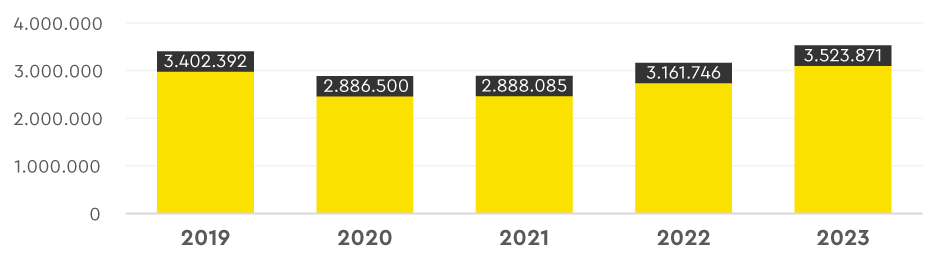
The year 2023 followed the trend of 2022 and, once again, there was an increase in the number of new labor lawsuits filed. Last year, 3.5 million new labor lawsuits were filed, which represents approximately 3,2% of Brazil's economically active population (108.3 million workers).
As a comparison, in Spain, in 2022, 373,374 lawsuits involving labor disputes were filed, which corresponds to 1.6% of the country's economically active population (23.5 million workers).
In 2022 and 2021, the number of labor lawsuits filed in Brazil was 3.16 million and 2.88 million, respectively.
Compared to 2021, the number of new cases increased by 15%. Our expectation is that this percentage will be even higher in 2024 – either because, in a recent ruling, the Super Labor Court (TST) established that the amounts indicated in the initial labor claim do not limit any conviction or because labor courts will set in 2024 a mandatory thesis on granting free justice to employees.
The high number of cases has generated debates among members of the Judiciary. In view of the significant backlog of cases in Labor Courts, the president of the Federal Supreme Court (STF), Justice Luís Roberto Barroso, announced the creation of a working group at the National Council of Justice (CNJ) on labor litigation in Brazil. The objective is to better understand the factors that contribute to the intense judicialization in the country.
The most recurrent claims continue to be related to overtime payments, additional allowance due to work under unhealthy conditions, differences in severance pay and fines for late payment of these amounts, when not made within ten days from the end of the employment contract.
Despite the volume of cases, Labor Courts continue to be the fastest to judge claims: the average time for a first level decision is 191 days.
In just over a year (415 days), a second level decision by has already been obtained before the Courts of Appeals. In a little less than three years (1,044 days), a decision is usually obtained before the TST which, except in certain cases, is the last possible instance of appeal.
Increase in Assessments by Labor Authorities
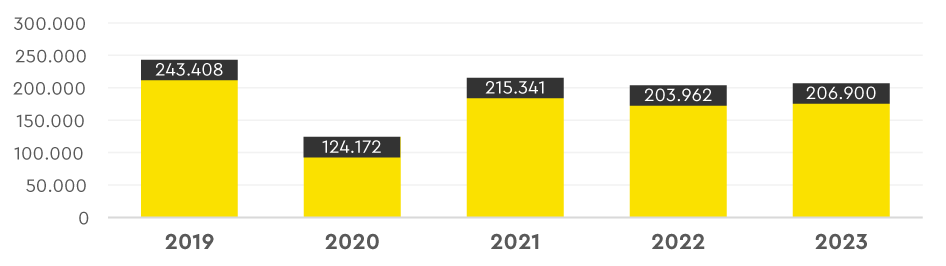
The Ministry of Labor and Employment (MTE) also continues to be very active. According to the Labor Inspection Portal, the number of infraction notices issued grew by 1.4%, compared to 2022.
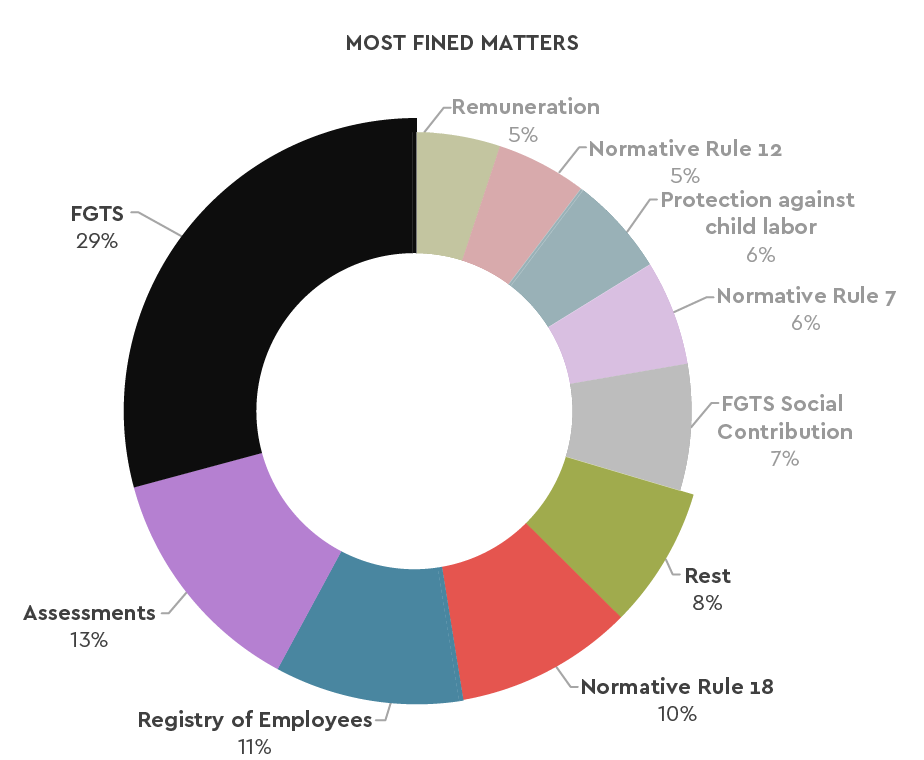
The five most fined matters were related to FGTS, registration and CTPS, Regulatory Standard 18 (which deals with health and safety at work in the construction industry) and rest.
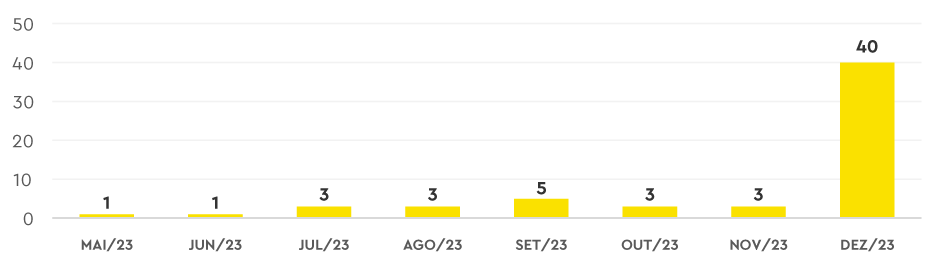
Another important piece of data is the number of infraction notices involving discriminatory practices. In December 2023, the number of infraction notices on the subject grew a lot, from three in October to 40 in December 2023.
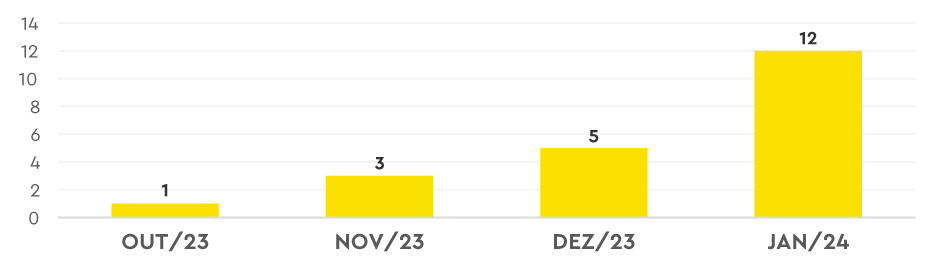
Regarding fines involving women's work, the increase in infraction notices is also visible as of October 2023. This growth may be linked, among other aspects, to the publication of the Law on Equal Pay for Women and Men (Law 14,611/23) in July 2023.
The trend is that infraction notices related to discrimination against women in the labor market will grow even more in 2024, due to the aforementioned law. In January 2024, the number of fines involving the topic increased by 58%, compared to December 2023.
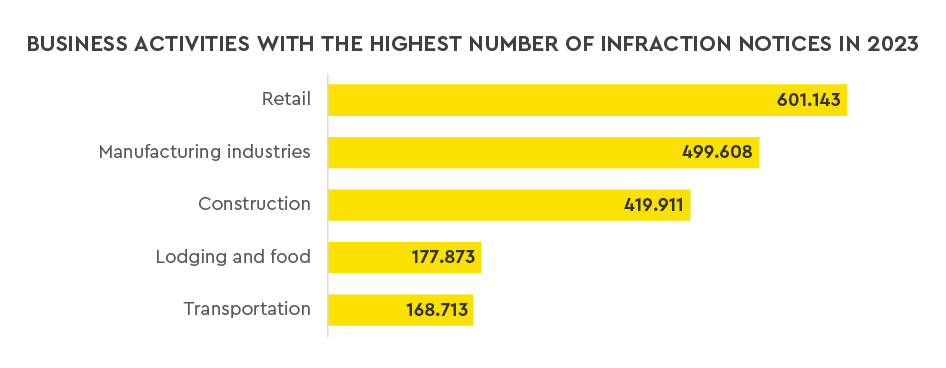
The business activities with the highest number of infraction notices in 2023 were:
- retail;
- manufacturing industries;
- construction;
- lodging and food; and
- transport.
The numbers above underscore the importance of companies aligning their internal practices with the requirements of labor law.
More than that: there is little point in encouraging a safe environment and taking care to avoid work accidents if the company cannot manage the delivery of personal protective equipment (PPE) to its employees.
The organization of documents, formalization of contractual changes, collection of employees' signatures on policies and the archiving of these documents are practices that should be as valued as supervising the performance of overtime.
Small procedural and governance adjustments can make a huge difference in labor lawsuits and inspections.
Investing in these management changes is a simple and effective way to reduce the exposure of employers who strive to comply with labor rules, in addition to avoiding the unpleasantness of a conviction or a fine that does not reflect the practices adopted by the company.

- Category: Labor and employment
Many companies are preparing and discussing strategies and procedures for sending information to government systems for the Ministry of Labor and Employment's Salary Transparency Report.
A significant number of these companies, however, have only begun to review this issue now, two months before publication of the report by the Ministry of Labor and Employment. This delay is due, in part, to the expectation that the ministry would extend the deadline for the report or even that Ordinance 3,714/23, which regulates Decree 11,795/23, would lose its effect.
However, as announced on January 17 by the Minister of Women, Cida Gonçalves, and the Minister of Labor and Employment, Luiz Marinho, the deadline for companies to provide additional information on the Emprega Brasil Portal for the preparation of the Salary Transparency Report by the Ministry of Labor and Employment begins today (January 22, 2024), with the publication of the Declaration of Equal Pay and Compensation Criteria tab on the Emprega Brasil Portal.
In this scenario, considering the first deadline set by Ordinance 3,714/23 (sending additional information in February), companies will have from January 22, 2024, to February 29, 2024, to report the following additional information on the Emprega Brasil Portal:
- Existence of a career ladder and job and salary plan;
- Existence of policies to encourage the hiring of women, such as: (i) a program to hire women who are victims of violence, provided for in the New Public Tenders Law 14,133/21; (ii) programs to hire women with disabilities; (iii) incentives to hire LGBTQI+ women; (iv) incentives to hire black women; and (v) incentives to hire women who are heads of household;
- Existence of policies to promote women to senior and managerial positions, such as: (i) flexible working arrangements to support working mothers; (ii) early granting of individual leave; (iii) approval of absences (article 473 of the CLT); (iv) extension of paternity leave and maternity leave; (vi) provision of daycare/childcare assistance;
- Salary and compensation criteria for access and progression or advancement of employees, such as: (i) meeting production targets set by the company; (ii) availability for overtime, travel, commitments to clients; (iii) availability of people in specific occupations in the job market; (iv) length of professional experience; (v) ability to work in a team; and (vi) proactivity (developing ideas and suggestions to improve results).
The questionnaire available on the Emprega Brasil Portal has a simplified format, allowing companies to answer the questions only with "yes", "no”, or multiple choice, without any field for further clarification. This methodology used by the Ministry of Labor and Employment reinforces our position that the data collected could generate a Salary Transparency Report that does not faithfully reflect the real structure of the companies. It is therefore essential that companies be prepared to take the necessary measures if they identify distortions in their reports.
In addition to sending the additional information, companies that have already provided information on eSocial should confirm that the data already provided on the platform is up to date. If necessary, companies should supplement eSocial with the missing data so that the Salary Transparency Report, to be drawn up by the Ministry of Labor and Employment, reflects up-to-date information.

- Category: Labor and employment
Today, the Ministry of Labor and Employment (MTE) provided clarifications on the Salary Transparency Report. The Report aims to assess the equality of pay and remuneration between men and women, as provided for in Law 14,611/23.[1]
According to the MTE, the first Salary Transparency Report will be available to companies by March 15. Each company will have until the end of the same month to publish its respective Report on its websites, social media, or similar channels, in a visible place, in order to ensure wide dissemination to its employees, workers and the general public.
The Pay Transparency Report will be divided into two parts and will consist of the following information:
- total number of employees considering gender and race/ethnicity;
- ratio between the remuneration of women and men, considering the average salary actually paid in 2022 and the average contractual and hiring salaries in 2023 – the comparison will be made based on the Major Groups of Occupations of the Brazilian Classification of Occupations (CBO); and
- additional information provided by the companies on the Emprega Brasil Portal.
According to MTE representatives, any cent difference that does not have a valid legal explanation will indicate discrimination. In this situation, the development of an action plan by the company will be required and employers will be exposed to the fines established by the legislation.
In view of the various doubts that have arisen about the Salary Transparency Report, the presentation of the model in today's event was important, as it brought greater clarity to companies. Employers are now able to visualize how the information will be used by the MTE and disseminated in practice, which will allow them to anticipate potential distortions and prepare to address them.
Based on the considerations presented by the MTE, we understand that the methodology to be adopted does not comply with the requirements for salary equalization, especially work of equal value and the exercise of the same function, as it does not follow the concept provided for in article 461, first paragraph of the Brazilian Labor Law (CLT) nor the provisions of Law 14,611/23 itself.
The use of average – and outdated remuneration (information from 2022 and 2023) – as a parameter is also based on a non-objective comparative basis, which does not reflect the company's current reality.
The use of the Major Groups of Occupations as a grouping parameter for comparing the remuneration of women and men indicates a broad assessment without the specificity that the theme requires (exercise of the same function). This is because this classification corresponds to the broadest level of the CBO, composed of only ten groups of occupations, which, individually, aggregate competencies and similarities of the activities performed by the respective specific occupations that compose them.
If we already suspected that the use of the CBO would make the result of the Salary Transparency Report uncertain, now we are sure that the data used will generate inconsistencies that do not reflect the reality of the companies.
There will be no comparison of pay between women and men performing the same activity or holding the same function. Depending on how men and women are distributed in the company's positions, the information disclosed in the Salary Transparency Report will indicate wage differences that, in practice, are not linked to gender discrimination.
The model presented by the MTE also does not use criteria/data that allow the identification of possible inequalities arising from nationality and age, disregarding part of the parameters established by Law 14,611/23.
The complementary information filled in by companies on the Emprega Brasil Portal will simply be reproduced by the MTE in the Salary Transparency Report. There will be no context or explanation of the purpose of the questions and, consequently, what context the answers fit into.
In other words, once again, the Salary Transparency Report does not explore practical issues that need clarification or even ignores specific methodologies used by companies that would make a difference in the result of the comparative analysis.
By opting for the methodology presented, the MTE disregards the current corporate structures of the largest companies in Brazil. The model released will treat the topic in a superficial way.
The proposed report, therefore, tends to generate more distortions than constructive discussions for the benefit of such a noble purpose and will not allow to achieve the result intended by the legislator when drafting Law 14,611/23 – verifying real gender equality in companies.
During the event, MTE representatives expressed concern about structural discrimination and clarified that, if companies have valid legal explanations for the identified salary differences, these differences will not characterize discrimination or violation of the Equal Pay Law (as in the case of pay differences related to the achievement of performance goals, specific characteristics of a particular occupation, difference in seniority among the employees who were grouped by the MTE analysis).
Before assessing the company, it was also clarified that the MTE will allow the company to explain whether there are legally valid reasons to justify the salary differences identified.
In view of the above, regardless of the disclosure by the MTE of the Salary Transparency Report and the fact that the representatives of the MTE and the Ministry of Women have expressly said that companies do not need to prepare their own Salary Transparency Reports, we understand that it remains essential and highly recommendable for companies to prepare their own reports.
In these documents, companies must observe the labor legislation correctly and address the inconsistencies and distortions pointed out in the model used by the MTE. Companies need to be prepared to provide the necessary information and clarifications to government authorities and also to society, demonstrating that there is no gender discrimination in their organization.
Machado Meyer Advogados will continue to monitor the evolution of the matter and its potential developments.
[1] The full MTE livestream, which was attended by representatives of the MTE and the Ministry of Women involved in the project, is available at this link.

- Category: Digital Law
Loot boxes. A loot box is a feature that is increasingly present in games precisely because it aims to improve and diversify the user experience. These are the well-known reward boxes that are distributed during the player's participation.
Video game loot boxes are accessible (i) during gameplay after the player has completed certain stages of the game or waited a certain period of time; or (ii) through optional payment by the player in currency.
For example, there are the well-known reward boxes that the player accesses when they pass a certain stage or buy access to, receiving a new item for use in the game itself (cards, in-game currency, items or skills to use on characters, etc.).
This is the concept taken from studies by the European Parliament that treat such practices in this way, such as the relevant one from 2020. Another example in this sense is the treatment given to the subject by the Belgian authority responsible (Belgian FPS Justice Gaming Commission), in which the term loot boxes comprises an umbrella of practices and game elements in which the player acquires items for free or for a fee in an apparently random manner.
There are three main elements that characterize a feature as a loot box, regardless of the game or the item it provides:
- Eligibility condition: the player needs to do something in order to gain access to the loot box.
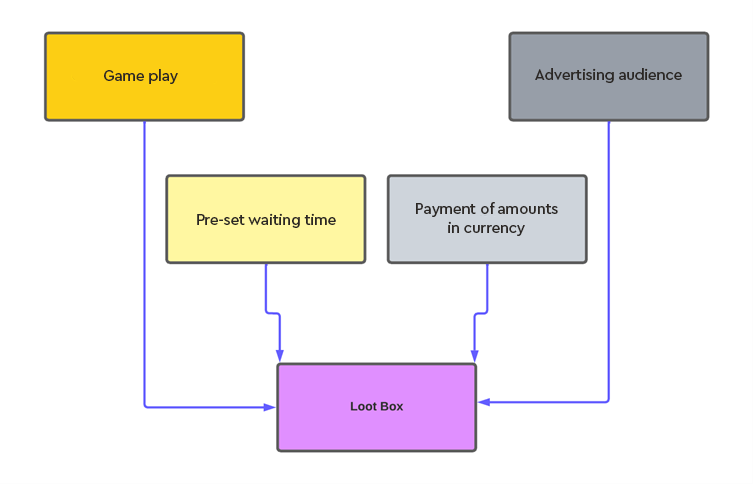
This can happen in various ways. The most common is via gameplay, by passing stages, acquiring skills and overcoming milestones. The player's eligibility can also take the form of pre-defined waiting times, which can often be overcome by paying real money or by watching a certain advertising video. The image below is very representative of this dynamic:
- Reward selection procedure: there is an algorithm or some random selection process that determines the result obtained by the player.
What is expected and appropriate is that these processes ensure equal chances for all players in the same eligibility condition and that these mechanisms are duly auditable, in order to ensure transparency and algorithmic explainability. In addition, biased situations should be avoided by adopting appropriate frameworks, such as the ISO/IEC 24.027/2021 standard.
In this context, game distributors such as e have started to demand that game apps be able to ensure transparency for players in relation to loot box eligibility criteria, real chances and prize profiles.
- Prize: The player receives a prize that can vary depending on the experience.
It can be content for mere customization (items to be used as skins and new features for avatars) or items that affect the gameplay itself (tools, weapons, levels, maps, in-game currency, etc.). In the case of content, it doesn't affect the player's competitiveness, but only alters their aesthetic experience.
The others, however, directly affect competitiveness. In the latter case, when the player can pay for items, the practice of Play-to-Win is characterized.
Based on these three elements, Loot Boxes can be classified according to the following table:
| Eligibility Conditions | |
|
|
|
Gameplay Waiting time |
Payment of current currencies Advertising audience |
|
|
|
Low Short period of time played or low cost in current currencies |
High Long period played, high number of repetitions (grinding) or high cost in current currencies |
| REWARD SELECTION PROCEDURE | |
|
|
|
The odds of obtaining the different items are known to the players. |
The odds of obtaining the different items are unknown to the players. |
|
|
|
Different items have similar or equal chances of appearing to users. |
Some items can be considered rare (2% chance of appearing, for example) and others are considered common (50% chance of appearing, for example). |
| PRIZE | |
|
|
|
Purely cosmetic or customization. |
They directly affect the game's playability and competitiveness. |
Play-to-earn. Another notable practice is Play to Earn (P2E), in which, in addition to entertainment, people earn rewards as the games progress. These can be items for the game itself (such as loot boxes) - a practice known as play-to-own (P2O), crypto-assets, financial values, or even experiences to be used outside the games.
Other purchasing systems. Unlike Loot Boxes in which there is an element of chance or luck present, as we have seen, games can feature other purchasing systems without luck.
These can be:
- Direct purchase of items: Players can shop directly for items that customize their experience or affect gameplay.
- Ad-viewing: Players can watch advertisements to unlock new items in the game. This practice is very common in situations where players have never spent any money on the game, so that the game's profitability comes from monetizing the ad itself. The Google Play store, for example, sets out its guidelines in this regard and options for developers.
- Add-ons and extensions: Games can be distributed in various versions and prices. In some cases, in order to have additional content, players need to pay for extensions.
- Game passes: Similar to extensions, some games allow you to buy specific access tickets or tickets for certain special events (a specific race, an event in the metaverse, etc.).
The series then goes on to look at legal and illegal gambling practices and current regulation.