Publications

- Category: Labor and employment
Employment relationships are characterized by a bond of trust between the employee and the employer as an intrinsic aspect of their continuity. Violation of this trust by either party can even lead to termination of the employment relationship for just cause.[1]
Just as employees expect their employers to protect their personal information, the reverse is also true. In day-to-day work, it is common for employees to have access to a wide range of business information, including that held by suppliers, clients, and third parties.
The duty of confidentiality of information has taken on greater shape with the entry into force of Law 13,709/18 (General Data Protection Law). Following a global trend of caring for personal data, this law brought in specific restrictions on the handling of individuals' data, imposing severe penalties for non-compliance. This reinforced article 3 of the Marco Civil da Internet (Brazilian Civil Rights Framework for the Internet, Law 12,965/14), which, even before, already highlighted the importance of protecting privacy and personal data.
This reciprocal duty of confidentiality persists even after the employment relationship has ended. Anyone who violates this obligation may be subject to damages. This is the case of a worker who presents documents protected by industrial secrecy (or secrecy of any kind) in a labor lawsuit, revealing confidential and sensitive information about operations and/or co-workers.
Recently, for example, a decision by the 8th Labor Court of São Paulo made headlines. In a labor lawsuit, the plaintiff submitted photographs of her computer containing confidential and sensitive information about co-workers and company operations. As this information was exposed in a lawsuit that was not under seal, she was ordered to compensate the defendant for moral damages after it filed a counterclaim.
The decision took into account that, in addition to the obligations provided for by law, the employer established confidentiality obligations in the contract, which lasted even after the end of the employment relationship.
Thus, even if, at the end of the employment contract, the case of just cause no longer applies, it is still possible for the former employer to seek compensation for economic and non-economic damages suffered as a result of the former employee's actions.
The decision reinforces the need for employees to respect the confidentiality of information obtained during their employment, under penalty of being liable for damages caused to the former employer.
[1] TST — AIRR 5771-56.2014.5.12.0018 — 8th Panel — decided on March 21, 2018 - decided by Márcio Eurico Vitral Amaro.

- Category: Labor and employment
The Federal Supreme Court (STF) validated the 12-hour workday followed by 36 hours of rest (12x36) when agreed by individual written agreement between employer and employee.
Before the Labor Reform (Law 13,467/17), this work schedule could only be adopted when provided for by law or by collective bargaining agreement, as set out in Precedent 444 of the Superior Labor Court (TST). However, the Labor Reform allowed for 12x36 working hours to be agreed by individual agreement, without the need for labor union participation.
As a result of this change, the National Confederation of Health Workers (CNTS) filed a Direct Action of Unconstitutionality (ADI 5994), arguing against the constitutionality of the rule in relation to the 12x36 working day. The organization argued that this practice would violate subsection XIII of article 7 of the Federal Constitution, which guarantees working hours of no more than 8 hours per day and 44 hours per week, with the possibility of offsetting working hours by collective bargaining agreement.
The discussion has been on the STF's agenda since April of 2021. The decision was issued on June 30, 2023, recognizing the constitutionality of the Labor Reform in this regard. Thus, based on workers' freedom, the STF validated that it is not necessary to negotiate with the labor union to apply the 12x36 work schedule.
Justice Marco Aurélio (reporting judge) voted to grant the action, on the understanding that the Constitution does not cover individual work agreements for the 12x36 work schedule. Justices Edson Fachin and Rosa Weber also voted in favor, with the same understanding.
However, the prevailing opinion was that of Justice Gilmar Mendes, on the grounds that the possibility of making an individual agreement is a prerogative of the worker's freedom, and the Constitution does not prevent the 12x36 work schedule, since the extra hours worked are offset with more rest time.
The Justice also pointed out that Precedent 444 of the TST provides for the legitimacy of the 12x36 work schedule, as long as it is provided for by law or collective bargaining agreement, and that the STF itself had already validated this work schedule for civilian firefighters (ADI 4842). The opinion was concurred with by Justices Dias Toffoli, Carmem Lúcia, Luís Roberto Barroso, Alexandre de Moraes, Nunes Marques, and Luiz Fux.
This decision is an important precedent and brings greater legal certainty to companies that have adopted this type of scale through individual agreements since the Labor Reform, reinforcing the guidelines for freedom of negotiation brought in by the legislation.

- Category: Labor and employment
Decree 11,795/23, published on November 24th, regulates Law 14,611/23, or the Law on Equal Pay for Women and Men.
The main innovation introduced is the stipulation of the months of March and September each year for the biannual publication of the Salary Transparency Report. This gives companies an extension to the deadline, initially set for January 2024.
Furthermore, Decree 11,795/23 did not bring in any significant changes in relation to what was already expected from the regulation and what we are applying to the reports of clients who are preparing to comply with the legal obligation.
Content of the report
According to the decree, the report must include, at the very least, information on the position or occupation contained in the Brazilian Classification of Occupations (CBO), with the respective duties and the amount of the worker's compensation.
As we anticipated, the comparison of compensation must include both the fixed and variable amounts paid to the worker:
- contractual salary;
- thirteenth salary;
- bonuses;
- commissions;
- overtime;
- night, hazard, hardship, and dangerous work premiums, among others;
- one-third for vacations;
- prior notice period worked;
- paid weekly rest;
- tips; and
- other payments that, by law or collective bargaining agreement, make up the compensation.
With regard to variable compensation, the challenge is to detail all the amounts separately and to point out that, although the criteria for payment are the same for women and men, the possible differences in salary are the result of different performance.
It will be necessary to have robust mechanisms to back up companies if questions arise that the differences in pay between men and women in the company are due to gender discrimination and not performance.
In addition, although the decree provides for the presentation of the amounts relating to compensation, it reinforced that the report must contain anonymized data and in compliance with the General Data Protection Law (LGPD), guaranteeing companies the possibility of not disclosing the absolute amounts paid to workers.
Publication of the report
The decree established that the Salary Transparency Report should be published in March and September, using two simultaneous approaches:
- Submission through a computerized tool provided by the Ministry of Labor and Employment (still pending creation and dissemination); and
- Publication on the companies' own websites, social networks, or similar tools, guaranteeing wide dissemination to employees, contingent workers, and the general public.
With the dates and places of publication of the Salary Transparency Report now defined, we understand that companies that were notified by the Labor Prosecutor's Office (MPT) to present the document in January of 2024 can rely on the regulation to present it only in March of 2024.
In any case, for companies that have already completed the report or that, due to administrative proceedings initiated by the MPT, find it advantageous to submit it early, we recommend that they do not wait for the deadline set in the decree.
Action plan
If the Ministry of Labor and Employment identifies unequal pay or compensation criteria between women and men, the company must draw up and implement an "Action Plan to Mitigate Unequal Pay and Remuneration Criteria between Women and Men" within 90 days of notice from the ministry.
The plan should establish the measures to be adopted, targets, and deadlines, as well as detail the creation of programs related to:
- training for managers, leaders, and employees on the subject of equality between women and men in the labor market;
- promoting diversity and inclusion in the workplace; and
- training of women to enter, remain in, and rise in the labor market on equal terms with men.
In drawing up and implementing the action plan, the participation of labor unions and employee representatives must be guaranteed. This should preferably be done in the manner defined in a collective bargaining agreement or, in the absence of such an agreement, by means of an employee committee established under the terms of the Consolidated Labor Laws (CLT).[1]
For companies with between 100 and 200 employees, a specific election procedure can be set up to establish a committee. The aim is to ensure effective participation of employees in drawing up and implementing the action plan.
Companies should therefore pay attention to this procedure and, if possible, negotiate through a collective bargaining agreement, how the participation of union representatives will be guaranteed.
Whistleblowing channel
The Ministry of Labor and Employment will provide a specific channel for receiving complaints involving discrimination in pay and compensation criteria between women and men.
Oversight
The decree gives the Ministry of Labor and Employment the power to:
- oversee the submission of Salary Transparency and Compensation Criteria Reports by companies; and
- analyze the information contained in the Salary Transparency and Compensation Criteria Reports.
It will also be incumbent on the Ministry of Labor and Employment, through the Labor Auditor’s Office, to notify companies in the event of a finding of unequal pay and compensation criteria between women and men, so that they can draw up an action plan within 90 days.
As expected since the publication of the Gender Pay Equity Law, the main impact of the change for companies is directly related to the effects that the information contained in the Salary Transparency Report will have on their institutional image.
Publicizing information, even if data anonymization is guaranteed, exposes possible discriminatory gender practices to the public. In today's context, this can affect companies' reputations, even resulting in financial damage due to the reactions of consumers, employees, and other stakeholders.
[1] Article 510-A. Companies with more than two hundred employees are guaranteed the election of a committee to represent them, with the aim of promoting a direct understanding with employers.
Paragraph 1. The committee shall be composed:
I - of three members at companies with more than two hundred and up to three thousand employees;
II - of five members at companies with more than three thousand and up to five thousand employees;
III - of seven members at companies with more than five thousand employees.
Paragraph 2. In the event that the company has employees in several states of the Federation and in the Federal District, the election of a committee of employee representatives per state or in the Federal District shall be ensured, in the same manner as established in paragraph 1 of this article.

- Category: Labor and employment
The long-awaited regulation of the salary transparency report and compensation criteria, published on November 27 by the Ministry of Labor and Employment (MTE) through MTE Ordinance 3,714/23, brought in as main innovations:
- the definition that the MTE will be responsible for drawing up the salary transparency report, based on information from eSocial and complementary information to be provided by companies; and
- companies must publicize the salary transparency report drawn up by the MTE, posting the document on their websites, social networks, or similar tools, always in a visible place, and ensuring that it is widely disseminated to their employees, workers, and the general public.
Although the regulation describes the data that will be used by the MTE, it does not establish what methodology will be used to prepare the salary transparency report or what information will actually be included by the ministry in the report.
This scenario of uncertainty exposes companies to irreparable damage related to competition, disclosure of personal data, and an indication of non-existent salary differences that can affect their image and institutional reputation.
So we've prepared a guide with questions and answers and a step-by-step guide to help companies' legal and HR departments deal with these challenges.
Question and answer guide
- What will be the basis for comparison? Can the Ministry of Labor and Employment use the name of the position or the Brazilian Classification of Occupations (CBO) to compare salaries?
According to the regulation, the MTE will extract data from the positions or CBOs already declared in eSocial, in order to ascertain pay equity and compensation criteria and issue the pay transparency report.
- Is the job title or the CBO enough to compare salaries between men and women?
No. Per Law 14,611/23, equal pay for women and men is governed by the requirements of article 461 of the Consolidated Labor Laws, which includes, among other things, identical duties, productivity, and technical perfection.
Simply naming the position, therefore, is not enough. The Labor Courts have had this understanding settled for decades. An assistant at a company, for example, can carry out administrative, financial, legal, or operational activities. None of the positions, despite the "assistant" nomenclature, has an identical function or performs work of the same value. The position alone does not allow for a proper comparison.
The same reasoning applies to cases where the CBO is used. Sometimes the description in the CBO that most closely matches the activities carried out is applied, but this can cover different activities carried out by different positions - which in no way reflect an identical function or a job with the same value. It should also be mentioned that MTE Ordinance 397/02 determined that the CBO should be adopted for specific purposes. There is no legal provision for using the CBO for salary matching purposes.
- What happens if you only use the name of the job or the CBO for the salary transparency report?
Salary differences will probably be identified on the basis of employees who are not actually comparable. These distortions could be interpreted by the authorities (and the general public) as gender discrimination.
- If salary differences are identified based on job title or CBO, can the company be notified to implement an action plan?
Yes. This is why companies must:
- review all the data sent through eSocial and which will be used as a source of information in the preparation of the salary transparency report, to minimize the possibility of data distortion and inconsistencies; and
- review in detail the salary transparency report issued by the Ministry of Labor and Employment and prepare to challenge, including in court, inconsistent results arising from the methodology used.
- Should companies publicize the salary transparency report if this document points to differences in salary as a result of the methodology used by the Ministry of Labor and Employment?
Although the regulations state that they do, we believe that companies can take legal action to guarantee their right not to publish a salary transparency report that does not reflect the reality of the information and, consequently, could affect the company's reputation and institutional image.
For this reason, companies should analyze in detail the reports drawn up by the Ministry of Labor and Employment and make sure that there are no inconsistencies resulting from the use of the wrong methodology.
- Will the salary transparency report disclose employee compensation?
The legislation establishes that data must be anonymized and that the General Personal Data Protection Law (LGPD) must be observed. However, as there is no express provision on how the information will be disclosed in the document to be issued by the MTE, we cannot rule out the possibility of the report disclosing employee compensation.
Considering that, in many cases, it is possible to identify the salary of a particular professional even if their name is not disclosed, drawing up a salary transparency report containing absolute salary and compensation figures could be interpreted as an affront to the LGPD. In addition, the disclosure of confidential company information could also damage competition.
If the salary transparency report is issued with absolute salary figures and monthly compensation, it would be possible to take legal action to secure the right not to publish the salary transparency report.
Step by step guide for legal and HR departments:
The adoption of the measures listed below by the legal and HR departments will enable companies to legally challenge any inconsistencies in the salary transparency report prepared by the Ministry of Labor and Employment:
- Analyze the data entered in eSocial about positions and the CBO and identify whether there is a need for adjustments that can minimize the risk of inconsistent salary differences that do not reflect reality.
- Analyze salary and compensation figures by position and CBO, anticipating any salary differences that may be pointed out by the Ministry of Labor and Employment.
- Look for legal justifications for the salary differences that the Ministry of Labor and Employment may point out, analyzing whether, from a legal point of view, the justifications are robust enough to explain the differentiated payment.
- Analyze whether there is a legal need to formalize variable compensation payments through policies or programs and strengthen the justifications directly related to individual performance.
- Analyze, from a legal point of view, the individual performance evaluation system, to ensure that the evaluation forms are consistent and strengthen the justifications directly related to individual performance.
- After the Ministry of Labor and Employment sends the salary transparency report, analyze the salary differences pointed out to see if the discrepancies are - or are not - in line with the legal parameters.
- Evaluate appropriate legal measures that guarantee the company the possibility of not publishing the salary transparency report until the errors and inconsistencies have been remedied, in addition to not being obliged to implement an action plan, under penalty of suffering irreparable damage to its image and reputation.
- Category: Life sciences and healthcare
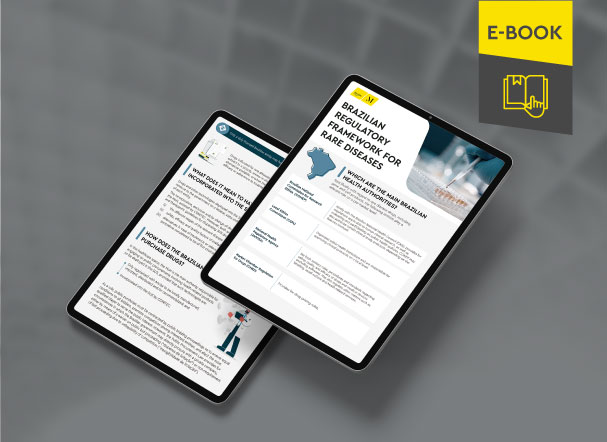
Our eBook on the “Brazilian Regulatory Framework for Rare Diseases” is an essential guide to Brazil’s healthcare system, providing a comprehensive analysis of the regulatory processes related to rare disease medications, including gene and cell therapies.
The publication can be useful for anyone who needs a better understanding of the regulatory landscape on the subject in Brazil, whether a healthcare professional, policy maker, or biotechnology analyst.
Here is a preview of the content:
- Legal definition: Learn how Brazil officially defines a rare disease.
- Key Brazilian health authorities: Understand the roles of major entities in the pre-market phase for rare disease drugs.
- From research to the patient: Explore the main steps in the journey of a rare disease drug – from research and development to reaching the patient.
- Drug marketing authorization: Find out how a drug gets marketing authorization in Brazil, and learn about the priority review process for drugs indicated for rare diseases.
- Drug incorporation into the SUS: Understand what it means for a drug to be incorporated into Brazil’s Unified Health System (SUS) and the role of the Ministry of Health in public procurements.
- Brazilian government drug purchases: Find out how the Brazilian government procures drugs, including the bidding process and direct procurement exceptions.
- Foreign biotech companies: Learn the necessary steps for a foreign biotech company to introduce their drug into the SUS.

- Category: Banking, insurance and finance
The Central Bank of Brazil (BCB) published, on June 29, 2023, the Normative Instruction BCB 397 (IN BCB 397/23), which amended IN 103/21, to disclose the procedures, documents, deadlines and information necessary for the investigation of authorization requests related to the operation of payment institutions, in addition to providing for other topics.
The edition of IN BCB 397/23, which entered into force on July 1, 2023, constitutes an important advance in the flexibility of the foreign exchange market in Brazil and is part of the list of measures that have been adopted by the Central Bank since the reform of the legal framework of the foreign exchange market, approved in 2021 with the edition of Law 14,286/21.
By promoting changes in IN BCB 397/23, the Central Bank took the opportunity to regulate requests for authorization by payment institutions to operate in the foreign exchange market, in line with the provisions of article 29, item III, of Resolution BCB 277/22.
With the regulation, payment institutions authorized to operate by the Central Bank as issuers of electronic money, issuers of postpaid payment instrument and / or accreditation can request authorization to operate in the foreign exchange market.
However, payment institutions that obtain authorization to operate in the foreign exchange market in the form of Resolution BCB 277/22 will be subject to the limitations established in the regulations.
According to article 29, item III, of BCB Resolution 277/22, payment institutions authorized to operate in the foreign exchange market may only execute:
- foreign exchange operations with clients for prompt settlement of up to US$100,000[1] or its equivalent in other currencies, and transfers relating to the trading of derivative financial instruments abroad are not permitted; and
- operations for ready settlement in the interbank market, arbitrations in the country and arbitrations with abroad.
According to IN BCB 397/23, payment institutions that wish to request authorization from the Central Bank to operate in the foreign exchange market must submit, within 15 days of the respective act or resolution, the following documents:
- application; and
- reasoned justification that proves the economic and financial viability of the enterprise, which must contain, at least:
- the impacts of a strategic nature, explaining, if applicable, the new strategic objectives and market opportunities that justify the operation;
- the impacts of an operational nature, explaining, if applicable, the changes in the standards and structure of corporate governance, internal controls, risk management, and in the procedures and controls for the detection and prevention of operations whose characteristics may indicate the existence of the practice of the crimes typified in Law 9,613/98, as amended;
- the impacts of an economic-financial nature, explaining the estimates for the critical variables such as rates and average values of operations, service tariffs, as well as the expected results;
- the impact of the operation on the operational limits established in the regulations in force; and
- the deadline for the start of activities with the operation, after authorization.
In the same way that IN BCB 397/23 regulated requests for authorization of payment institutions to operate in the foreign exchange market, the same standard also regulated requests for cancellation of authorization for payment institutions to operate in the foreign exchange market.
Such request for cancellation must be instructed within 15 days of the respective act or resolution, with the following documents:
- application; and
- a statement that the exchange operations that are private or permitted to the institution have been settled or transferred.
[1] The mentioned value limit: (a) does not prevent the execution of an exchange operation related to payment or receipt installments provided for in a business disbursement schedule with a total value higher than the aforementioned limits; and (b) does not apply when the payment institution authorized to operate in foreign exchange is the buyer and seller of the foreign currency and is acting to fulfill obligations arising from the operations of its customers.