
- Category: Labor and employment
This exclusive publication offers a detailed look at the most important labor judgments of 2023, highlighting legal trends for 2024. In a month-by-month analysis, we provide a comprehensive overview of the most relevant cases that have marked the year and are likely to influence the decisions of companies, unions, executives, and workers.
In addition to the judgments, we highlight important news from each month, all the topics covered in the TST Library, and the labor law articles published on the Legal Intelligence portal throughout 2023.
Also, take a look at the main topics of material and procedural labor law that are on the agenda of the STF and the TST for the coming year. They indicate the trends in constitutional labor jurisprudence for 2024 and reveal the possible establishment of theses in repetitive resources incidents, guiding legal professionals on the future paths of labor legislation.
- Category: Labor and employment
The new Federal Law 14,786/23 establishes a protocol for preventing embarrassment and violence against women, including in the workplace. By addressing which employers and establishments are required to follow the law, this ebook highlights the importance of complying with the "No Means No" protocol in nightclubs, bars, and events with the sale of alcoholic beverages.
The publication also details the meaning and relevance of the "No Means No - Safe Women" seal, addresses the rights of women in situations of embarrassment or violence, and explains the duties and responsibilities of employers and establishments in ensuring a safe environment.
The ebook also contains guidance on additional measures that can be taken to reinforce security, including the use of cameras and alert codes in women's restrooms.

- Category: Labor and employment
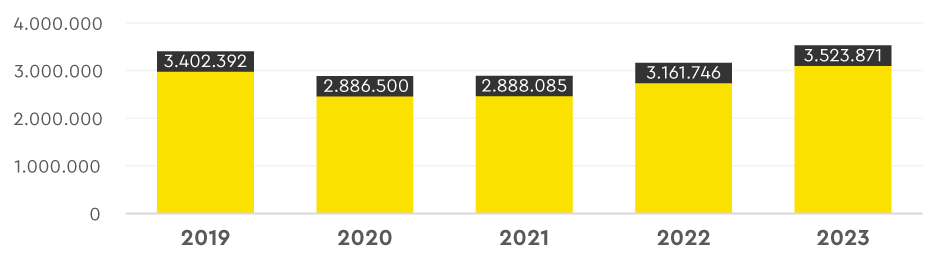
The year 2023 followed the trend of 2022 and, once again, there was an increase in the number of new labor lawsuits filed. Last year, 3.5 million new labor lawsuits were filed, which represents approximately 3,2% of Brazil's economically active population (108.3 million workers).
As a comparison, in Spain, in 2022, 373,374 lawsuits involving labor disputes were filed, which corresponds to 1.6% of the country's economically active population (23.5 million workers).
In 2022 and 2021, the number of labor lawsuits filed in Brazil was 3.16 million and 2.88 million, respectively.
Compared to 2021, the number of new cases increased by 15%. Our expectation is that this percentage will be even higher in 2024 – either because, in a recent ruling, the Super Labor Court (TST) established that the amounts indicated in the initial labor claim do not limit any conviction or because labor courts will set in 2024 a mandatory thesis on granting free justice to employees.
The high number of cases has generated debates among members of the Judiciary. In view of the significant backlog of cases in Labor Courts, the president of the Federal Supreme Court (STF), Justice Luís Roberto Barroso, announced the creation of a working group at the National Council of Justice (CNJ) on labor litigation in Brazil. The objective is to better understand the factors that contribute to the intense judicialization in the country.
The most recurrent claims continue to be related to overtime payments, additional allowance due to work under unhealthy conditions, differences in severance pay and fines for late payment of these amounts, when not made within ten days from the end of the employment contract.
Despite the volume of cases, Labor Courts continue to be the fastest to judge claims: the average time for a first level decision is 191 days.
In just over a year (415 days), a second level decision by has already been obtained before the Courts of Appeals. In a little less than three years (1,044 days), a decision is usually obtained before the TST which, except in certain cases, is the last possible instance of appeal.
Increase in Assessments by Labor Authorities
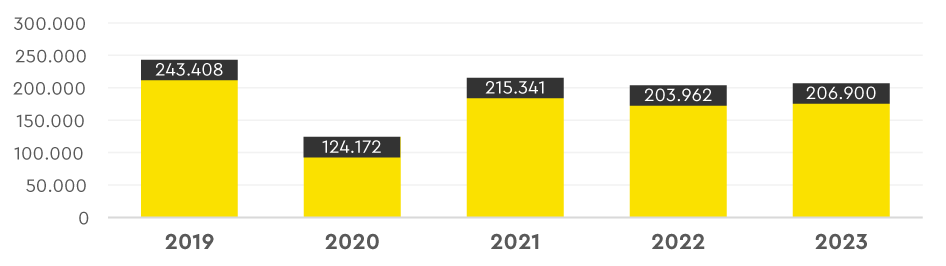
The Ministry of Labor and Employment (MTE) also continues to be very active. According to the Labor Inspection Portal, the number of infraction notices issued grew by 1.4%, compared to 2022.
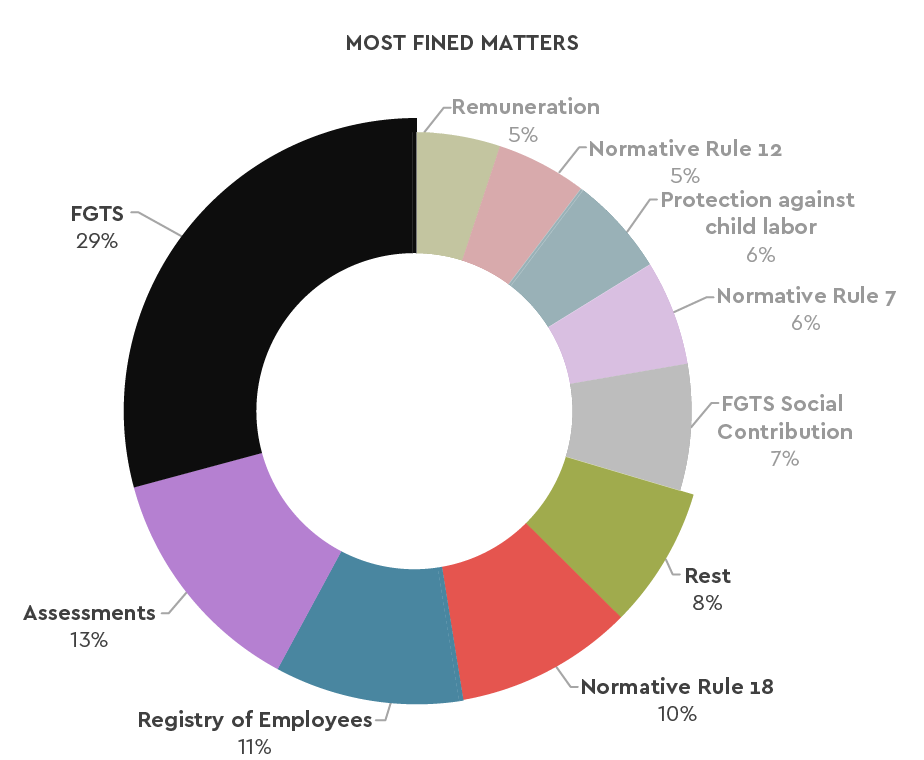
The five most fined matters were related to FGTS, registration and CTPS, Regulatory Standard 18 (which deals with health and safety at work in the construction industry) and rest.
Another important piece of data is the number of infraction notices involving discriminatory practices. In December 2023, the number of infraction notices on the subject grew a lot, from three in October to 40 in December 2023.
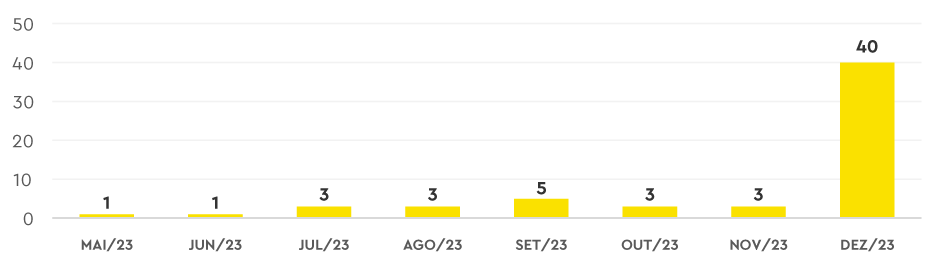
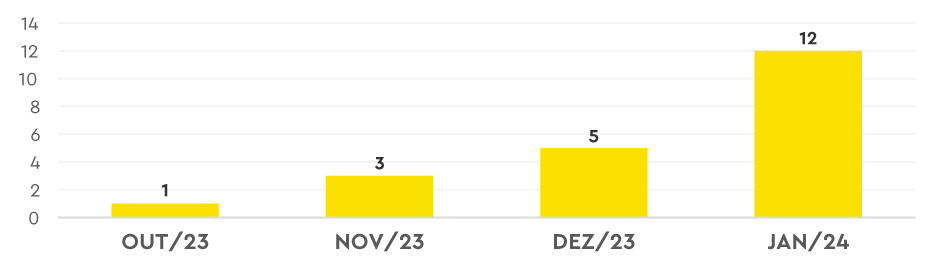
Regarding fines involving women's work, the increase in infraction notices is also visible as of October 2023. This growth may be linked, among other aspects, to the publication of the Law on Equal Pay for Women and Men (Law 14,611/23) in July 2023.
The trend is that infraction notices related to discrimination against women in the labor market will grow even more in 2024, due to the aforementioned law. In January 2024, the number of fines involving the topic increased by 58%, compared to December 2023.
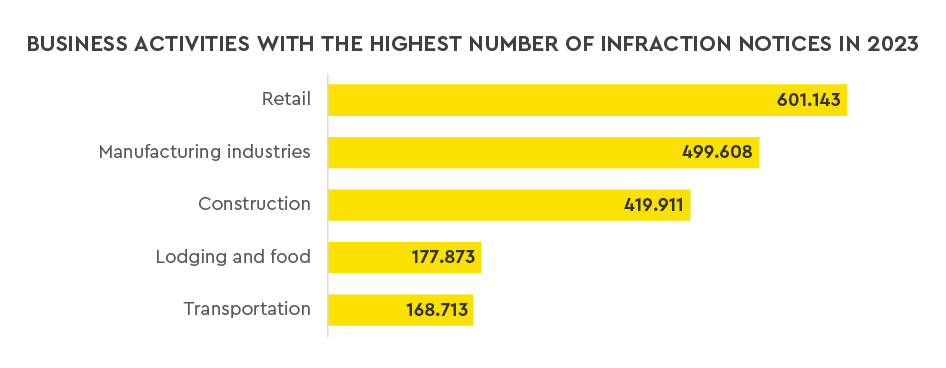
The business activities with the highest number of infraction notices in 2023 were:
- retail;
- manufacturing industries;
- construction;
- lodging and food; and
- transport.
The numbers above underscore the importance of companies aligning their internal practices with the requirements of labor law.
More than that: there is little point in encouraging a safe environment and taking care to avoid work accidents if the company cannot manage the delivery of personal protective equipment (PPE) to its employees.
The organization of documents, formalization of contractual changes, collection of employees' signatures on policies and the archiving of these documents are practices that should be as valued as supervising the performance of overtime.
Small procedural and governance adjustments can make a huge difference in labor lawsuits and inspections.
Investing in these management changes is a simple and effective way to reduce the exposure of employers who strive to comply with labor rules, in addition to avoiding the unpleasantness of a conviction or a fine that does not reflect the practices adopted by the company.

- Category: Labor and employment
Many companies are preparing and discussing strategies and procedures for sending information to government systems for the Ministry of Labor and Employment's Salary Transparency Report.
A significant number of these companies, however, have only begun to review this issue now, two months before publication of the report by the Ministry of Labor and Employment. This delay is due, in part, to the expectation that the ministry would extend the deadline for the report or even that Ordinance 3,714/23, which regulates Decree 11,795/23, would lose its effect.
However, as announced on January 17 by the Minister of Women, Cida Gonçalves, and the Minister of Labor and Employment, Luiz Marinho, the deadline for companies to provide additional information on the Emprega Brasil Portal for the preparation of the Salary Transparency Report by the Ministry of Labor and Employment begins today (January 22, 2024), with the publication of the Declaration of Equal Pay and Compensation Criteria tab on the Emprega Brasil Portal.
In this scenario, considering the first deadline set by Ordinance 3,714/23 (sending additional information in February), companies will have from January 22, 2024, to February 29, 2024, to report the following additional information on the Emprega Brasil Portal:
- Existence of a career ladder and job and salary plan;
- Existence of policies to encourage the hiring of women, such as: (i) a program to hire women who are victims of violence, provided for in the New Public Tenders Law 14,133/21; (ii) programs to hire women with disabilities; (iii) incentives to hire LGBTQI+ women; (iv) incentives to hire black women; and (v) incentives to hire women who are heads of household;
- Existence of policies to promote women to senior and managerial positions, such as: (i) flexible working arrangements to support working mothers; (ii) early granting of individual leave; (iii) approval of absences (article 473 of the CLT); (iv) extension of paternity leave and maternity leave; (vi) provision of daycare/childcare assistance;
- Salary and compensation criteria for access and progression or advancement of employees, such as: (i) meeting production targets set by the company; (ii) availability for overtime, travel, commitments to clients; (iii) availability of people in specific occupations in the job market; (iv) length of professional experience; (v) ability to work in a team; and (vi) proactivity (developing ideas and suggestions to improve results).
The questionnaire available on the Emprega Brasil Portal has a simplified format, allowing companies to answer the questions only with "yes", "no”, or multiple choice, without any field for further clarification. This methodology used by the Ministry of Labor and Employment reinforces our position that the data collected could generate a Salary Transparency Report that does not faithfully reflect the real structure of the companies. It is therefore essential that companies be prepared to take the necessary measures if they identify distortions in their reports.
In addition to sending the additional information, companies that have already provided information on eSocial should confirm that the data already provided on the platform is up to date. If necessary, companies should supplement eSocial with the missing data so that the Salary Transparency Report, to be drawn up by the Ministry of Labor and Employment, reflects up-to-date information.

- Category: Labor and employment
Today, the Ministry of Labor and Employment (MTE) provided clarifications on the Salary Transparency Report. The Report aims to assess the equality of pay and remuneration between men and women, as provided for in Law 14,611/23.[1]
According to the MTE, the first Salary Transparency Report will be available to companies by March 15. Each company will have until the end of the same month to publish its respective Report on its websites, social media, or similar channels, in a visible place, in order to ensure wide dissemination to its employees, workers and the general public.
The Pay Transparency Report will be divided into two parts and will consist of the following information:
- total number of employees considering gender and race/ethnicity;
- ratio between the remuneration of women and men, considering the average salary actually paid in 2022 and the average contractual and hiring salaries in 2023 – the comparison will be made based on the Major Groups of Occupations of the Brazilian Classification of Occupations (CBO); and
- additional information provided by the companies on the Emprega Brasil Portal.
According to MTE representatives, any cent difference that does not have a valid legal explanation will indicate discrimination. In this situation, the development of an action plan by the company will be required and employers will be exposed to the fines established by the legislation.
In view of the various doubts that have arisen about the Salary Transparency Report, the presentation of the model in today's event was important, as it brought greater clarity to companies. Employers are now able to visualize how the information will be used by the MTE and disseminated in practice, which will allow them to anticipate potential distortions and prepare to address them.
Based on the considerations presented by the MTE, we understand that the methodology to be adopted does not comply with the requirements for salary equalization, especially work of equal value and the exercise of the same function, as it does not follow the concept provided for in article 461, first paragraph of the Brazilian Labor Law (CLT) nor the provisions of Law 14,611/23 itself.
The use of average – and outdated remuneration (information from 2022 and 2023) – as a parameter is also based on a non-objective comparative basis, which does not reflect the company's current reality.
The use of the Major Groups of Occupations as a grouping parameter for comparing the remuneration of women and men indicates a broad assessment without the specificity that the theme requires (exercise of the same function). This is because this classification corresponds to the broadest level of the CBO, composed of only ten groups of occupations, which, individually, aggregate competencies and similarities of the activities performed by the respective specific occupations that compose them.
If we already suspected that the use of the CBO would make the result of the Salary Transparency Report uncertain, now we are sure that the data used will generate inconsistencies that do not reflect the reality of the companies.
There will be no comparison of pay between women and men performing the same activity or holding the same function. Depending on how men and women are distributed in the company's positions, the information disclosed in the Salary Transparency Report will indicate wage differences that, in practice, are not linked to gender discrimination.
The model presented by the MTE also does not use criteria/data that allow the identification of possible inequalities arising from nationality and age, disregarding part of the parameters established by Law 14,611/23.
The complementary information filled in by companies on the Emprega Brasil Portal will simply be reproduced by the MTE in the Salary Transparency Report. There will be no context or explanation of the purpose of the questions and, consequently, what context the answers fit into.
In other words, once again, the Salary Transparency Report does not explore practical issues that need clarification or even ignores specific methodologies used by companies that would make a difference in the result of the comparative analysis.
By opting for the methodology presented, the MTE disregards the current corporate structures of the largest companies in Brazil. The model released will treat the topic in a superficial way.
The proposed report, therefore, tends to generate more distortions than constructive discussions for the benefit of such a noble purpose and will not allow to achieve the result intended by the legislator when drafting Law 14,611/23 – verifying real gender equality in companies.
During the event, MTE representatives expressed concern about structural discrimination and clarified that, if companies have valid legal explanations for the identified salary differences, these differences will not characterize discrimination or violation of the Equal Pay Law (as in the case of pay differences related to the achievement of performance goals, specific characteristics of a particular occupation, difference in seniority among the employees who were grouped by the MTE analysis).
Before assessing the company, it was also clarified that the MTE will allow the company to explain whether there are legally valid reasons to justify the salary differences identified.
In view of the above, regardless of the disclosure by the MTE of the Salary Transparency Report and the fact that the representatives of the MTE and the Ministry of Women have expressly said that companies do not need to prepare their own Salary Transparency Reports, we understand that it remains essential and highly recommendable for companies to prepare their own reports.
In these documents, companies must observe the labor legislation correctly and address the inconsistencies and distortions pointed out in the model used by the MTE. Companies need to be prepared to provide the necessary information and clarifications to government authorities and also to society, demonstrating that there is no gender discrimination in their organization.
Machado Meyer Advogados will continue to monitor the evolution of the matter and its potential developments.
[1] The full MTE livestream, which was attended by representatives of the MTE and the Ministry of Women involved in the project, is available at this link.

- Category: Digital Law
Loot boxes. A loot box is a feature that is increasingly present in games precisely because it aims to improve and diversify the user experience. These are the well-known reward boxes that are distributed during the player's participation.
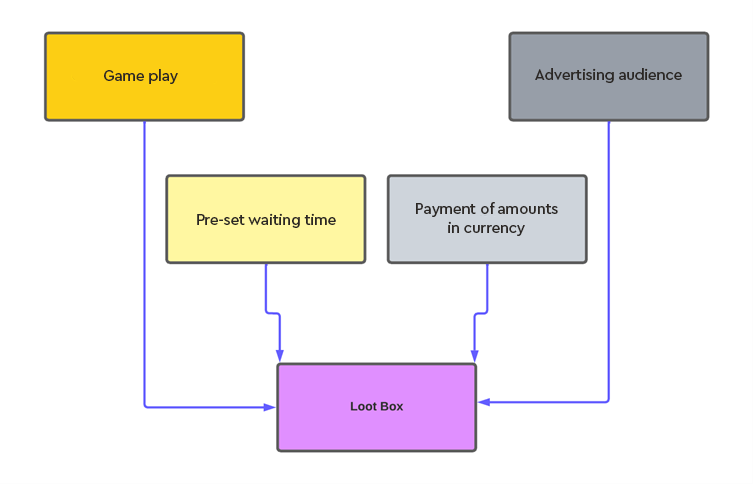
Video game loot boxes are accessible (i) during gameplay after the player has completed certain stages of the game or waited a certain period of time; or (ii) through optional payment by the player in currency.
For example, there are the well-known reward boxes that the player accesses when they pass a certain stage or buy access to, receiving a new item for use in the game itself (cards, in-game currency, items or skills to use on characters, etc.).
This is the concept taken from studies by the European Parliament that treat such practices in this way, such as the relevant one from 2020. Another example in this sense is the treatment given to the subject by the Belgian authority responsible (Belgian FPS Justice Gaming Commission), in which the term loot boxes comprises an umbrella of practices and game elements in which the player acquires items for free or for a fee in an apparently random manner.
There are three main elements that characterize a feature as a loot box, regardless of the game or the item it provides:
- Eligibility condition: the player needs to do something in order to gain access to the loot box.
This can happen in various ways. The most common is via gameplay, by passing stages, acquiring skills and overcoming milestones. The player's eligibility can also take the form of pre-defined waiting times, which can often be overcome by paying real money or by watching a certain advertising video. The image below is very representative of this dynamic:
- Reward selection procedure: there is an algorithm or some random selection process that determines the result obtained by the player.
What is expected and appropriate is that these processes ensure equal chances for all players in the same eligibility condition and that these mechanisms are duly auditable, in order to ensure transparency and algorithmic explainability. In addition, biased situations should be avoided by adopting appropriate frameworks, such as the ISO/IEC 24.027/2021 standard.
In this context, game distributors such as e have started to demand that game apps be able to ensure transparency for players in relation to loot box eligibility criteria, real chances and prize profiles.
- Prize: The player receives a prize that can vary depending on the experience.
It can be content for mere customization (items to be used as skins and new features for avatars) or items that affect the gameplay itself (tools, weapons, levels, maps, in-game currency, etc.). In the case of content, it doesn't affect the player's competitiveness, but only alters their aesthetic experience.
The others, however, directly affect competitiveness. In the latter case, when the player can pay for items, the practice of Play-to-Win is characterized.
Based on these three elements, Loot Boxes can be classified according to the following table:
| Eligibility Conditions | |
|
|
|
Gameplay Waiting time |
Payment of current currencies Advertising audience |
|
|
|
Low Short period of time played or low cost in current currencies |
High Long period played, high number of repetitions (grinding) or high cost in current currencies |
| REWARD SELECTION PROCEDURE | |
|
|
|
The odds of obtaining the different items are known to the players. |
The odds of obtaining the different items are unknown to the players. |
|
|
|
Different items have similar or equal chances of appearing to users. |
Some items can be considered rare (2% chance of appearing, for example) and others are considered common (50% chance of appearing, for example). |
| PRIZE | |
|
|
|
Purely cosmetic or customization. |
They directly affect the game's playability and competitiveness. |
Play-to-earn. Another notable practice is Play to Earn (P2E), in which, in addition to entertainment, people earn rewards as the games progress. These can be items for the game itself (such as loot boxes) - a practice known as play-to-own (P2O), crypto-assets, financial values, or even experiences to be used outside the games.
Other purchasing systems. Unlike Loot Boxes in which there is an element of chance or luck present, as we have seen, games can feature other purchasing systems without luck.
These can be:
- Direct purchase of items: Players can shop directly for items that customize their experience or affect gameplay.
- Ad-viewing: Players can watch advertisements to unlock new items in the game. This practice is very common in situations where players have never spent any money on the game, so that the game's profitability comes from monetizing the ad itself. The Google Play store, for example, sets out its guidelines in this regard and options for developers.
- Add-ons and extensions: Games can be distributed in various versions and prices. In some cases, in order to have additional content, players need to pay for extensions.
- Game passes: Similar to extensions, some games allow you to buy specific access tickets or tickets for certain special events (a specific race, an event in the metaverse, etc.).
The series then goes on to look at legal and illegal gambling practices and current regulation.

- Category: Digital Law
In the fifth and final article in the series "Gaming, betting and eSports Law: what do you need to know?" we look at how companies can act ethically, responsibly and in compliance with applicable regulations.
The aim is to provide information that will help companies strengthen their legal security and properly manage the risks involved, so that they can make the most of the opportunities and reap better results from their practices.
Privacy and protection of personal data. Activities involving gaming and eSports practices, although they vary in terms of profile and governance structure, use personal data to carry them out. In other words, data that makes it possible to extract information about the individuals involved in these activities, especially players, bettors and employees.
It is essential that companies have solid governance of personal data in order to mitigate risks and be fully compliant with personal data protection legislation, in particular the General Personal Data Protection Law (LGPD) and its regulation by the National Data Protection Authority (ANPD). Solid governance will also be profoundly strategic if companies are to be able to use data in a legally compliant manner and be well-prepared to receive investments, positioning themselves consistently in the due diligences to which they are subjected.
- Companies also need to be ready to account for their activities. To do so, they must
- - have privacy as a key element of their vision and mission;
- - structure a team responsible for privacy issues and, above all, appoint a Data Protection Officer;
- - draw up and keep up-to-date data inventories, especially records of operations involving personal data, identifying and mapping all the legal bases and producing the relevant documents;
- - establish routines that consolidate the ideal of privacy by design so that privacy and the protection of personal data are integrated into all the organization's activities;
- - carrying out all relevant and necessary assessments, such as:
- o balancing tests for activities that draw on legitimate interest;
- o data protection impact reports for high-risk data processing and other situations;
- o artificial intelligence assessments;
- o supplier assessments;
- o assessments of information security controls and routines; and
- o relevant due diligence
- - drawing up and updating privacy policies and notices;
- - draw up and maintain a plan for responding to requests from personal data subjects.
- - implement training and awareness-raising measures for professionals;
- - properly prepare the company's contracts, with a clear configuration of the role of the processing agent and other relevant clauses;
- - adopt all technical or administrative measures to prevent any unlawful or inappropriate processing of personal data and privacy incidents, including drawing up a privacy incident response and remediation plan that includes simulated exercises to check risks and procedures in practice.
Nudges techniques and dark patterns. In order to maintain compliance with applicable legislation, especially on privacy and protection involving specific audiences such as children, adolescents and the elderly, it is highly recommended to avoid adopting nudges techniques and dark patterns.
Preventive technical and legal assessments are great initiatives to mitigate risks and avoid wasting investments. They can prevent the release of games that don't comply with best practices, or that require disrupting the production flow in order to make corrections or adjustments.
- Nudges techniques are resources used in the course of the game that guide or lead the user to follow the path that the developer wants. However, if the technique or this "path" harms the player's rights, these practices should be avoided.
- Dark patterns are nudges techniques that are more ostentatious or exert greater pressure on the user to choose what is best for the developer. Examples of what should be avoided in the initial evaluation and development of the practice, product or service - whatever its modality or platform of use - include the following features:
- play to skip, in which players are "invited" to pay a fee to make progress during the game;
- play to unlock, in which players are "invited" to pay an amount to unlock certain stages of the game or specific content; and
- dayly rewards, in which players receive prizes or in-game items on a daily basis, prompting them to play the game regularly.
Children and adolescents. Considered one of the main target audiences for these practices, there are concerns and risks directly related to the protection of children and adolescents. It is important to ensure that the development of practices aimed at this audience are in line with legislation, especially the Statute of the Child and Adolescent (ECA), the Consumer Protection Code (CDC) and the LGPD.
The mitigation of legal risks and the credibility of games are directly related to the ability of companies to include legal protection parameters in the game development process. Legal assessments and alignments are fundamental.
Among the main measures to be considered are:
- adopting mechanisms to identify players under the age of 18 with a high degree of accuracy and implementing tools and communications that discourage false declarations of age.
- prioritizing practices and initiatives that are not harmful to the health and well-being of children. For example, it is advisable to adopt measures to discourage playing games for long periods of time. These measures include:
- introducing frequent checkpoints;
- avoiding the use of loot boxes which make it a condition of eligibility to remain in the game for a long period of time;
- adopting age-related protocols to encourage players to take breaks; and
- not associating game results or success during the game with long periods of permanence.
- pay attention to misleading (not in line with reality) and abusive (taking advantage of the fragility or ignorance of children) advertising practices aimed at marketing games, services or related items.
- prioritize as a standard the non-adoption of profiling[1] of players for marketing or advertising purposes, especially those related to monitoring user behavior.
- implement measures to monitor or control games, advertising and player migrations to third-party activities that may not be at the same level of suitability and compliance.
- avoid the use of nudges techniques and dark patterns in the players' journey, mainly due to the greater vulnerability of this audience.
- adopt appropriate means to identify inappropriate or illegal behavior in interaction spaces (video, chat, etc.), including extreme situations in which adults participate in the game to commit crimes related to exposure and/or child pornography.
Artificial intelligence. Practices use artificial intelligence tools in a large part of their processes and operations. It is important for companies to seek the legal certainty necessary for the use of artificial intelligence, by adopting best practices for the use of this technology, in order to minimize risks, maximize opportunities and guarantee adequate levels of ethics, transparency, reliability and information security.
Among the initiatives, we recommend:
- develop and apply frameworks and solutions for ethical governance and legal compliance, with the identification of applicable ethical parameters, legislation and national and foreign precedents, highlighting, for example, the recent approval of the AI Act by the European Union;
- drawing up applicable transparency policies and documents;
- preparing the necessary assessments, such as those relating to the protection of personal data and the use of artificial intelligence;
- evaluate and contract suppliers;
- monitor and audit artificial intelligence systems; and
- training and raising awareness among the teams responsible, including policies on the conscious use of these systems to protect personal data and the company's intellectual property.
Information security. Information security is also a highly sensitive issue. Companies need to be prepared to mitigate the risks of digital fraud, cyber attacks and crises, as well as being ready to respond appropriately to all these situations.
It is essential that companies focus on:
- preparation, developing appropriate plans and structures to manage cyber risk and respond to incidents quickly and effectively. To this end, it is advisable to draw up and review response plans, policies, contracts, campaigns, codes of conduct and corporate governance structures to reduce exposure to risk and guarantee the preservation of electronic evidence, based on best market practices, ISO ABNT 27.000 and 31.000 standards, COBIT, ITIL, NIST practices, comparative law and current legislation.
- response, remaining prepared to contain the negative impacts of the event, ensure business continuity and protect the brand's reputation. To this end, it is recommended that companies be ready to investigate incidents, preserve the necessary evidence, manage crises by interacting with authorities and regulators, senior management and other stakeholders such as employees, suppliers and customers.
- remediation, remaining prepared to mitigate the impact of legal actions resulting from the incident - including liability - class actions, administrative proceedings, among others. It is also recommended that companies be prepared to review incidents in a process of evaluating gaps and lessons learned that helps strengthen the organization's information security.
[1] Profiling is any form of automated processing of personal data that evaluates personal aspects relating to an individual. The aim is to analyze or predict aspects relating to the data subject's performance, economic situation, health, personal preferences or interests, reliability or behavior, location or movements.
- Category: Digital Law
In this fourth article in the series "Gaming, betting and eSports Law: what do you need to know?", we deal with the concepts of gambling, the elements that differentiate the practices and the laws that regulate them.
Gambling. This broad category includes all practices, whether or not permitted by law and Brazilian case law, in which, in addition to the purpose of entertainment, the following elements are identified cumulatively:
- Payment of a consideration made by the person either directly (such as payment for the bet itself) or indirectly (as in the case of participation in a prize draw conditional on payment for some product or service, collection of personal data, etc.).
- The person has the chance of winning a financial or non-financial prize. It could be, for example, a product or an indirect benefit - such as discounts, loyalty program points, specific NFTs, accessories for characters in games, experiences, etc.
- The prize is won by participating in a game that depends solely on luck (chance) or luck combined with the participant's skill (skill). Games of pure skill would not be included.
There is a lot of disagreement about this third element. So far, there is no broad definition in Brazil. The expression "games of chance" adopted in the well-known article 50, paragraph 3, "a", of the Criminal Contraventions Law, which prohibits their exploitation, stands out. The provision defines a game of chance as "a game in which winning or losing depends exclusively or mainly on luck".
Subparagraphs b and c of paragraph 3 also mention other practices considered games of chance by the Brazilian legislator. Both deal with betting, whether on horse races not organized with state authorization or on any sports practice. There is a debate as to whether or not skill prevails in sports betting, as we will show below.
Some legislations (such as those of certain US states) and some of the literature on the subject work with a narrower concept of gambling, which only includes practices in which the results depend exclusively or predominantly on luck. If the player's skill is predominant, the practice is not considered gambling according to this concept.
How do you know if luck or skill is predominant?
One of the techniques used is the so-called "dominant factor or predominance test", which consists of identifying which of the elements is more present. The idea is to break down and understand all the elements and determine, on a scale, which ones prevail over the others, in a weighting exercise.
Other regulations are broader and consider the three elements above without distinguishing whether it is luck or skill that prevails.
This second group includes, for example, the broad concept introduced by the UK's Gambling Act of 2005, which encompasses the practices of gaming, betting and participating in lotteries (Section 3). Gambling would thus be the genus of these three species:
- Gaming: seen as "playing a game of chance for a prize" - Section 6 (1). At first reading, this could suggest games based solely on luck or predominantly on luck. For the Gambling Act, however, "game of chance" includes: games that involve luck and skill; games that involve luck even if skill prevails; and games in which elements of luck are introduced - Section 6 (2) (a). The practice of sports does not characterize a "game of chance" - Section 6 (2) (b).
- Betting: placing or accepting a bet on the results of races, competitions or any event; the probability of anything happening or not happening; or whether something is true or not - Section 9 (1).
- Lottery: any situation or arrangement that characterizes any of the situations defined in the Gambling Act Subsections (2) and (3).
The same occurs in French legislation in its Code de la sécurité intérieure (Article L 320-1), which, although it uses the expression games of chance, adopts the broad meaning. As such, it considers all practices that depend totally or partially on luck to be included in this category.
France used to separate games of chance, which were prohibited, from games of skill, which were permitted. As of 2019, they are all prohibited, with specific and regulated permissions for only a few practices.
Legality or illegality of gambling practices in Brazil
Currently, due to article 50 of the Criminal Contraventions Law, the assessment of the legality or illegality of a given practice in Brazil is linked to the legal concept of gambling and depends on the joint analysis of the two points below:
- Presence of the three elements: consideration, prize and luck (isolated or predominant). If any of them is not present, regardless of the item below, the practice will be considered lawful.
- Even if all three elements are present, it is necessary to check whether there is authorization in legislation or case law for the practice to be carried out, even if it is based on the three elements above.
By way of exception, some practices are permitted in Brazil, such as lotteries operated directly or indirectly by the state. If there is no legal permission and all three elements are present, the practice is prohibited under Article 50. If skill prevails (as in the case of sports poker), the practice is permitted.
Casino games. This subcategory of gambling includes all typical casino practices in which the results depend exclusively or predominantly on luck. Some examples:
- slot machines;
- roulettes;
- dice-based games;
- blackjack;
- baccarat;
- sweepstakes;
- jogo do bicho; and
- bingo with no social purpose
These practices are prohibited in Brazil under article 50 of the Criminal Contraventions Act, whether they take place in person or online. However, if the skill component prevails in any practice carried out in a face-to-face or online casino (as we will see later in the case of poker), the practice will not be considered gambling and may be permitted.
There are a number of bills underway that discuss the legalization of these practices. The main one is Bill 442/91, which proposes to allow most casino games and gambling practices in general. The bill was approved in 2022 in the Chamber of Deputies and is currently before the Federal Senate.
Lotteries. Another subcategory of gambling is lotteries. They bring together the elements of gambling, since there is a consideration (payment of money) by the player, who competes for predefined prizes. The prizes are conditional on luck. Lotteries are permitted in Brazil and operated at federal and state level.
At the federal level, according to Decree-Law 204/67 and federal laws 6.717/79 and 759/69, lotteries are organized and operated exclusively by Caixa Econômica Federal.
State exploitation was permitted by the Supreme Court in 2020 (Action for Failure to Comply with Fundamental Precept 492). Each state is responsible for defining how it operates the lottery.
Sports betting. Sports betting has been a growing and successful activity all over the world. In Brazil, it is estimated that the activity will generate R$12 billion by 2023.
Here, the modality is already commonplace and practiced on platforms hosted outside the country. Its regulation and permission began with Federal Law 13.756/18, which, in its article 29, defined sports betting as fixed-odds betting.
The regulation was renewed by Provisional Measure 1.182/23 and the Normative Ordinance of the Ministry of Finance 1.330/23 - to learn more about the norm, read a specific article published on the portal.
Executive Bill 3.626/23 is also currently being processed. The bill, which aims to regulate the issue, has already been approved by the Chamber of Deputies in the first vote and recently by the Federal Senate. The text returned to the House.
Sports betting or fixed-odds betting (or sports betting, online or otherwise) is defined in the legal system as betting systems related to real sporting events, in which, at the time the bet is placed, the bettor knows how much he could win if the prediction of the bet is confirmed.
By going into a little more detail about the concept, it is possible to extract the following elements:
- there is a betting contract signed with a promise of a consideration for the user if the prediction is confirmed;
- the bet must be linked to a real sporting event, which includes any sporting event - such as soccer, chess, eSports - but excludes fantasy or non-real situations (fantasy sports, for example);
- the activity must be carried out by a physical or digital system (set of organized elements), usually supported by the well-known betting platforms that operate the business (bookmakers); and
- when the bet is placed (either before the sporting event or during it), the bettor already knows how much he will receive if the prediction of his bet (future results of the sporting event) is confirmed (bet result equals the actual final result).
Poker. Poker in Brazil, mainly online, has grown exponentially, especially after the pandemic, with the popularization of home office.
There is no specific regulation on the practice of poker in the country and the legal debates on the subject refer, in particular, to the discussion of whether the practice is considered gambling or game of chance (based on luck) or not (based on skill).
How can gaming, betting and eSports practices be conducted in an ethical, responsible and legally compliant manner? This is the subject of the fifth and final article in this series.
- Category: Digital Law
In this second article in the series "Gaming, betting and eSports Law: what do you need to know?" we look at the legal aspects of games and electronic games.
Games. This category includes practices and electronic games whose main element is to entertain users, regardless of the type of game: sports, action, adventure, strategy, role playing games (RPG), racing, simulators etc.
The number of users, the profile of the players (children, teenagers, adults, the elderly) and even the platforms ou gadgets used (consoles, computers, smartphones, tablets, among others) are not relevant elements to categorize the practice as games or electronic games.
Documents from the European Parliament, for example, propose classifying games as:
- video games: broader category involving games played on mobile and other devices - such as computers and consoles.
- mobile games: category of games played on mobile devices - such as smartphones and tablets.
- online games: this category includes all games in which elements are played online. It allows, for example, interaction between players in multiplayer games.
If the game involves, in addition to entertainment, the elements that characterize the practice of gambling (identified later in our series of articles), it will fall into this category for the purposes of regulation, compliance and risks.
Legal Framework for Games (Bill 2.796/21). The Chamber of Deputies approved this bill in October 2022. The text proposes to regulate the manufacture, import, marketing and development of electronic games in the country. The bill is currently being considered by the Federal Senate.
The creation of the Legal Framework for Games is important for legal certainty in the sector. It provides important definitions, proposes initiatives to foster development, reinforces the role of the state as an incentive for the segment and does justice by bringing the tax treatment of electronic games into line with that of computer products.
It also recognizes the growth of eSports (see below) and encourages the creation of technical courses and innovation. It also proposes establishing legal limits for the practices, as long as they are not strictly characterized as games of chance.
Fantasy games. This is a sub-category of games. Fictitious teams or groups are assembled virtually, using real people or companies as a reference. The results of real games directly influence the results and winnings of electronic games.
In addition to the entertainment element, the results and winnings or prizes of electronic games - which can be exclusively financial - reflect what happens in reality. In some cases, elements of gambling or games of chance are present. When this occurs, these practices are characterized.
The best known are the so-called fantasy sports, in which players field fictitious teams made up of professional athletes from the real world. In these games, statistics accumulated from the performances of real athletes, teams and results are used.
One of the best-known examples of this category in Brazil is Cartola FC, operated by the company Globo Comunicação e Participações S.A. The game Rei do Pitaco is another example. There are many games of this type abroad, including NBA Fantasy and NFL Fantasy in the United States and Fantasy Premier League in England.
eSports. This is the so-called electronic sports, in which players compete professionally in games. They are real sporting competitions. Players act as professional athletes, compete against each other - individually or in groups - and are watched by a large audience - in person or remotely - on platforms or even on sports channels.
The main professionals involved include:
- pro players (those who perform the competitive function and play directly - the faces of the teams);
- coaches (responsible for training pro players and teams);
- designers (responsible for creating and managing the teams' visual identities);
- data analysts (responsible for analyzing data and producing statistics for the teams);
- social media professionals (responsible for the teams' social media); and
- managers (responsible for the administrative and operational coordination of the teams).
This is a strong and booming market, in which Brazil occupies a prominent position. The relationships associated with the practice have highly relevant commercial impacts and require more and more legal measures to guarantee the legal certainty necessary for its development.
In terms of legal regulation, there is no definition of "eSport" in the country or specific regulation for the practices.
The Pelé Law (Federal Law 9.615/98) defines, in its Article 1, that "Brazilian sport encompasses formal and non-formal practices" and defines formal sporting practice as that "regulated by national and international standards and by the rules of sporting practice for each discipline, accepted by the respective national sports administration bodies" (Article 1, §1).
Non-formal sports practice, on the other hand, is defined as "characterized by the playful freedom of its practitioners" (Art. 1, §2).
The law therefore delegates the definition to the specific regulations of the entities responsible or, on the other hand, accepts generic practices based on people's daily lives.
This year, the General Sports Law (Law 14.597/23) was passed, which did not deal with the issue and defined sport as "any form of predominantly physical activity which, in an informal or organized way, aims to practice recreational activities, health promotion, high performance sport or entertainment." (Art. 1, §1).
At the same time, Bill 70/22, which proposes regulating e-sports, is being processed in the Chamber of Deputies. According to the substitute approved this year, the practice would be included in the General Sports Law and eSport or electronic sport defined as "the activity that requires eminently intellectual exercise and dexterity, in which people or teams compete in virtual games, with predefined rules, through the internet or a set of networked computers".
In the next article in the series, we'll deal with two other fundamental issues: so-called loot boxes and play-to-earn practices.
- Category: Tax
Our eBook provides detailed insights into the new legislation on the subject.
Published on January 10, 2024, Law No. 14.801/24 introduces a new type of debenture in the infrastructure sector, with specific tax benefits and significant modifications to Law No. 12.431/11. With the expectation of lower interest rates and the attraction of new investors, the legislation promises to transform the infrastructure capital market.
Our eBook details the legislative changes, highlighting the creation of infrastructure debentures and changes in the rules relating to specific Brazilian investment funds, such as FIP-IE, FIP-PD&I, and FI-Infra.
- Understand who can issue infrastructure debentures, the tax benefits for issuers and debenture holders, as well as the associated responsibilities and prohibitions.
- Explore the changes in taxation, the conditions for investments in environmental or social projects, and the alterations in the investment fund regime.

- Category: Digital Law
With this publication we inaugurate a series of five articles that will cover the main legal concepts and aspects related to gaming, betting, and eSports. In general, the legal practice related to these subjects encompasses all issues associated with regulation and business related to electronic games or games, betting of any kind, typical casino games and electronically practiced sports.
The series is divided into five articles that will be published on our website:
- What is the legal practice of gaming, betting, and eSports?
- Games, fantasy games and eSports: main aspects
- What are loot boxes and play-to-earn practices?
- An overview of gambling, gaming and betting practices
- Gaming, gambling and eSports: the road to legal certainty
All these practices are growing rapidly. Generations Z and Alpha (today's and tomorrow's consumers) have migrated from more static social media content to video and interactive content. The new generations are looking for spaces to get entertainment and content and, at the same time, socialize in a real way. Games have players, not just users, and function as spaces for interaction and, often, escape from the patterns artificially established by social media.
Concepts about these practices are not uniform and are sparse. They may vary from country to country or according to the literature consulted. The most important thing is to identify each practice individually and its own elements in order to then understand the specific regulation applicable (in material and territorial terms) and the risks that need to be addressed.
Depending on the elements, the classifications can intersect: a game can be recognized as or contain a gambling practice, and vice versa. In fact, there is growing convergence between gaming and gambling practices. The inclusion of gambling elements in electronic games is increasing. The so-called loot boxes, discussed in another article in this series, are perhaps the greatest example of this interaction.
The legality or illegality of each practice is not automatically related to its category or denomination. It depends on individual analysis. For example, gambling may or may not be legally permitted. A specific game may contain unauthorized gambling elements, making the practice prohibited by law or deserving of adjustments.
These practices and the development of the metaverse are connected precisely by the socialization provided and sought in games. These practices will dictate a large part of the rules and risks, especially considering that the new generations are already directly responsible for business and regulatory guidelines.
The metaverse is much more than just virtual reality. It is the interconnection between our physical (analog) and digital lives. It represents an uninterrupted flow between what we are and what we see in the analog world, to a completely digital environment. An interoperable digital environment created jointly by the initiatives of various organizations.
Businesses, products and content have been directed towards this new environment. As a result, strategy, compliance and risk mitigation activities need to be directly related to this new reality.
In the next article in the series, we'll look at the legal aspects of games and electronic games.

- Category: Life sciences and healthcare
The growing number of scientific studies on the therapeutic properties of Cannabis Sativa and psychedelic substances points to the need for relevant updates in Brazilian regulation. Our Life Sciences and Health experts bring the most current overview of the topic, as well as perspectives for the near future.

- Category: Capital markets
CVM Resolution 175/22 represents a new regulatory framework for investment funds, modernizing the rules on the constitution, operation and disclosure of fund information and the provision of services to funds. The rule replaces and repeals 35 normative instructions and three resolutions issued by the Brazilian Securities and Exchange Commission (CVM).
In this ebook, we detail the changes brought about by the new regulations, which came into force on October 2, and their tax aspects.
- Category: Tax
Elected as a national priority, the tax reform will unify the main taxes on consumption in order to improve Brazil's business environment and boost its economic growth.
To help you understand the changes and the impact of these transformations on the business landscape, we have put together a complete guide to the Tax Reform on Consumption, summarizing the challenges and opportunities for companies as they adapt to the new tax environment.
The guide explains the evolution in the way taxes are collected and administered in Brazil and the new tax categories, which simplify the tax system and seek to promote greater efficiency. Understand what Dual VAT is, the situations in which the Differentiated Taxation System will be applied, and which other tax systems will be maintained.
Check out the Portuguese and Spanish versions of the content at the following links:

- Category: Labor and employment
The year 2023 was marked by a clash between the decisions handed down by the Labor Courts and the Federal Supreme Court (STF), especially with regard to accepting the validity of other types of employment relationships, in addition to the employment relationship provided for in the Consolidated Labor Laws (CLT).
Despite the decisions handed down by the STF in actions for concentrated control of constitutionality (ADPF 324, ADC 48, ADIs 3.961, and 5.625) and the theory established in general repercussion in the judgment of RE 958252 (Topic 725), the Labor Courts continue to recognize the unlawfulness of other forms of hiring.
This understanding was sometimes based on doctrinal ideals used as grounds for legal relationships regulated by different instruments to be considered fraudulent and end up having an employment relationship recognized as established in the CLT.
As a result, there was a flurry of constitutional complaints that culminated in hundreds of STF decisions annulling decisions handed down by the Labor Courts due to non-compliance with Supreme Court precedents. These STF decisions are sometimes accompanied by severe criticism of the way in which the Labor Courts administer justice.
The Labor Courts, in turn, feels increasingly under attack in the face of threats to strip it of its jurisdiction and the constant overturning by the Supreme Court of understandings that had previously been established in the Labor Courts.
The clashes between the STF and the Labor Courts show that we are still a long way from achieving the legislator's goals of reducing repetitive litigation, guaranteeing equal protection for the litigants, and increasing the legal certainty of judicial activity. It is not new that the Brazilian legal system has been structured to achieve these goals, as was the case with the reforms to the old Code of Civil Procedure, Constitutional Amendment 45, the promulgation of the Code of Civil Procedure in 2015, and the Labor Reform in 2017, among other initiatives.
With the enactment of Constitutional Amendment 45 (EC 45/03), the constitution introduced the concept of binding precedents into our legal system. Taken in its full context, this initiative is an approximation of the idea of the duty to observe judicial precedent present in common law. The aim is precisely to impose a normative mechanism that helps to standardize case law and provide greater legal certainty for the litigants.
In the same vein, the 2015 Code of Civil Procedure requires judges to comply not only with binding precedents, but also with all decisions handed down by the STF in actions for concentrated control of constitutionality, in rulings on incidental proceedings for assumption of jurisdiction, or resolution of repetitive demands and in the judgment of repetitive extraordinary and special appeals, and with the precedents handed down by the STF and STJ. The same applies to the guidelines of the courts en banc or special bodies of the courts to which they are attached.
Despite the legislator's efforts to impose mechanisms for the social pacification of judicial activity, 20 years after EC 45/03 and almost a decade after the "New" CPC entered into force, little progress has been made in reducing repetitive litigation. There are still many conflicting decisions on the same subject, which creates undeniable legal uncertainty for labor litigants.
Much has been said about the political differences between the two judicial bodies as the cause of these conflicting positions. However, it seems to us that the difficulty in providing greater legal certainty in decisions is, in fact, intrinsically related to the undue use of discretion in judicial activity, which must be rejected in any instance.
Within the scope of the Labor Courts, despite the fact that the Constitution confers jurisdiction on these courts to prosecute and judge any and all disputes over labor relations, in general, what was observed was an almost automatic classification of the legal relationship between the parties under the CLT.
This practice was often carried out in a discretionary manner, as a way of protecting one of the parties from what was seen as making labor precarious, completely ignoring the circumstances that permeated other forms of hiring. This led the discussion to the STF so that the issue could be settled.
Currently, even in the face of the STF's binding decisions, some Labor Courts continue to act in a discretionary manner by not even weighing the STF's precedents when faced with discussions regarding invalidating legal relationships without an employment relationship.
By legal and constitutional force, the decisions handed down by the STF in actions of concentrated control of constitutionality - such as those handed down in ADPF 324, ADC 48, ADIs 3.961 and 5.625, as well as in the judgment of RE 958252, which led to the theory general repercussion set out in the enunciation of Topic 725 - consist of formal sources of labor law.
These decisions cannot, as some labor judges have been doing, be ignored in judicial rulings. The STF's intention to curb decisions that, based on discretionary acts, ignore the existence of binding decisions is therefore legitimate.
On the other hand, the existence of binding decisions as mentioned above cannot have the power to rule out the functional jurisdiction of the Labor Courts, provided for in the Constitution, to hear and decide conflicts related to labor relations. Labor judges have the prerogative to proceed with a hermeneutic interpretation of labor law, in all its sources, which includes binding decisions, with the autonomy to cease applying them, as long as the techniques for overcoming precedents are duly used, with an emphasis on distinguishing and overruling.
In this sense, it seems to us that the solution to impasses of this kind will only come about when the courts overcome totalitarian ideologies and definitively abolish the adoption of discretionary criteria in the administration of justice, using techniques for the formation and interpretation of precedents. This is necessary in order to ensure greater legal certainty and swift and efficient access to justice for all litigants.
These are certainly the wishes for 2024 of all legal practitioners, especially those who practice in the Labor Courts.

- Category: Labor and employment
The joint judgment of the motions for clarification filed due to omissions, contradictions, and obscurities in the preliminary injunction granted in Direct Action for Unconstitutionality 7.222 (ADI 7.222) was completed on December 18th.
The ADI was filed by the National Confederation of Health, Hospitals, and Establishments and Services (CNSaúde) against Law 14.434/22, which established the national salary floor for nurses, nursing technicians, nursing assistants, and midwives (national nursing floor).
In an en banc judgment of the Federal Supreme Court (STF), the dissent opened by Justice Dias Toffoli prevailed. There were six votes in favor of the understanding that:
- the implementation of the national nursing floor must be carried out through collective bargaining for employed professionals in general;
- the national nursing floor refers to the overall remuneration of the civil servant or the employed professional; and
- the proportionality of the national nursing floor is in relation to the working day of eight hours a day or 44 hours a week.
Collective bargaining is essential in order to apply the floor
Among the points addressed in the motions for clarification filed in ADI 7.222 was obscurity as to what would consist of "sufficiently substantive and apt collective bargaining" to serve as an indispensable condition for application of the national nursing floor described in the decision granting a preliminary injunction upheld by the STF in July of 2023.
In partially granting amending effect to the motion for clarification filed by CNSaúde, Justice Dias Toffoli presented a vote in which he defined application of the national nursing floor through regionalized collective bargaining and observing the base date. If collective bargaining is unsuccessful, the parties have the prerogative to initiate collective dissent. Justice Dias Toffoli established a new wording for item (iii) of the decision granting a preliminary injunction upheld by the STF:
"(iii) in relation to employed professionals in general (article 15-A of Law No. 7,498/1986), implementation of the salary floor must take place on a regionalized basis through collective bargaining carried out in the different territorial bases and on the respective base dates, with what is negotiated prevailing over what is legislated, in view of the concern regarding possible layoffs and the essential nature of the health service. If collective bargaining is unsuccessful, collective dissent, by mutual agreement, is fitting (article 114, paragraph 2, of the Federal Constitution of 1988), or, independently of this, in the event of a momentary stoppage of services carried out by any of the parties (article 114, paragraph 3, of the Federal Constitution of 1988). The resolution of the conflict by the Labor Courts will be guided by the primacy of maintenance of jobs and the quality of patient care, respecting the economic realization of each region."
The dissenting vote presented by Justice Dias Toffoli - and concurred with by Justices Alexandre de Moraes, Cristiano Zanin, Gilmar Mendes, Luiz Fux, and Nunes Marques - made collective bargaining an essential procedure for application of the national nursing floor, favoring what is negotiated over what is legislated.
As we had already argued when the STF's decision granting a preliminary injunction was published, in July of 2023, the logic behind the preliminary injunction was to make collective bargaining a condition for implementation of the national nursing floor, in order to avoid negative externalities.
In the case of the national nursing floor, as highlighted in the vote of Justice Gilmar Mendes, the negative externalities would be "reduction of jobs through the practice of mass layoffs" and "damage to the continuity of provision of health services."
Overall remuneration
As Justice Dias Toffoli's dissenting vote prevailed, item (iv) was set as part of the decision granting a preliminary injunction upheld by the STF in July of 2023, to define that the national nursing floor refers to the "minimum amount to be paid according to full working day."
Accordingly, the national nursing floor will correspond to the "overall remuneration" of the civil servant or employed professional, encompassing "all the amounts received" and not just the base salary or wage.
Proportionality of the floor to the working day
Although the reporting judge, Justice Luís Roberto Barroso, presented a vote that reduced the working hours parameter for the payment of the national nursing floor to 40 hours a week, the dissenting vote presented by Justice Dias Toffoli prevailed.
Thus, item (iv) set for addition to the decision granting a preliminary injunction upheld by the STF in July of 2023 mentioned the working hours of eight hours a day or 44 hours a week as a parameter for payment of the floor. Working hours can be reduced proportionally through collective bargaining.
The STF has yet to decide on the merits of ADI 7.222 filed by CNSaúde. The judgment refers only to the motions for clarification filed against the decision granting a preliminary injunction upheld by the STF en banc.
The decision, therefore, only clarifies omissions, contradictions, and obscurities related to the preliminary injunction granted by the STF, resulting from CNSaúde's request to suspend the effects of Law 14,434/22.
The appellate decision has yet to be drafted by Justice Dias Toffoli.