
- Category: Labor and employment
Published on December 22, Law 14,766/23 added another paragraph to article 193 of the Consolidated Labor Laws (CLT). This article deals with activities considered hazardous and provides for the granting of a 30% hazard premium to workers exposed to them.
The new provision mainly benefits employers in the road transport sector, as it rules out the payment of hazard pay to vehicle drivers under certain conditions.
The new provision states:
"Paragraph 5. The provisions of subsection I of the head paragraph of this article do not apply to the quantities of flammables contained in the original factory fuel tanks and supplementary fuel tanks, for the own consumption of cargo vehicles and public passenger transport vehicles, machinery and equipment, certified by the competent body, and in cargo refrigeration equipment."
With the inclusion of paragraph 5 in article 193 of the CLT, therefore, the hazardous nature of the activities and operations carried out by drivers of vehicles exposed to flammable fuels is expressly ruled out, provided that the requirements mentioned in the text are met.
The change in the CLT is relevant due to the divergent interpretations given by regional courts regarding the mandatory payment of the hazard premium to workers exposed to this situation. In addition, the Superior Labor Court (TST) has already established that the premium must be paid, even if the legislation in force states otherwise.
Decisions favoring payment of hazard pay are based on the text of Regulatory Standard 16 (NR-16) created by the Ministry of Labor to regulate hazardous activities and operations established in articles 193 to 196 of the CLT.
This is because item 16.6 of NR-16 states that "transport operations of flammable liquids or liquefied gases, in any container and in bulk, are considered to be hazardous, with the exception of transport in small quantities, up to a limit of two hundred (200) liters for flammable liquids and one hundred and thirty-five (135) kilos for flammable liquefied gases."
However, when ordering employers to pay hazard pay, judges end up disregarding items 16.6.1 and 16.6.1.1, included in NR-16 in December of 2019.
These items exclude from the standard established by item 16.6 the quantities of flammables contained in vehicles' own consumption tanks, as well as those contained in original factory fuel tanks and supplementary tanks certified by the competent body.
It is therefore believed that the inclusion of paragraph 5 in article 193 of the CLT will guide the courts in their judgments and bring an end to discussions on the subject.
It is important, however, to keep a close eye on future decisions, as it is uncertain whether the change will affect current employment contracts or only those entered into after the law's publication.

- Category: Labor and employment
Among other qualities, the legal community is very skilled at creating memes on social media. And there's no time of year better suited to generating memes than the so-called judicial recess. "It's already judicial recess in Australia," says a meme that has now become a tradition.
This article aims to clear up some myths related to the judicial recess and vacations, as well as revealing two or three well-kept secrets about labor law practice in the higher courts.
- OVERCOMING A MYTH AND REVEALING SOME SECRETS
To begin with, the most important thing: the myth that all deadlines are suspended during the judicial recess and vacations is false.
We are not referring to statutory limitations or lapse periods, nor to the exception made by article 215 of the Code of Civil Procedure (CPC) on the time limits that apply during judicial vacations. Nor is it the case of the rule in article 129, II, of Law 8,213/91, which provides for the processing of disputes and injunctive measures relating to accidents at work, including during judicial vacations. Or, again, the time limit for an action for vacatur - which, as is well known, is extended to the first subsequent business day "when it expires during judicial vacations, recesses (...)" (article 975, paragraph 1, CPC).
We are dealing here with labor procedural deadlines that are not suspended during judicial recess and vacations. These deadlines exist and overcome the myth that all labor procedural deadlines are suspended during judicial recesses and vacations. The fall of this myth is also the revelation of a first secret: the existence of a universe that does not stop working during judicial recesses and vacations, the Disciplinary Board of the Labor Judiciary (CGJT).[1]
A subject little studied by the legal profession and to a certain extent unknown even to lawyers, the jurisdiction and duties of the Disciplinary Board of the Labor Judiciary form a magnificent universe that is fully expanding even during the judicial recess and vacations.[2] The CGJT's own case law establishes that its activities are uninterrupted:
- “APPEAL PURSUANT TO INTERNAL RULES OF COURT. PARTIAL CORRECTION. UNTIMELINESS. COURT RECESS. UNINTERRUPTED ACTIVITY OF THE DISCIPLINARY BOARD. 1. An interlocutory appeal does not merit relief when the reasons given fail to undermine the grounds set out in the decision rejecting the complaint. 2. The activities of the Disciplinary Board of the Labor Judiciary are uninterrupted, and the judicial recess does not constitute a cause for suspension of the time limit in the rules referred to in article 17 of the RICGJT. Precedents. 3. Interlocutory appeal denied relief." (TST, Special Body, CorPar - 1000013-93.2019.5.00.0000, opinion drafted by Justice Lelio Bentes Correa, DJ, October 15, 2019, emphasis added)
The precedent shows that the deadline laid down in article 17 of the Internal Rules of the Disciplinary Board of the Labor Judiciary (RICGJT) is not influenced by the judicial recess.[3] This reveals a second secret - perhaps the most important one: the five-day deadline for filing for a partial correction influences the deadline for filing an appeal in the main action.
The subject is broad and beyond the limits of this short article. The idea, however, is simple: if the party wants to preserve the useful outcome of the main proceedings, it should bring forward the filing of the appeal in the main action and make it coincide with the deadline for filing the partial correction. It's something that even relates to article 218, paragraph 4, of the CPC and with the rule that says that an appeal filed before the start of the deadline is timely.[4]
An important precaution can be added to equalize the judicial recess and group judicial vacations.
For labor lawyers who do not practice before the Superior Labor Court, the judicial recess is established by article 775-A of the CLT: the procedural deadlines are suspended between December 20th and January 20th, inclusive.[5]
But Brazilian cassazionisti or barristers practicing before the Superior Labor Court need to consider in their strategies the canonical judicial recess, so to speak, and the group judicial vacations, "in the periods from January 2 to 31 and from July 2 to 31" (article 66, paragraph 1, of Complementary Law 35/79).
Another trap is hidden here and a third secret for lawyers is revealed: even during the group vacation period , the work of the Disciplinary Board of the Labor Judiciary is uninterrupted. CGJT case law states as follows:
- “APPEAL PURSUANT TO INTERNAL RULES OF COURT IN A PARTIAL CORRECTION. UNTIMELINESS OF THE CORRECTION MEASURE. JUDICIAL RECESS AND GROUP VACATIONS. UNINTERRUPTED ACTIVITY OF THE DISCIPLINARY BOARD. 1. The activity of the Disciplinary Board of the Labor Judiciary is uninterrupted. In the event of any absences or temporary impediments, the Disciplinary Board of the Labor Judiciary will be replaced by the Deputy Chief Judge, or, in the absence of the Deputy Chief Judge, by the Chief Judge, and then by the Justices, in descending order of seniority, in accordance with articles 15, subsection III, of the Internal Rules of the Superior Labor Court and 2, paragraph 2, of the Internal Rules of the Disciplinary Board of the Labor Judiciary. For this reason, neither the judicial recess nor the group vacations of the Justices of the TST constitute a cause for suspending the five-day deadline for the interested party to request partial correction from the Disciplinary Board of the Labor Judiciary. Particularly in this case, where the party invokes a suspension of deadlines within the jurisdiction of the Regional Court. 2. The Appellant did not put forward any argument that would undermine the grounds of the order under appeal, which is why the request for modification of the decision does not prosper. (TST, AgR-CorPar 1002-24.2016.5.00.0000, reporting judge Justice João Batista Brito Pereira, Special Body, DEJT, June 14, 2016, emphasis added)
- DISTINCTION BETWEEN THE DEADLINES FOR FILING FOR PARTIAL CORRECTION AND FOR FILING AN INTERLOCUTORY APPEAL PER INTERNAL RULES OF COURT
The difference is fundamental between the deadline for submitting the partial correction and the deadline for filing an interlocutory appeal with the Special Body of the Superior Labor Court - an appeal that may be lodged, depending on the alternative chosen by the Justice member of the Disciplinary Board of the Labor Judiciary (a position currently held by Justice Dora Maria da Costa) when submitting the application for partial correction.
One of the alternatives involves immediate rejection of the partial correction, "if it is inadmissible, inept, untimely, or unaccompanied by an essential document" - which reinforces the need to pay attention to timeliness, even during judicial recesses and vacations.[6]
A question little debated in labor law scholarship: if the request for correction is rejected or granted during the recess and vacation periods, is the deadline for filing the interlocutory appeal, provided for in article 35 of the RICGJT,[7] influenced by the suspension of deadlines or is it not suspended?
It seems like a simple question, but it led to a tie,[8] a request for review, twists and turns,[9] and a great deal of reflection in the paradigmatic precedent RC 1552056-38.2005.5.00.0000, in which the theory was established that the time limit for the interlocutory appeal is suspended during judicial recesses and vacations. Since then, this understanding has been reiterated, maintaining the distinction between the deadlines for filing for a partial correction and for filing an interlocutory appeal:
- “(...) V - Here it is worth noting the impertinence of the appellate decision in AG-RC-1552056-38.2005.5.00.0000 (DJ of September 1, 2006), invoked by the appellant to support its version that the case law that does not suspend deadlines in this Disciplinary Board during the judicial recess is not settled. VI - It was argued there that the urgency capable of justifying absence of suspension of the deadline during the judicial recess was indiscernible in the case of an interlocutory appeal, that is, an "appeal filed against a decision of the Disciplinary Board," a situation different from that outlined in the decision under appeal, in which the untimeliness of the partial correction was recorded. VII - The subject-matter inadequacy of the provisions of articles 173, head paragraph, 179 of the CPC and 183 of the RITST should also be emphasized, since the rules of the CPC and the Internal Rules of this Court refer to procedural deadlines, that is, deadlines that must be observed in the triangular procedural relationship in which its protagonists are involved, among which the deadlines referring to the judge stand out, with everything indicating that they refer substantially to the exercise of judicial activity, unrelated to the duty of the Disciplinary Board, known to be of an administrative nature, according to article 709 of the CLT and article 6, subsection II, of the RICGJT/2011. VIII - Hence no violation of subsections XXXV, LIV, and LV of article 5 of the Constitution can be seen, either because the decision under appeal refers to the repeated actions of the Disciplinary Board, or because the untimeliness of the partial correction does not reach a constitutional level. IX - Interlocutory appeal denied relief." (TST-AG-CorPar-301-68.2013.5.00.0000, Special Body, reporting Justice Barros Levenhagen, DEJT, April 5, 2013, emphasis added)
- CONCLUSION
There are many lessons in the case law of the Disciplinary Board of the Labor Judiciary that, if looked at carefully, become secrets revealed to the lawyer obliged to act during judicial recesses and vacations.
Only those who have had to draft and file a partial correction on Christmas Eve know that obtaining a favorable decision from the Disciplinary Board of the Labor Judiciary on Christmas Day gives new meaning to hope in justice and makes concrete the theoretical idea that to win without challenges is to triumph without glory.[10] For the lawyer who prefers to wait until the end of the judicial recess and vacation to file a partial correction, there will always be the story already told by the precedent TST-AG-CorPar-301-68.2013.5.00.0000:
- "INTERLOCUTORY APPEAL IN PARTIAL CORRECTION - IN LIMINE DISMISSAL OF THE COMPLAINT AS UNTIMELY - NON-SUSPENSION OF THE DEADLINE FOR FILING THE CORRECTIVE MEASURE DURING THE JUDICIAL RECESS - READING OF ARTICLES 15, SUBSECTION III, OF THE RITST AND 2, PARAGRAPH 2, OF THE RICGJT/2011 - INSUBSISTENCE OF THE ARGUMENTS ON APPEAL. I - It should be noted, as it was in the decision under appeal, that article 15, subsection III, of the RITST provides that, in the event of absences or temporary impediments, the Disciplinary Board of the Labor Judiciary will be replaced by the Deputy Chief Judge, or, in the absence of the Deputy Chief Judge, by the Chief Judge, and then by the Justices, in descending order of seniority". II - Article 2, paragraph 2, of the RICGJT/2011, in turn, states that "in the event of absences, impediments, and vacations, the Justice serving as Disciplinary Reviewer will be replaced, in the exercise of his functions, by the Deputy Chief Justice or, in his absence, by the Chief Justice of the Court and, if this is not possible, by the Justices in descending order of seniority". III - It is clear from the aforementioned rules of procedure that the exercise of the duties conferred on the Disciplinary Board of the Labor Judiciary does not suffer from dissolution of continuity, such that the judicial recess and collective vacations cannot be characterized as causes that suspend expiration of the period for the interested party to file for partial correction (precedents of the Disciplinary Board of the Labor Judiciary). IV - Based on these considerations and taking into account the rule of article 17, head paragraph, of the RICGJT/2011, which sets the deadline for filing for partial correction at five days, the measure sought is untimely, since the applicant was unequivocally aware of the decision to be corrected on December 19, 2012, and did not realize that the deadline had fallen on December 24, 2012, and only filed the complaint on January 11, 2013. (...)." (TST-AG-CorPar-301-68.2013.5.00.0000, Special Body, reporting judge Justice Barros Levenhagen, DEJT, April 5, 2013, emphasis added)
Of course, for many lawyers, all the "secrets" revealed by this article are nothing more than Pulcinella's secret.[11] Anyone who is familiar with the case law of the Superior Labor Court knows that, "according to long-standing and settled case law, the recess does not constitute a cause for suspending the flow of time limits for the applications for correction." This case law was already well-established in 2009, when the following judgment was published:
- "On the other hand, the Application for Correction is manifestly untimely. Under the terms of article 15 of the Internal Rules of the Disciplinary Board of the Labor Judiciary, the deadline for filing an application for correction is five days, counting from publication of the act or order in the official gazette, or from the party's unequivocal knowledge of the facts relating to the objection. In this case, the act now contested was published in the Electronic Journal of the Labor Courts on Thursday, December 18, 2008 (page 481). Thus, the legal five-year period for filing an application for correction began on Friday, December 19, 2008, and ended on Tuesday, December 23, 2008. The Application for Correction under examination, however, was only filed on Thursday, February 5, 2009 (page 2). Untimely, therefore. It is important to emphasize that, according to long-standing and settled case law, the recess does not constitute a cause of suspension of the flow of the deadline for applications for correction, either because there is no legal permission, or because the Disciplinary Board of the Labor Judiciary runs uninterruptedly. (...)." (TST, RC-2044806-52-2009.5.00.0000, Disciplinary Board of the Labor Judiciary, Justice João Oreste Dalazen, decided on February 12, 2009, emphasis added)
But the competence and duties of the Disciplinary Board of the Labor Judiciary involve highly complex and challenging issues. Just think, for example, of the impact and potential that article 22 of the RICGJT can acquire in a system of mandatory and qualified precedents.[12] Not to mention the gigantic scenario that emerges from reading the sole paragraph of article 13 of the RICGJT.[13] To return to the memes: those in the know will know.[14]
Finally, when you see a legal meme about the judicial recess and vacations, remember that neither St. Ivo nor St. Claus will be able to help if your lawyer forgets that the activities of the Disciplinary Board of the Labor Judiciary are uninterrupted.
[1]The purpose of this article is to deal with the dynamics of the Disciplinary Board of the Labor Judiciary during judicial recesses and vacations. At some point in the future, another article will have to be written to deal with the equally relevant and admirable performance of the chief judge’s chambers of the Superior Labor Court during judicial recesses and vacations. As the TST operates on call during this period and there is no service in the offices and chambers of the Justices, it is incumbent on the Chief Judge, independently of the reporting judge, to "decide, during the judicial recess, collective vacations, and holidays, on petitions for injunctions in applications for mandamus, provisional injunctions of an urgent nature, and other measures claiming urgency" (article 41 of the Internal Rules of the TST).
[2] In general, when thinking about the jurisdiction and duties of the CGJT, it is not usually considered beyond the head paragraph of article 13 of the RICGJT, according to which "Partial Correction is appropriate to correct errors, abuses, and acts contrary to good procedural order and which imply an infringement of legal procedural formulas, when there is no appeal or other specific procedural means for the case."
[3] RICGJT, article 17: The deadline for filing a Partial Correction is five (5) days, counting from the publication of the act or order in the official gazette, or from the party's unequivocal knowledge of the facts relating to the objection.
[4]CPC, article 218, paragraph 4: Any act carried out before the initial deadline will be considered timely.
[5] However, there is already a case of this rule being relaxed: lawyers who work at the Campinas Labor Court in São Paulo, for example, managed to sensitize the administration of the Court of the 15th Region and won a few more days of judicial recess. As a result, procedural deadlines in that court will also be suspended from January 21 to 29, 2024, with deadlines resuming on January 30, inclusive (GP-CR Ordinance 15/23).
[6]The alternative of an immediate dismissal of partial correction is indicated in article 20, I, of the RICGJT. The second alternative is provided for in article 20, II, of the RICGJT: preliminary granting of suspension of the act objected to by the application for partial correction. The third alternative is provided for in article 20, III, of the RICGJT: to dismiss the partial correction outright, provided that the request is manifestly unfounded. And a fourth alternative has been noted in practice: the scheduling of a conciliation hearing.
[7]RICGJT, article 35: Decisions handed down by the Disciplinary Board may be appealed to the Special Body of the Superior Labor Court, in accordance with article 69, item I, letter "g", of the RITST.
[8] In the judgment session of November 10, 2005, two justices voted that the time limit for an interlocutory appeal was uninterrupted and two justices considered that the time limit for an interlocutory appeal was suspended during the judicial recess. A request for review of the record suspended the judgment, with the following scenario being recorded: "Decision: unanimously to adjourn the judgment of the case due to the request for review of the record granted to Justice João Oreste Dalazen, after the votes of the Hon. Justices Rider Nogueira de Brito and Ronaldo Lopes Leal to dismiss the appeal as untimely. The Hon. Justices Vantuil Abdala and José Luciano de Castilho Pereira voted to hear the appeal, dismissing it as untimely."
[9] It took a few months for the winning theory to be set, which established that the time limit for the interlocutory appeal is suspended during judicial recesses and vacations. The threshold issue of in limine rejection of the interlocutory appeal was rightly noted: "Decision: I - by a majority, to reject the threshold issue of non-admission of the interlocutory appeal, over the dissent of the Hon. Justices Ronaldo Lopes Leal, Antônio Barros Levenhagen, José Simpliciano Fernandes, and Emmanoel Pereira; II - unanimously, to dismiss the interlocutory appeal. Note: I - Justice Rider Nogueira de Brito, reporting judge, changed his vote in the session of November 10, 2005" (TST, en banc, published in the Gazette of the Judiciary on September 1, 2006).
[10] Among many precedents, see the emblematic decision handed down by Justice Dora Maria da Costa in CorPar 1001189-68.2023.5.00.0000, decided on December 22, 2023.
[11] Segreto di Pulcinella is an Italian idiomatic expression used to indicate a secret that is not actually secret because it has become public, despite the attempts to keep it secret by those who think they are the only people to know the "secret". In short, Pulcinella's secret is an obvious one known to all.
[12]RICGJT, article 22: The Disciplinary Board, if it deems it necessary, may order a copy of the final decision to be sent to other Judges and Courts for uniform observance.
[13]RICGJT, article 13, sole paragraph: In an extreme or exceptional situation, the Disciplinary Board may adopt the necessary measures to prevent damage that would be difficult to repair, thus ensuring a useful outcome to the proceeding, until the matter is examined by the competent judicial body.
[14]To go beyond the meme, we recommend reading the application of ADI 4.168 (reporting judge Justice Nunes Marques), filed by Anamatra to protect the freedom of labor judges against the actions of the Disciplinary Board of the Labor Judiciary.

- Category: Labor and employment
Whether it's on the way to the courthouse or at the indefatigable end-of-year gatherings, it's not uncommon for us to listen patiently to a cousin, brother-in-law, acquaintance, or even the cab driver himself tell the story of how he filed a labor lawsuit against his former employer and was successful.
With some variation in the plot - and this includes the personal experiences of each interlocutor in the dreaded pre-trial hearing - the conclusion of the conversation is usually the same: "but the boss always loses, doesn't he?"
After hearing this same question for many years, we decided to reflect on the outcome of the lawsuits: does the boss always lose?
We believe that "employers" should be divided into two groups: those who strive to comply with labor rules, adopting best practices on a daily basis, and those who effectively make no effort to follow the rules and treat labor claims as a predictable factor in their balance sheets.
For the second group, the natural answer to the question from the fellow taxi driver or that distant cousin is "yes". In that case, the boss will always lose, because he doesn't even expect to win. The labor claims and the settlements that will be reached in the course of the proceeding make up a global number in their accounts, and losses are already expected.
In the case of the first group, the answer couldn't be more relevant to our profession and that is "it depends". Often the question of losing or winning is not just based on business practices and their implementation in the employee's day-to-day life.
The Labor Courts judge with what they have in hand. In this case, the evidence in the record. Even if companies follow labor rules, have good practices, and ensure that each of them is correctly implemented in the workplace, the outcome of a labor claim is also directly related to the employer's ability to provide the judge with proof of all these elements.
There is little point, for example, in encouraging a safe environment in which every care is taken to avoid accidents at work, if, on the other hand, the company is unable to manage the provision of personal protective equipment (PPE) for its employees.
This leads us to consider that just as important as following labor rules is the company's ability to demonstrate, within the proceeding, that these rules have been complied with.
Organizing documents, formalizing contractual changes, collecting employee signatures on policies, and archiving these documents are practices that should be as valued as supervising overtime. These small adjustments can make a huge difference in a trial.
Investing in these management changes is a simple and effective way to reduce the exposure of employers who strive to comply with labor rules and avoid dissatisfaction with a judgment that does not reflect the practices adopted at the company.
Some newer discussions in the judiciary should be handled with more caution by the defending party. Unusual issues for labor judges, who are swamped with lawsuits on the same topics, can fall into the mass grave at the time of a trial or even in the course of a pre-trial hearing, and thus be judged in a legally incorrect manner.
In such cases, a good way to avoid unpleasant surprises at trial is to follow the proceedings closely, to be present in the judges' chambers to explain and clarify controverted points, and to focus on the evidence in the record - especially documentary evidence, which often goes unnoticed.
With these precautions, we can begin to change the general perception that "the boss always loses" and thus also change the direction of end-of-year conversations.

- Category: Tax
The Secretariat of Finance and Planning of the State of São Paulo (Sefaz/SP) republished, on August 9, the SRE Ordinance 52/23, which amended the regulation of requests for special regimes provided for in articles 479-A and 489 of the ICMS Regulation (RICMS/SP) and established by Ordinance CAT 18/21.
The new deadlines for the entry into force of decisions on special regimes are among the main changes It has been established that,:
- if there is a request for extension of validity, the decision will have immediate effect, except in case of refusal, in which case the decision will be valid from the first day of the second month after the date on which the interested party was informed; and
- if there is a request for Amendment of procedures provided for in the special regime in force, the decision will be valid from the first day of the second month after the date on which the interested party was informed.
Other item changed was the exemption from analysis of tax the regularity of the taxpayer. The analysis of fiscal regularity, the changes could be waived at the discretion of Sefaz, if it had already been carried out in another application for special regime submitted in the period of up to two years before the date of verification. Now, although the analysis will continue to be waived when it has already been carried out in a special regime application submitted previously, this occurs only in the cases of applications submitted less than 180 days from the date of verification.
Another amendment was the repeal of the exemption from the analysis of fiscal regularity of companies classified in categories "A+" or "A" of the Nos Conformes program, since paragraph 5 of article 9 was repealed.
Despite the repeal, in order to still benefit these taxpayers and speed up the process of applications, it was stipulated that the decision on the extension of the requests for special regime submitted by these taxpayers will be taken by the regional tax delegate.
For this displacement of competence to occur, Sefaz/SP will consider as "A +" or "A" the classification of the 12 months prior to the request for extension of the validity of the special regime, highlighting that:
- To be considered as "A+", the company must have been classified:
- in at least 9 of the 12 months immediately preceding the application;
- in its most recent rating to the request.
- To be considered as "A", the company must have been classified:
- in at least 9 of the 12 months immediately preceding the application; or
- higher, in its most recent rating to the request.
In the case of requests for extension made by these companies, the attribution of the decision-making competence to the regional tax delegate will only happen if the decision to grant or extend it has been issued by the Executive Board of the Tax Administration (Deat) or by the coordinator within five years.

- Category: Labor and employment
Since the Consolidated Labor Laws (CLT) entered into force, the chapter on working hours, in particular the limitation of working hours to eight hours per day and the payment of overtime, has included exceptions provided for in article 62 of the same law.
The articles on the subject are not new, but the discussions in legal scholarship and case continue to be heated, especially since the emergence of the internet and the evolution of technology.
The main criterion used in some labor court rulings to rule out falling within the exception provided for in article 62, subsection I, is the existence of direct or indirect means of monitoring the employee's working hours.
The mere possibility of supervision, even if it is not practiced, is considered sufficient by some courts to justify finding absence of off-site working hours. The understanding is based on the fact that the article of the law stipulates that off-site activity must be incompatible with fixed working hours.
Although it is necessary to analyze the body of evidence on a case-by-case basis in order to assess all the elements and grounds for persuasion, article 62, subsection I, of the CLT does not stipulate that the mere provision of telematic devices, such as a corporate telephone or iPad, disqualifies the classification in the exception in question.
This is because the wording of subsection I, despite having undergone changes over the years, continues to provide that the conditions that qualify the employee in the legal scenario mentioned would be:
- exercise of off-site activity incompatible with the establishment of working hours; and
- annotation of this condition in the Work and Social Security Ledger (CTPS).
Considering the wording used by the legislator, what establishes a true off-site employee is not the mere possibility of supervision by the employer, but the determination that work hours be carried out within a defined timetable.
With the advance of telematic means, there is always the possibility of controlling an employee's working hours. However, if the employer does not do this, i.e. does not set working hours for off-site workers to carry out their activities, the case of article 62, I, of the CLT applies.
Any understanding other than this represents usurpation of jurisdiction, making the exception in the article mentioned “dead letter law".
What really needs to be assessed in order to apply the rule to reality is whether the employer can order the employee to work within a specific period of hours. It must also be assessed whether it will be possible to accurately ascertain whether employees carried out their work activities within those working hours.
As explained by Judge Ricardo Apostólico Silva of the 13th Panel of the Regional Court of Labor Appeals of São Paulo (2nd Region) when deciding a case brought by a sales representative for the pharmaceutical industry, "it is not enough to know the time at which the worker performed the first and last services of the day; it must be possible for the employer to know and control how the worker spent his time throughout the day. On the other hand, those who work off-site may, in theory, invest part of the time between the start and end of the work day to resolve private issues, which obviously does not give rise to the right to compensation."[1]
With this in mind, we believe that the way to try to avoid judgments for overtime due to misapplication of the exception to off-site working hours provided for in article 62, subsection I, of the CLT is to look for alternatives to recognize the exception. The issue should also continue to be taken to the Superior Labor Court (TST) in order to standardize case law and bring it into line with current reality.
The first alternative to avoid a judgment is to increasingly adapt field practices to demonstrate the autonomy and flexibility of off-site workers, presenting proof that the telematic instruments, including the systems installed in them, are intended for organizing day-to-day work and not for controlling/interfering with working hours.
Drawing up notarial minutes with screenshots of the system, with the information that must be filled in and a demonstration of what information the managers have access to (as little as possible - only what is essential to validate the work done), has also proved to be a valuable resource in lawsuits.
Another option that has become more effective since June of 2022, with the judgment of Topic 1,046, by the Federal Supreme Court (STF), is the provision in a collective bargaining agreement that employees of a certain category or company who carry out off-site work are not subject to receiving overtime under the terms of article 62, subsection I, of the CLT.
With the STF holding that “collective bargaining agreements which, taking into account the negotiated sectoral adequacy, agree to limitations or withdrawals of labor rights, regardless of the specific explanation of compensatory advantages, provided that absolutely inalienable rights are respected, are constitutional", the validity of this type of clause has gained strength in the Labor Courts.
Along these lines is the opinion drafted by Justice Alexandre Luiz Ramos of the 4th Panel of the TST in case 0001128-95.2017.5.17.0152 and that of Justice Breno Medeiros of the 5th Panel in case 0020364-97.2018.5.04.0010. Both recognize that a provision in a collective bargaining agreement for the applicability of the exception in article 62, subsection I, of the CLT does not constitute an unlawful purpose or an inalienable right.
As Justice Breno Medeiros noted in his ruling, failure to recognize the validity of this provision represents a violation of article 7, subsection XXVI, of the Federal Constitution.
These decisions reinforce the understanding of validating a clause that for years has been included in various collective bargaining agreements for employees in off-site categories, such as sales reps in commerce and industry in general, including the pharmaceutical industry. They bring the hope of complete and correct practical applicability of article 62, subsection I, of the CLT, which, unfortunately, since the emergence of geolocation systems such as GPS, has been weakened.
Therefore, until the TST defines the real concept of off-site working hours, the only thing left to do is for companies to adapt their defense arguments and their management practices for employees belonging to this category. Organizations should also strive to defend the autonomy of the collective will, to strengthen the validity of the exception and avoid unlawful judgments, especially in cases where the collective standard already provides for the application of article 62, subsection I, of the CLT.
[1] Case 1001663-90.2019.5.02.0463 – published on August 21, 2023

- Category: Labor and employment
For some it's a path backwards, for others a plot twist by the Supreme Court. The many scenes in the movie about union dues have prompted reflections - in our view necessary - about trade union funding in Brazil. Pressing the "stop" button, what does the new position of the Federal Supreme Court (STF) reveal about the current "frame" of union dues?
At the beginning of September this year, Justice Alexandre de Moraes voted in a virtual judgment of the STF (in the context of a motion for clarification in ARE 1018459 - topic of general repercussion 935) reinforced the very new position of the majority of the Court's justices regarding the possibility of unions charging all those represented, regardless of membership or association with the organization, union dues provided for in a collective bargaining agreement, provided that:
- it is approved by a general meeting of affiliated and non-affiliated workers; and
- it gives those who do not wish to pay dues the right to object.
In the not so distant past, in November of 2017, the Labor Reform (Law 13,467/17) made impactful changes to the main sources of funding for trade union activities and ended the obligation to pay union dues (collected in March of each year in an amount equivalent to one day's salary).
The end of this compulsory contribution dried up the source of funding for many unions in Brazil, leading to the closure of various organizations at the time. The most committed organizations survived, adapting to the end of the dues and, especially through negotiations, engaging members or voluntary contributions.
Shortly before the Reform, the STF had already indicated the scenes that were to come: prohibition on compulsory collection of the numerous dues instituted by a collective bargaining agreement, including the compulsory union dues.[1]
In general terms, contributions to trade unions became optional, and were only obligatory for employees and companies that were members or for non-union members who voluntarily wanted to contribute - as long as they authorized any payment to the unions individually, and not collectively.
In the post-reform period, although under strong criticism from experts and organizations, this logic of voluntary contribution continued to be supported by the majority of STF justices - as seen by all in the judgment of ADI 5.794 -, guiding the dynamics of union funding in Brazil over the last six years.[2]
As the STF pointed out in the judgment of ADI 5.794, the compulsory union dues in Brazil (nicknamed by some as a "negotiation fee") is similar to the so-called agency fee, charged by US unions to workers to fund collective bargaining, with the exception of the employee's right to object when it becomes clear that these funds are being used inappropriately, such as for political funding.
The move towards compulsory union funding only for some and not for others has intensified the controversy over the lack of funding for employees and companies that benefit from collective bargaining but choose not to contribute to the unions that negotiated these rules.
Some have called the non-paying beneficiaries "hitchhikers"[3] - a term cited by the US Supreme Court in the grounds of the emblematic precedent Janus v. AFSCME (2018), also dealing with agency fee contributions from non-unionized (public) workers to unions.
There are those who say that, in practice, the change in the STF's position on issue 935 on compulsory union dues flirts with the concept of the now defunct union tax, based on the practical need to resolve the financial issue of unions in the post-Labor Reform period.
On the other hand, in what seems to us to be a reasonable balance, there are those who argue that the costs of union representation in collective bargaining can be shared among those represented who benefit from the collective bargaining agreements, regardless of their union membership, with the exception of the right to object to the payment of these fees for those who prefer to do so.
After all, how could the members of a category benefit from the "lunches", even if they don't bring the best menu, but insist on it being free?
Raising awareness about financing among all those who benefit from collective bargaining agreements, regardless of union membership, inevitably involves a debate that brings together both companies and labor lawyers.
The STF's case law also deserves attention, especially in view of the questions that may arise regarding the liability of companies that fail to deduct the union dues from their employees or, by omission, fail to pass on the amounts arising from this fee to the unions.
For now, we await the publication of the STF's decision, which will certainly bring more scenes to this feature film.
[1] ARE 1018459 RG / PR, decision published on March 10, 2017.
[2] STF/ADI 5.794, decision published on June 29, 2018.
[3] free translation of the expression "free rider", a term mentioned by the U.S. Supreme Court in the judgment of the case Janus v. AFSCME, 585 U.S. __ (2018).

- Category: Labor and employment
Working hours on Sundays and public holidays have been the subject of debate and updates over the last few years. In 2021, with the Infralegal Labor Regulatory Framework (Decree 10,854/21), a bill was launched to update infralegal labor rules, including authorization to work on Sundays and public holidays.
In the context of the Infralegal Labor Regulatory Framework, on November 11, 2021, MTP Ordinance 671 was published, which granted permanent authorization to work on Sundays and public holidays for various activities. In addition, the ordinance removed the need for authorization to work on public holidays in commerce to be done through a collective bargaining agreement.
However, Ordinance 3,665/23, issued by the Ministry of Labor and Employment and published on November 14, revoked the permanent authorization to work on public holidays for various sectors of commerce. They are:
- fish retailers;
- retailers of fresh meat and game;
- fruit and vegetable retailers;
- poultry and egg retailers;
- retailers of pharmaceutical products (pharmacies, including handling of prescriptions);
- trade in regional products at hydro-mineral resorts;
- trade at ports, airports, roads, and bus and train stations;
- commerce at hotels;
- commerce in general;
- wholesalers and distributors of industrialized products;
- dealers in tractors, trucks, cars, and similar vehicles;
- retail trade in general; and
- markets, retail supermarkets, and hypermarkets, whose main activity is the sale of food, including the transportation inherent to them.
With the revocation of the authorization, these sectors of commerce must once again negotiate with the professional unions so that their employees can work on public holidays.
Work on Sundays, on the other hand, remains authorized for commerce in general, under the terms of article 6 of Law 10,101/00. There has been no change in this respect.
The sectors of commerce listed above, therefore, in addition to complying with the specific legislation in force, must exercise greater caution in collective bargaining to ensure that they can also operate on public holidays.
If there is no express authorization through a collective bargaining agreement negotiated with the professional union, working on public holidays in these sectors of commerce exposes companies to penalties in the event of an inspection, including payment of an administrative fine.

- Category: Labor and employment
With the publication of the full decision of the Federal Supreme Court (STF) regarding the Court's new understanding of compulsory union dues, the theory is clear - or almost: the right to object is guaranteed at the meeting. However, one practical question remains: how should this objection be formalized?
Almost two months ago, at the beginning of September this year, the STF concluded the judgment of the motions for clarification in ARE 1018459 - topic of general repercussion 935. The Court decided by a majority vote that compulsory union dues to trade unions are constitutional, as long as the right to object is preserved, which we commented on in a recent article.
In the meantime, there was suspense: some experts and organizations questioned whether the Court would rule on the form of objection or whether, in addition to the legislation, it would bring in new rules on compulsory union dues.
Published on October 30, 2023,[1], the STF ruling details the factual and legal reasons for the change in the majority position of the justices. Central to this decision was the incorporation of Justice Luís Roberto Barroso's opinion - which addresses the right of objection - into the opinion delivered by the reporting judge Justice Gilmar Mendes, who was responsible for leading the 180º turn on compulsory union dues at the STF.
According to Justice Barroso, the employee must be guaranteed the right to object to the payment of the union dues, which will be dealt with in a meeting "with a guarantee of ample information about the collection and, on that occasion, the worker is allowed to object to that payment".
In addition, Barroso explains the contrast between the opt-out of objections and the express and individual authorization previously affirmed by the Court: "the logic is reversed: as a rule, the charge is allowed and, if the worker objects, it is no longer charged."
In other words: the right to object must take place at the employers' or professionals' meeting, when the terms of the collective bargaining agreement previously announced in the call notice will be debated. Also to be discussed is how stakeholders can contribute to the cost of collective bargaining (which usually covers fees, compensation, and the maintenance of labor unions' administrative activities).
With the publication of the alternative solution designed by Barroso, the right to object will now be debated, and exercised, at the time of the meeting. Among the labor unions, there is already a debate: if the employee expresses his refusal to pay, but is voted down by the majority in the meeting, would he then have exercised his right to object and start contributing, like everyone else, to the costs of the negotiation?
Could the class, at the time of the meeting, vote to receive "in real time" the now well-known letters of objection, signed by those who prefer to exercise their right to oppose the charge? These and other questions hang in the balance without a clear guideline.
Companies still have doubts about how to proceed
If organizations and those they represent are looking for a consensus, companies are looking for answers on how to proceed with payroll deductions and, especially, how to adapt to the STF's decision in this new reality of labor union funding in Brazil.
The path that honors the sovereignty of collective decisions in meetings seems right to us. In it, members of the economic and professional categories can exercise their right to object to a vote, with the will of the majority and the joint autonomy of those present prevailing. It is essential to communicate the meeting's decision to the participating companies so that they can proceed with the discounts.
However, it is essential that the right to vote - and to objection - in a meeting be harmonized with the right of free association, i.e.: in cases where only members are allowed to object in resolutions, the same opportunity must be given to non-members, even if at a later date.
In addition, if the community chooses to ensure the right to object by means of a letter or written notice that identifies the individuals opposed to paying the union dues, it also seems reasonable to us that this collective will should prevail. This expression of the will of the majority can be incorporated into the collective bargaining agreement to regulate the cost of negotiations.
In an attempt to clear the way, the Attorney General's Office filed a motion for clarification of the STF's ruling in order to remedy omissions in the following areas:
- softening of the effects of the decision in order to delimit from when on the collection can be done;
- prohibition of third-party intervention in the right of objection; and
- the reasonable level for setting the union dues.
The analysis of these and other motions for clarification is pending, but there are undoubtedly new perspectives and heated debates ahead on financial support for labor unions in Brazil. Until a consensus is reached, it is important that the debates reflect a joint commitment to defending the interests of the majority of those who will be affected by the decision.
[1] ARE 1018459 RG / PR, decision published on October 30, 2023.

- Category: Labor and employment
Employment relationships are characterized by a bond of trust between the employee and the employer as an intrinsic aspect of their continuity. Violation of this trust by either party can even lead to termination of the employment relationship for just cause.[1]
Just as employees expect their employers to protect their personal information, the reverse is also true. In day-to-day work, it is common for employees to have access to a wide range of business information, including that held by suppliers, clients, and third parties.
The duty of confidentiality of information has taken on greater shape with the entry into force of Law 13,709/18 (General Data Protection Law). Following a global trend of caring for personal data, this law brought in specific restrictions on the handling of individuals' data, imposing severe penalties for non-compliance. This reinforced article 3 of the Marco Civil da Internet (Brazilian Civil Rights Framework for the Internet, Law 12,965/14), which, even before, already highlighted the importance of protecting privacy and personal data.
This reciprocal duty of confidentiality persists even after the employment relationship has ended. Anyone who violates this obligation may be subject to damages. This is the case of a worker who presents documents protected by industrial secrecy (or secrecy of any kind) in a labor lawsuit, revealing confidential and sensitive information about operations and/or co-workers.
Recently, for example, a decision by the 8th Labor Court of São Paulo made headlines. In a labor lawsuit, the plaintiff submitted photographs of her computer containing confidential and sensitive information about co-workers and company operations. As this information was exposed in a lawsuit that was not under seal, she was ordered to compensate the defendant for moral damages after it filed a counterclaim.
The decision took into account that, in addition to the obligations provided for by law, the employer established confidentiality obligations in the contract, which lasted even after the end of the employment relationship.
Thus, even if, at the end of the employment contract, the case of just cause no longer applies, it is still possible for the former employer to seek compensation for economic and non-economic damages suffered as a result of the former employee's actions.
The decision reinforces the need for employees to respect the confidentiality of information obtained during their employment, under penalty of being liable for damages caused to the former employer.
[1] TST — AIRR 5771-56.2014.5.12.0018 — 8th Panel — decided on March 21, 2018 - decided by Márcio Eurico Vitral Amaro.

- Category: Labor and employment
The Federal Supreme Court (STF) validated the 12-hour workday followed by 36 hours of rest (12x36) when agreed by individual written agreement between employer and employee.
Before the Labor Reform (Law 13,467/17), this work schedule could only be adopted when provided for by law or by collective bargaining agreement, as set out in Precedent 444 of the Superior Labor Court (TST). However, the Labor Reform allowed for 12x36 working hours to be agreed by individual agreement, without the need for labor union participation.
As a result of this change, the National Confederation of Health Workers (CNTS) filed a Direct Action of Unconstitutionality (ADI 5994), arguing against the constitutionality of the rule in relation to the 12x36 working day. The organization argued that this practice would violate subsection XIII of article 7 of the Federal Constitution, which guarantees working hours of no more than 8 hours per day and 44 hours per week, with the possibility of offsetting working hours by collective bargaining agreement.
The discussion has been on the STF's agenda since April of 2021. The decision was issued on June 30, 2023, recognizing the constitutionality of the Labor Reform in this regard. Thus, based on workers' freedom, the STF validated that it is not necessary to negotiate with the labor union to apply the 12x36 work schedule.
Justice Marco Aurélio (reporting judge) voted to grant the action, on the understanding that the Constitution does not cover individual work agreements for the 12x36 work schedule. Justices Edson Fachin and Rosa Weber also voted in favor, with the same understanding.
However, the prevailing opinion was that of Justice Gilmar Mendes, on the grounds that the possibility of making an individual agreement is a prerogative of the worker's freedom, and the Constitution does not prevent the 12x36 work schedule, since the extra hours worked are offset with more rest time.
The Justice also pointed out that Precedent 444 of the TST provides for the legitimacy of the 12x36 work schedule, as long as it is provided for by law or collective bargaining agreement, and that the STF itself had already validated this work schedule for civilian firefighters (ADI 4842). The opinion was concurred with by Justices Dias Toffoli, Carmem Lúcia, Luís Roberto Barroso, Alexandre de Moraes, Nunes Marques, and Luiz Fux.
This decision is an important precedent and brings greater legal certainty to companies that have adopted this type of scale through individual agreements since the Labor Reform, reinforcing the guidelines for freedom of negotiation brought in by the legislation.

- Category: Labor and employment
Decree 11,795/23, published on November 24th, regulates Law 14,611/23, or the Law on Equal Pay for Women and Men.
The main innovation introduced is the stipulation of the months of March and September each year for the biannual publication of the Salary Transparency Report. This gives companies an extension to the deadline, initially set for January 2024.
Furthermore, Decree 11,795/23 did not bring in any significant changes in relation to what was already expected from the regulation and what we are applying to the reports of clients who are preparing to comply with the legal obligation.
Content of the report
According to the decree, the report must include, at the very least, information on the position or occupation contained in the Brazilian Classification of Occupations (CBO), with the respective duties and the amount of the worker's compensation.
As we anticipated, the comparison of compensation must include both the fixed and variable amounts paid to the worker:
- contractual salary;
- thirteenth salary;
- bonuses;
- commissions;
- overtime;
- night, hazard, hardship, and dangerous work premiums, among others;
- one-third for vacations;
- prior notice period worked;
- paid weekly rest;
- tips; and
- other payments that, by law or collective bargaining agreement, make up the compensation.
With regard to variable compensation, the challenge is to detail all the amounts separately and to point out that, although the criteria for payment are the same for women and men, the possible differences in salary are the result of different performance.
It will be necessary to have robust mechanisms to back up companies if questions arise that the differences in pay between men and women in the company are due to gender discrimination and not performance.
In addition, although the decree provides for the presentation of the amounts relating to compensation, it reinforced that the report must contain anonymized data and in compliance with the General Data Protection Law (LGPD), guaranteeing companies the possibility of not disclosing the absolute amounts paid to workers.
Publication of the report
The decree established that the Salary Transparency Report should be published in March and September, using two simultaneous approaches:
- Submission through a computerized tool provided by the Ministry of Labor and Employment (still pending creation and dissemination); and
- Publication on the companies' own websites, social networks, or similar tools, guaranteeing wide dissemination to employees, contingent workers, and the general public.
With the dates and places of publication of the Salary Transparency Report now defined, we understand that companies that were notified by the Labor Prosecutor's Office (MPT) to present the document in January of 2024 can rely on the regulation to present it only in March of 2024.
In any case, for companies that have already completed the report or that, due to administrative proceedings initiated by the MPT, find it advantageous to submit it early, we recommend that they do not wait for the deadline set in the decree.
Action plan
If the Ministry of Labor and Employment identifies unequal pay or compensation criteria between women and men, the company must draw up and implement an "Action Plan to Mitigate Unequal Pay and Remuneration Criteria between Women and Men" within 90 days of notice from the ministry.
The plan should establish the measures to be adopted, targets, and deadlines, as well as detail the creation of programs related to:
- training for managers, leaders, and employees on the subject of equality between women and men in the labor market;
- promoting diversity and inclusion in the workplace; and
- training of women to enter, remain in, and rise in the labor market on equal terms with men.
In drawing up and implementing the action plan, the participation of labor unions and employee representatives must be guaranteed. This should preferably be done in the manner defined in a collective bargaining agreement or, in the absence of such an agreement, by means of an employee committee established under the terms of the Consolidated Labor Laws (CLT).[1]
For companies with between 100 and 200 employees, a specific election procedure can be set up to establish a committee. The aim is to ensure effective participation of employees in drawing up and implementing the action plan.
Companies should therefore pay attention to this procedure and, if possible, negotiate through a collective bargaining agreement, how the participation of union representatives will be guaranteed.
Whistleblowing channel
The Ministry of Labor and Employment will provide a specific channel for receiving complaints involving discrimination in pay and compensation criteria between women and men.
Oversight
The decree gives the Ministry of Labor and Employment the power to:
- oversee the submission of Salary Transparency and Compensation Criteria Reports by companies; and
- analyze the information contained in the Salary Transparency and Compensation Criteria Reports.
It will also be incumbent on the Ministry of Labor and Employment, through the Labor Auditor’s Office, to notify companies in the event of a finding of unequal pay and compensation criteria between women and men, so that they can draw up an action plan within 90 days.
As expected since the publication of the Gender Pay Equity Law, the main impact of the change for companies is directly related to the effects that the information contained in the Salary Transparency Report will have on their institutional image.
Publicizing information, even if data anonymization is guaranteed, exposes possible discriminatory gender practices to the public. In today's context, this can affect companies' reputations, even resulting in financial damage due to the reactions of consumers, employees, and other stakeholders.
[1] Article 510-A. Companies with more than two hundred employees are guaranteed the election of a committee to represent them, with the aim of promoting a direct understanding with employers.
Paragraph 1. The committee shall be composed:
I - of three members at companies with more than two hundred and up to three thousand employees;
II - of five members at companies with more than three thousand and up to five thousand employees;
III - of seven members at companies with more than five thousand employees.
Paragraph 2. In the event that the company has employees in several states of the Federation and in the Federal District, the election of a committee of employee representatives per state or in the Federal District shall be ensured, in the same manner as established in paragraph 1 of this article.

- Category: Labor and employment
The long-awaited regulation of the salary transparency report and compensation criteria, published on November 27 by the Ministry of Labor and Employment (MTE) through MTE Ordinance 3,714/23, brought in as main innovations:
- the definition that the MTE will be responsible for drawing up the salary transparency report, based on information from eSocial and complementary information to be provided by companies; and
- companies must publicize the salary transparency report drawn up by the MTE, posting the document on their websites, social networks, or similar tools, always in a visible place, and ensuring that it is widely disseminated to their employees, workers, and the general public.
Although the regulation describes the data that will be used by the MTE, it does not establish what methodology will be used to prepare the salary transparency report or what information will actually be included by the ministry in the report.
This scenario of uncertainty exposes companies to irreparable damage related to competition, disclosure of personal data, and an indication of non-existent salary differences that can affect their image and institutional reputation.
So we've prepared a guide with questions and answers and a step-by-step guide to help companies' legal and HR departments deal with these challenges.
Question and answer guide
- What will be the basis for comparison? Can the Ministry of Labor and Employment use the name of the position or the Brazilian Classification of Occupations (CBO) to compare salaries?
According to the regulation, the MTE will extract data from the positions or CBOs already declared in eSocial, in order to ascertain pay equity and compensation criteria and issue the pay transparency report.
- Is the job title or the CBO enough to compare salaries between men and women?
No. Per Law 14,611/23, equal pay for women and men is governed by the requirements of article 461 of the Consolidated Labor Laws, which includes, among other things, identical duties, productivity, and technical perfection.
Simply naming the position, therefore, is not enough. The Labor Courts have had this understanding settled for decades. An assistant at a company, for example, can carry out administrative, financial, legal, or operational activities. None of the positions, despite the "assistant" nomenclature, has an identical function or performs work of the same value. The position alone does not allow for a proper comparison.
The same reasoning applies to cases where the CBO is used. Sometimes the description in the CBO that most closely matches the activities carried out is applied, but this can cover different activities carried out by different positions - which in no way reflect an identical function or a job with the same value. It should also be mentioned that MTE Ordinance 397/02 determined that the CBO should be adopted for specific purposes. There is no legal provision for using the CBO for salary matching purposes.
- What happens if you only use the name of the job or the CBO for the salary transparency report?
Salary differences will probably be identified on the basis of employees who are not actually comparable. These distortions could be interpreted by the authorities (and the general public) as gender discrimination.
- If salary differences are identified based on job title or CBO, can the company be notified to implement an action plan?
Yes. This is why companies must:
- review all the data sent through eSocial and which will be used as a source of information in the preparation of the salary transparency report, to minimize the possibility of data distortion and inconsistencies; and
- review in detail the salary transparency report issued by the Ministry of Labor and Employment and prepare to challenge, including in court, inconsistent results arising from the methodology used.
- Should companies publicize the salary transparency report if this document points to differences in salary as a result of the methodology used by the Ministry of Labor and Employment?
Although the regulations state that they do, we believe that companies can take legal action to guarantee their right not to publish a salary transparency report that does not reflect the reality of the information and, consequently, could affect the company's reputation and institutional image.
For this reason, companies should analyze in detail the reports drawn up by the Ministry of Labor and Employment and make sure that there are no inconsistencies resulting from the use of the wrong methodology.
- Will the salary transparency report disclose employee compensation?
The legislation establishes that data must be anonymized and that the General Personal Data Protection Law (LGPD) must be observed. However, as there is no express provision on how the information will be disclosed in the document to be issued by the MTE, we cannot rule out the possibility of the report disclosing employee compensation.
Considering that, in many cases, it is possible to identify the salary of a particular professional even if their name is not disclosed, drawing up a salary transparency report containing absolute salary and compensation figures could be interpreted as an affront to the LGPD. In addition, the disclosure of confidential company information could also damage competition.
If the salary transparency report is issued with absolute salary figures and monthly compensation, it would be possible to take legal action to secure the right not to publish the salary transparency report.
Step by step guide for legal and HR departments:
The adoption of the measures listed below by the legal and HR departments will enable companies to legally challenge any inconsistencies in the salary transparency report prepared by the Ministry of Labor and Employment:
- Analyze the data entered in eSocial about positions and the CBO and identify whether there is a need for adjustments that can minimize the risk of inconsistent salary differences that do not reflect reality.
- Analyze salary and compensation figures by position and CBO, anticipating any salary differences that may be pointed out by the Ministry of Labor and Employment.
- Look for legal justifications for the salary differences that the Ministry of Labor and Employment may point out, analyzing whether, from a legal point of view, the justifications are robust enough to explain the differentiated payment.
- Analyze whether there is a legal need to formalize variable compensation payments through policies or programs and strengthen the justifications directly related to individual performance.
- Analyze, from a legal point of view, the individual performance evaluation system, to ensure that the evaluation forms are consistent and strengthen the justifications directly related to individual performance.
- After the Ministry of Labor and Employment sends the salary transparency report, analyze the salary differences pointed out to see if the discrepancies are - or are not - in line with the legal parameters.
- Evaluate appropriate legal measures that guarantee the company the possibility of not publishing the salary transparency report until the errors and inconsistencies have been remedied, in addition to not being obliged to implement an action plan, under penalty of suffering irreparable damage to its image and reputation.
- Category: Life sciences and healthcare
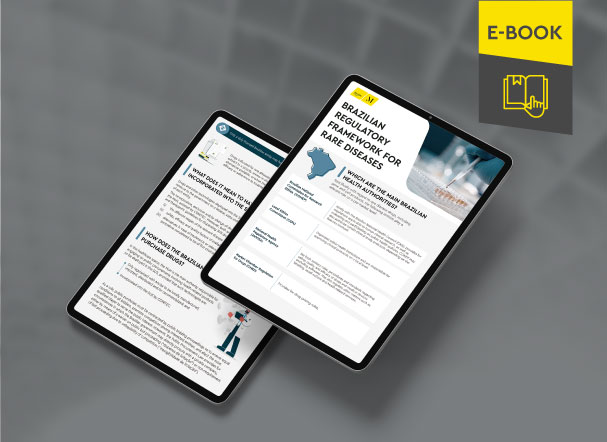
Our eBook on the “Brazilian Regulatory Framework for Rare Diseases” is an essential guide to Brazil’s healthcare system, providing a comprehensive analysis of the regulatory processes related to rare disease medications, including gene and cell therapies.
The publication can be useful for anyone who needs a better understanding of the regulatory landscape on the subject in Brazil, whether a healthcare professional, policy maker, or biotechnology analyst.
Here is a preview of the content:
- Legal definition: Learn how Brazil officially defines a rare disease.
- Key Brazilian health authorities: Understand the roles of major entities in the pre-market phase for rare disease drugs.
- From research to the patient: Explore the main steps in the journey of a rare disease drug – from research and development to reaching the patient.
- Drug marketing authorization: Find out how a drug gets marketing authorization in Brazil, and learn about the priority review process for drugs indicated for rare diseases.
- Drug incorporation into the SUS: Understand what it means for a drug to be incorporated into Brazil’s Unified Health System (SUS) and the role of the Ministry of Health in public procurements.
- Brazilian government drug purchases: Find out how the Brazilian government procures drugs, including the bidding process and direct procurement exceptions.
- Foreign biotech companies: Learn the necessary steps for a foreign biotech company to introduce their drug into the SUS.

- Category: Banking, insurance and finance
The Central Bank of Brazil (BCB) published, on June 29, 2023, the Normative Instruction BCB 397 (IN BCB 397/23), which amended IN 103/21, to disclose the procedures, documents, deadlines and information necessary for the investigation of authorization requests related to the operation of payment institutions, in addition to providing for other topics.
The edition of IN BCB 397/23, which entered into force on July 1, 2023, constitutes an important advance in the flexibility of the foreign exchange market in Brazil and is part of the list of measures that have been adopted by the Central Bank since the reform of the legal framework of the foreign exchange market, approved in 2021 with the edition of Law 14,286/21.
By promoting changes in IN BCB 397/23, the Central Bank took the opportunity to regulate requests for authorization by payment institutions to operate in the foreign exchange market, in line with the provisions of article 29, item III, of Resolution BCB 277/22.
With the regulation, payment institutions authorized to operate by the Central Bank as issuers of electronic money, issuers of postpaid payment instrument and / or accreditation can request authorization to operate in the foreign exchange market.
However, payment institutions that obtain authorization to operate in the foreign exchange market in the form of Resolution BCB 277/22 will be subject to the limitations established in the regulations.
According to article 29, item III, of BCB Resolution 277/22, payment institutions authorized to operate in the foreign exchange market may only execute:
- foreign exchange operations with clients for prompt settlement of up to US$100,000[1] or its equivalent in other currencies, and transfers relating to the trading of derivative financial instruments abroad are not permitted; and
- operations for ready settlement in the interbank market, arbitrations in the country and arbitrations with abroad.
According to IN BCB 397/23, payment institutions that wish to request authorization from the Central Bank to operate in the foreign exchange market must submit, within 15 days of the respective act or resolution, the following documents:
- application; and
- reasoned justification that proves the economic and financial viability of the enterprise, which must contain, at least:
- the impacts of a strategic nature, explaining, if applicable, the new strategic objectives and market opportunities that justify the operation;
- the impacts of an operational nature, explaining, if applicable, the changes in the standards and structure of corporate governance, internal controls, risk management, and in the procedures and controls for the detection and prevention of operations whose characteristics may indicate the existence of the practice of the crimes typified in Law 9,613/98, as amended;
- the impacts of an economic-financial nature, explaining the estimates for the critical variables such as rates and average values of operations, service tariffs, as well as the expected results;
- the impact of the operation on the operational limits established in the regulations in force; and
- the deadline for the start of activities with the operation, after authorization.
In the same way that IN BCB 397/23 regulated requests for authorization of payment institutions to operate in the foreign exchange market, the same standard also regulated requests for cancellation of authorization for payment institutions to operate in the foreign exchange market.
Such request for cancellation must be instructed within 15 days of the respective act or resolution, with the following documents:
- application; and
- a statement that the exchange operations that are private or permitted to the institution have been settled or transferred.
[1] The mentioned value limit: (a) does not prevent the execution of an exchange operation related to payment or receipt installments provided for in a business disbursement schedule with a total value higher than the aforementioned limits; and (b) does not apply when the payment institution authorized to operate in foreign exchange is the buyer and seller of the foreign currency and is acting to fulfill obligations arising from the operations of its customers.

- Category: Restructuring and insolvency
The Third Panel of the Superior Court of Justice (STJ) recognized, in the judgment of Special Appeal 1.991.103/MT (REsp 1.991.103/MT), which took place in April, the limits of the judicial reorganization court's power to decide on restraints imposed in individual executions filed by out-of-court creditors and the (im)possibility of prohibiting restraints that fall on the debtor's assets after the legal period of suspension of executions against the company in reorganization, the so-called stay period.
In an interpretation of articles 6, paragraph 7-A, of Law 11,101/05, included in the 2020 reform, and the final part of article 49, paragraph 3, of the same law, established that "the jurisdiction of the reorganization court to suspend the constrictive act carried out as part of the execution of an extrajudicial credit is restricted to that which falls solely on capital assets essential to maintenance of the business activity (...) to be exercised only during the stay period."
According to the STJ's interpretation in the judgment of REsp 1.991.103/MT, based on this new provision, it would not be possible to speak of a universal court of judicial reorganization, insofar as it would not always have the power to decide on the legality of all the acts that affect the debtor's assets.
The jurisdiction of the judicial reorganization court, according to the decision in the special appeal, would be limited to examining:
- attachments on capital goods (i.e. those directly used in the production chain) that are essential to the debtor's business; and
- the stay period of the executions referred to in article 6, subsection II, of Law 11,101/05.
At the time, the importance of equalizing the interests of creditors was highlighted who, by legislative choice, are excluded from the effects of judicial reorganization, with the principle of company preservation: "once the stay period has expired, especially in cases where a judgment granting judicial reorganization is passed, giving rise to novation of all obligations subject to the judicial reorganization plan, it is absolutely necessary for the bankruptcy exempt creditor to have his claim duly equalized within the scope of the individual execution, and it is not possible for the reorganization court to continue, after such an interregnum, to obstruct the satisfaction of his claim, based on the principle of company preservation, which is not absolute."
The aim of Law 11,101/05 is to guarantee the recovery of effectively viable business activities, by removing unviable entrepreneurs from the market as quickly as possible.
The dependence on the assets of certain creditors (the equitable owners excluded from the judicial reorganization) coupled with the inability to meet their extrajudicial obligations, even after the restructuring of debts through the judicial reorganization plan, would even create doubts as to the debtor's economic viability.
In the words of the reporting judge, Marco Aurélio Belizze, "if even after the stay period has elapsed (and once the judicial reorganization has been granted), the maintenance of the business activity depends on the use of the asset, which, in truth, is not properly owned by the company, and the related creditor who owns it, on the other hand, does not have its debt duly equalized in any other way, this factual circumstance, in addition to showing a serious indication of the unfeasibility itself of the company's recovery, completely distorts the way in which the reorganization process was designed, emptying the legal privilege conferred on bankruptcy-exempt creditors, in an unreasonable benefit to the company in reorganization and the creditors subject to the judicial reorganization."
The precedent is quite important, especially for the credit market, as it seems to indicate a welcome limitation on the understanding that the principle of company preservation would override the rights and interests of creditors. This has sometimes been the line adopted even by the STJ to submit acts of asset constriction to the judicial reorganization court.[1]
The decision in REsp 1.991.103/MT reinforces the impossibility of recurrence of cases involving companies in judicial reorganization which, after the end of the stay period, indefinitely prevent the execution of claims or repossession of assets fiduciarily sold by their bankruptcy-exempt creditors.
It was not uncommon for the judicial reorganization court to reject the rights of non-subject creditors on the basis of the application of the principle of company preservation.
Accordingly, it seems to us that the STJ's understanding expressed in the special appeal mentioned above has given Law 11,101/05 the interpretation most in line with the legislator's objectives, adequately equalizing the interests involved in a judicial reorganization.
In any case, it is still too early to predict whether REsp 1.991.103/MT will lead the STJ to consolidate this position.
It is important to monitor future STJ decisions on the subject. New judgments on the limitation of the judicial reorganization court's jurisdiction to restrict freezes ordered by the courts in which individual executions of bankruptcy-exempt creditors are being processed and the possibility of repossession of capital assets after the end of the stay period will allow us to see whether there is a consensus in the court's understanding on this matter.
[1] For example, we cite Special Appeal 1.610.860/PB, decided by the Third Panel of the STJ, and Internal Interlocutory Appeal 1.692.612/RJ, decided by the Fourth Panel of the STJ

- Category: Real estate
The Superior Court of Justice (STJ), in the judgment of Repetitive Topic 1,142/STJ, put an end to the following controversies:
- "define whether the scenario for unenforceability of collection provided for in the final part of article 47, paragraph 1, of Law 9,636/98 covers or does not cover the Federal Government's credits related to sporadic revenue, notably that related to annual land rent;" and
- "assess whether lack of real estate registration of the transaction (drawer agreements) prevents finding of taxable event of annual land rent and, therefore, prevents the flow of the lapse period for it to be levied."
In the case in question, the Federal Government lodged the respective special appeals on the grounds that the provision of article 47, paragraph 1, of Law 9,636/98 covers only periodic revenue of the Federal Government, not applying to occasional revenue, such as annual land rent.
Revenues from annual land rent, therefore, should not be included in the rule of unenforceability of the debts mentioned in the rule, according to recommendations provided in internal memoranda and opinions.[1]
The Federal Government also argued that legal transactions between private individuals allow the collection of annual land rent. Therefore, the taxable event is independent of real estate registration. The private transfers (drawer agreements) are characterized as a sufficient fact justifying the levy of annual land rent.
Finally, the special appeals argue that the initial term for counting the statute of limitations for the collection of annual land rent should be based on the moment when the Federal Government becomes aware of the taxable event.
The judgment, with the vote of the reporting justice Gurgel de Faria, partially met the Federal Government's requests, admitting that lack of real estate registration for the transaction would not prevent finding of the taxable event of the annual land rent, since, if it prevented, it would result in encouraging illegality to avoid its collection.
The decision also indicated that reading article 3 of Decree-Law 2,398/87, as amended by Law 13,465/17, could only result in the interpretation that the legislator established two alternative forms of levy: transfer for consideration of the equitable ownership of Federal Government land or assignment of rights related to it.
In addition, the request that the limitation period should start from the date of formal knowledge of the transaction by the Public Administration was accepted. In addition, it was pointed out that the topic had already been previously mentioned by the Second Panel in REsp 1.765.707/RJ.[2]
In this special appeal, the theory was established that the triggering event for counting the limitations period corresponds to the moment when the Federal Government becomes aware of the sale, instead of the date on which the legal transaction between the individuals was consolidated or, even, the date of registration of the transaction in the real estate registry.
The STJ, however, held that the final provision of paragraph 1 of article 47 of Law 9,636/98 applies to cases of annual land rent. The reason for the understanding is that the legislator did not differentiate between periodic revenue and sporadic revenue, and therefore the issue of lapse and the statute of limitations of non-taxable asset revenues of the Federal Government must follow the rules established in the provision, regardless of qualification.
In this context, from the judgment of Repetitive Topic 1,142, the interpretation that must be given to the subject was standardized, thus making it unequivocal that:
- private contracts, even without real estate registration, are facts that generate annual land rent;
- computation of lapse periods and statutory limitations periods follow the rules of article 47, paragraph 1, of Law 9,636/98; and
- the collection of the annual land rent must be limited to the five years preceding the knowledge, by the Public Administration, of the legal business entered into between individuals.
[1] Memorandum 10,040/2017 of the Ministry of Planning, Development, and Management, Circular Memorandum 372/2017-MP, Opinion 0088 - 5.9/2013/DPC/CONJUR-MP/CGU/AGU, Opinion/MP/CONJUR/DPC/N. 0471 - 5.9/2010
[2] REsp 1765707/RJ, opinion drafted by Justice Herman Benjamin, Second Panel, decided on August 15, 2019, DJe of October 11, 2019